

Crew
Director – Marc Munden, Teleplay – Jack Thorne, Based on the Novel Lord of the Flies (1954) by William Golding, Producer – Callum Devrell-Cameron, Photography – Mark Wolf, Music – Cristobal Tapia De Veer, Main Theme/Additional Music – Kara Talve & Hans Zimmer, Visual Effects – Citystate Studio (Supervisors – Peter Moran & Anton Yri), Covert (Supervisor – Andrew Maddison), FixFX, Goldcrest Post Production & Imaginary Unit, Special Effects Supervisor – Herbie Blank, Production Design – Simon Walker. Production Company – Eleven Film.
Cast
Winston Sawyers (Ralph), Lox Pratt (Jack), David McKenna (Piggy), Ike Talbutt (Simon), Thomas Connor (Roger), Noah Flemyng (Sam), Cassius Flemyng (Maurice), Tom Paige-Turner (Bill), Tom Goodman-Hill (Naval Officer), Rory Kinnear (Ralph’s Father), Lake Coleman (Boy With Birthmark)
Plot
British schoolboys wash up on a desert island, the survivors of a plane crash. Two of the boys, Ralph and Piggy, gather everybody together and try to organise them to create shelter, find food and start a bonfire to alert any passing ships or planes. Jack splinters off another group to be hunters of the wild pigs on the island and a number of the boys join them. There is increasing conflict between the two groups as Jack and Piggy try to focus on the practical essentials of survival and keeping the signal bonfire lit. Instead, the Hunters throw themselves into the excitement of hunting and are driven by Jack’s inflammatory rhetoric about a mythical beast supposedly on the island.
William Golding’s Lord of the Flies (1954) is one of the classic works of postwar literature – I remember being assigned it in English class when I was in high school. It regularly makes it onto various lists of the 100 Best Books of All-Time. The book comes with a vivid central thesis – that civilization is a thin veneer over human savagery and the questions of what happens when those restraints fail. It was the first book written by William Golding (1911-81) – it may perhaps explain things when one finds that Golding was a high school teacher, principally of English, for 25 years.
There have been several film adaptations first with Peter Brook’s stark and vivid Lord of the Flies (1964), which is very faithful to the book. There was then the disastrous US-remake Lord of the Flies (1990), which turned the British schoolboys into American military cadets. In the mid-2010s, there seemed the strange idea touted for a time of conducting an all-girl version. This never emerged, although you could say that the tv series Yellowjackets (2021- ), a work that owes a heavy debt of influence to Lord of the Flies, ended up being that version.
This is a new four-part tv mini-series based on the book. It is written by Jack Thorne who has a substantial number of credits writing for British film and tv since the early 2000s. I must admit to being in two minds about Jack Thorne. He has done brilliant work such as This is England ’86 (1990) and sequels and The Fades (2011). On the other side of the coin, I was under-impressed with Enola Holmes (2020) and in particular His Dark Materials (2019-22), which mangled a fine set of books. I watched the massively popular Adolescence (2025) not long before Lord of the Flies, but it felt like a work that took a swing at an incisive modern issue without having anything to say about it – sort of like someone who namedrops references to popular topics and falls apart when required to hold a conversation about them.
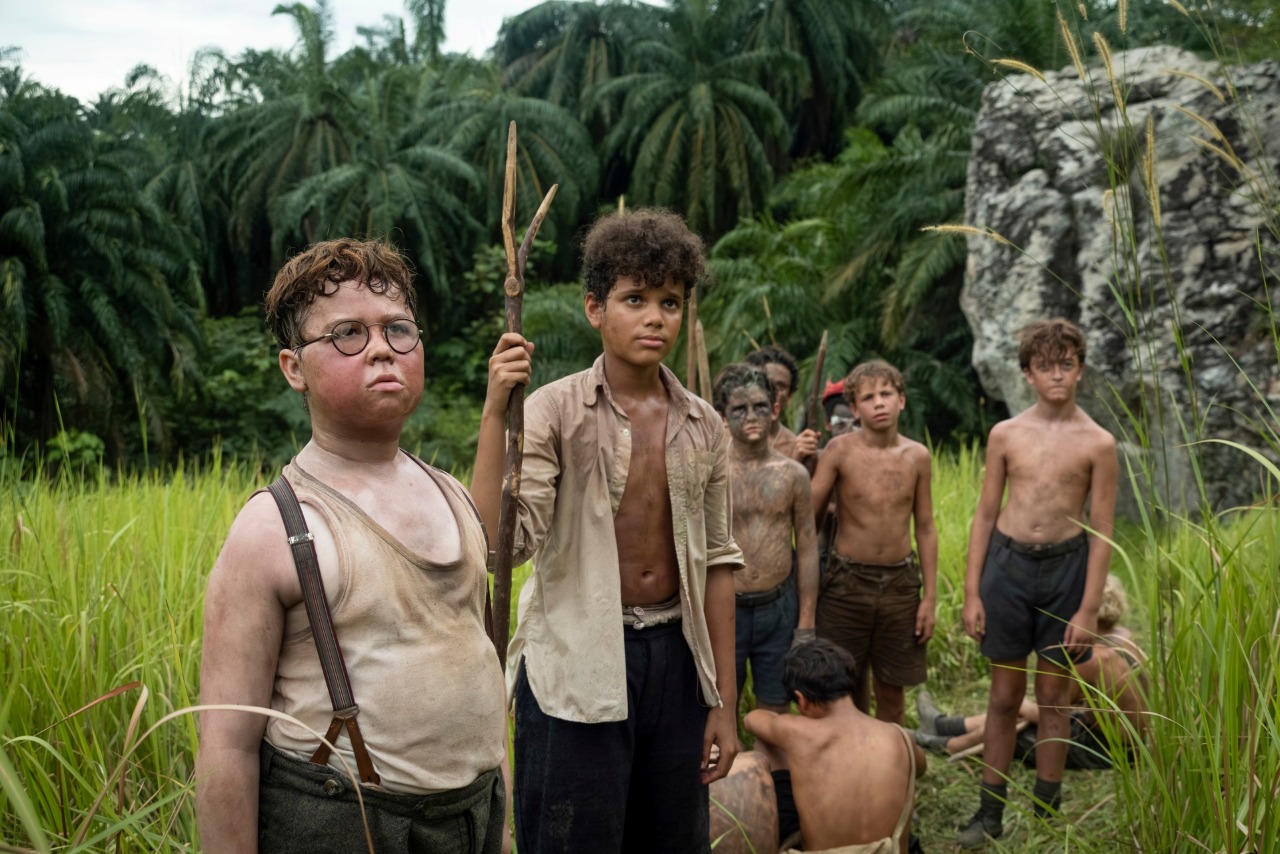
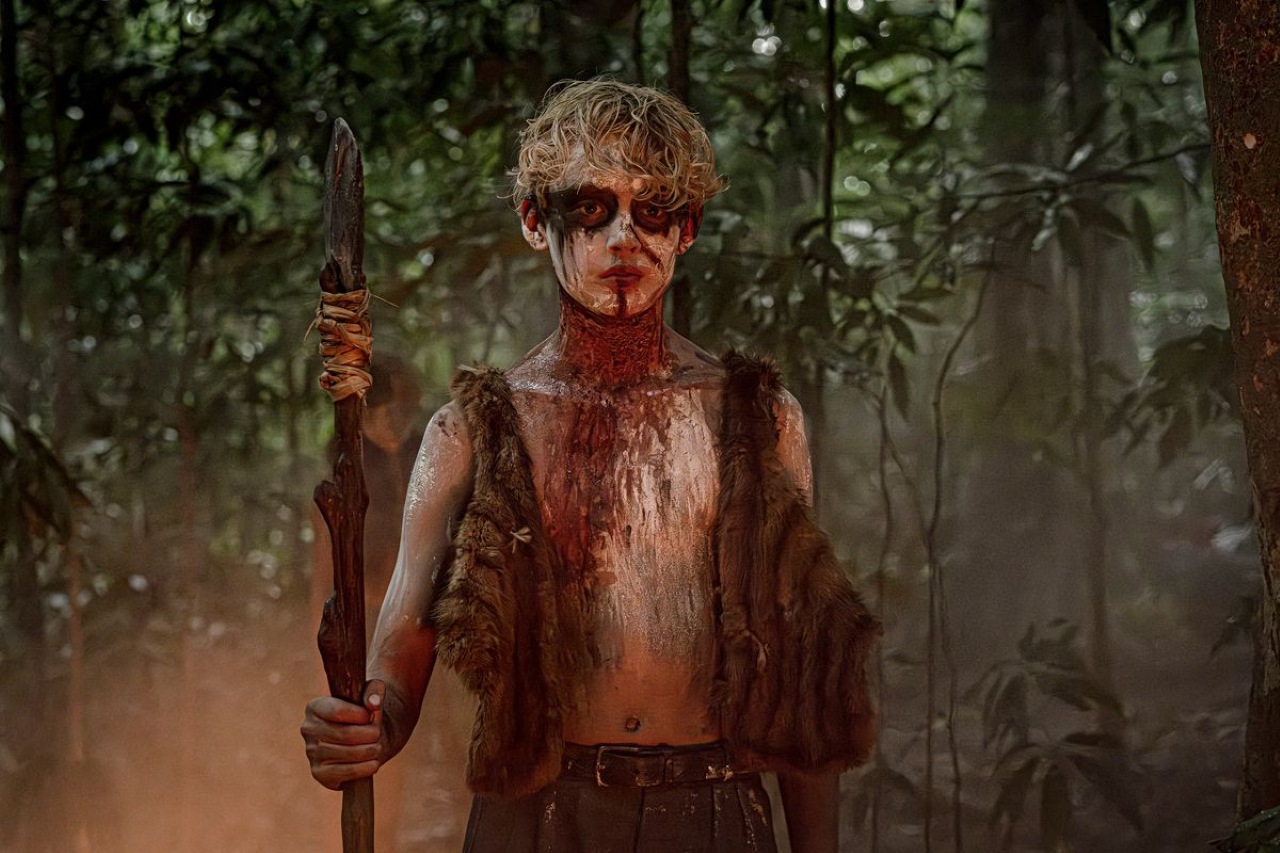
What impressed me most with the Lord of the Flies mini-series was the casting. David McKenna gets the role of Piggy down absolutely perfectly as though the character could have stepped right off Golding’s page untouched. There is an exceptional performance from Lox Pratt as Jack. Pratt’s performance is charismatic and you can see what it is about him that commands the boys. Jack Thorne opens the character of Jack up from what he is in the book. From the scenes where we see Jack confronting Piggy over hesitating to kill the pig, or the walk across the rock bridge, Thorne’s ingenuity is in peeling this open and showing Jack as someone afraid and uncertain while maintaining a façade of bravado.
On the other hand, I felt less sure about Winston Sawyers’ Ralph who never quite comes across as the hero of the story he is in the book – the mini-series breaking up the point-of-view and giving one episode to each of the principal boys does not help here. You seem Ralph struggling to maintain control but he never emerges as the central character of the story and Sawyers’ performance is outshone by Lox Pratt’s Jack. What the mini-series does particularly well is capture an unsentimentalised view of kids – not movie kids who are either precocious or cute sidekicks but the fearful, bullying, uncertain ways that they deal with the world.
The mini-series is faithful to the book. My main issue is that it adds more to it. Each of the four episodes is dedicated to one of the boys and adds small pieces of flashbacks to their lives before the island, although these are fairly negligible. (You do have to commend Lord of the Flies here as it keeps the flashbacks to the period the book was written, although this is often subtle). The only major change I remember is getting rid of the character of the pilot in the first episode where the body is not found until much later in the book. I also felt that the mini-series miscued the death of one of the major characters in the fourth episode. When this happens in the book and other films, the abruptness of it is a shock. However, we miss that here where the scene is drawn out much more and the death itself never actually seen.
At other times, Lord of the Flies seems to be building up big pieces of drama for the way that they will play out visually on the screen – pushing the body of the pilot downhill; the signal fire going out of control and consuming half the island that ends Episode 1; of Jack climbing the cliff; the walk across the rock bridge; and the pig hunt. That said, the direction of the mini-series obtains far more of the raw primality of the boys’ descent to barbarism than the book did. Director Marc Munden gets right in there with them during the pig hunt and other scenes and we get a visceral feel for the hunt, the life in the jungle and the sheer colour and excitement of the ritual they create. The results are quite magnificent.
Trailer here