
Crew
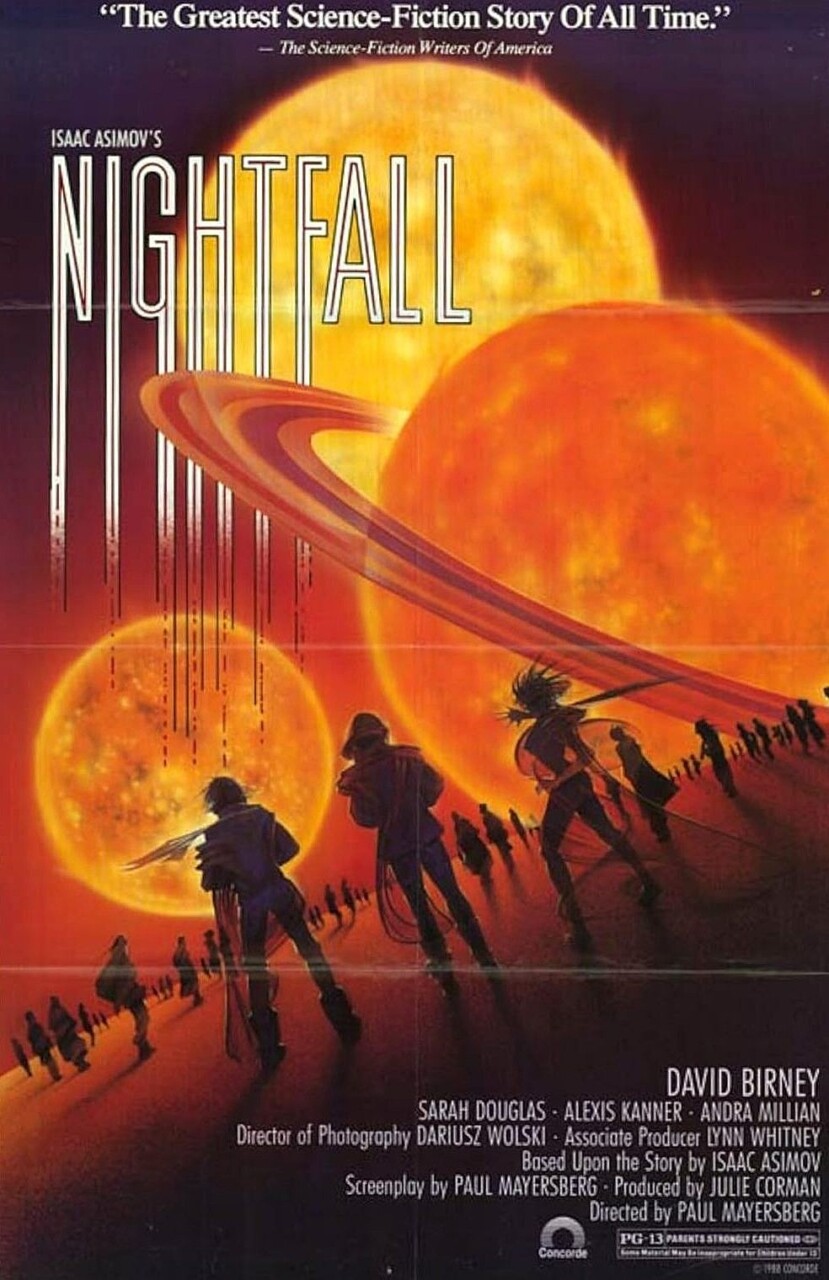
Director/Screenplay – Paul Mayersberg, Based on the Short Story Nightfall (1941) by Isaac Asimov, Producer – Julie Corman, Photography – Dariusz Wolski, Music – Frank Serafine, Visual Effects Consultant – Chuck Cominsky, Production Design – Craig Hodgetts. Production Company – Concorde.
Cast
David Birney (Aton), Alexis Kanner (Sor), Andra Millian (Ana), Charles Hayward (Kin), Sarah Douglas (Roa), Staar Andreeff (Bet), Russell Wiggins (Zol), Jonathan Emerson (Architect), Susie Lindeman (Boffin)
Plot
The residents of a planet fear the coming time when there will be an eclipse of all three of its suns and their world will be plunged into darkness. The astronomer Aton urges calm. However, he has been distracted by a mystery woman Ana and ignores all entreaties in favour of her. His son contrives to drive Ana out of the community into the desert. Meanwhile, Sor leads a group of cultists and preaches that the coming nightfall will spell doom for their civilisation.
Isaac Asimov (1920-92) is one of the great names in science-fiction literature. In his lifetime, Asimov was an extraordinarily prolific writer, not just in fiction but in a series of books on almost every topic under the sun, principally popular science but everything else from mathematics and history to Bible stories. He started out in the 1940s as a protege of the influential publisher John W. Campbell, Jr, the editor of Astounding magazine, where he wrote the stories that became the basis of his two most famous works – the Foundation series and the I, Robot books. (See below for other adaptations of Isaac Asimov’s works).
Isaac Asimov’s Nightfall (1941) is regarded as one of the greatest science-fiction short stories of all-time. Asimov was inspired by John W. Campbell who gave him a Ralph Waldo Emerson quote about how miraculous it would be if the stars only appeared once every thousand years. Asimov went away and conceived of a story about the planet Lagash, which is at the centre of the galaxy and surrounded by six suns, meaning that there is only an eclipse every two thousand years. Scientists try to piece together why civilisation falls every time during this period and realise that the appearance of the stars causes the populace to go insane. Asimov and Robert Silverberg later expanded the story into a novel Nightfall (1990).
The rights to Nightfall were picked up by Roger Corman’s wife Julie and produced through Corman’s Concorde production company. The director eventually selected was Paul Mayersberg who was most known at the time for his associations with Nicolas Roeg on the scripts for The Man Who Fell to Earth (1976) and Eureka (1983), as well as Merry Christmas Mr. Lawrence (1983). Mayersberg subsequently went on to write Return from the River Kwai (1989), Croupier (1998) and The Intruder (1998). When it came to Nightfall, Mayersberg was able to make a deal with Corman to also direct the film. He was previously directed/written the abduction thriller Captive (1986) and subsequently went on to make The Last Samurai (2003), not to be confused with the Tom Cruise film.
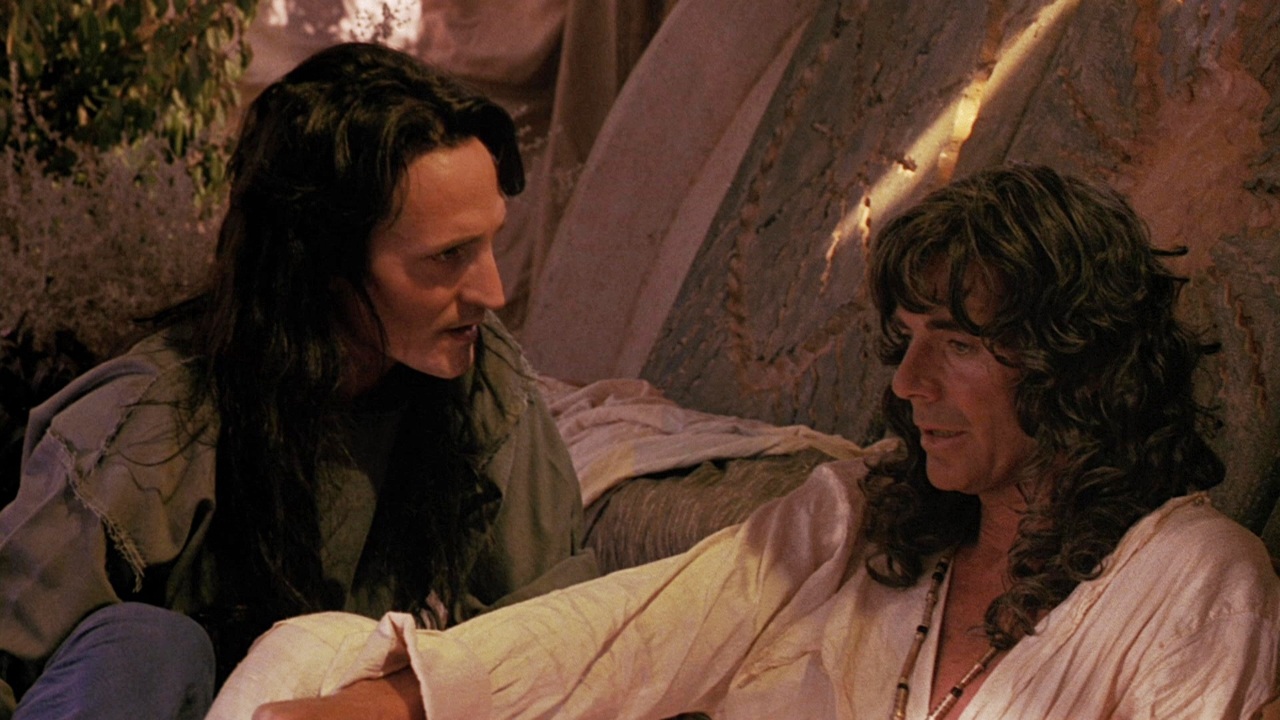
Nightfall is better budgeted than the typical fare that Roger Corman and Concorde were churning out during this era. The depiction of another planet is done in an imaginative way by shooting at the Arcosanti and Cosanti experimental towns in Arizona, where the spacy arcologies leads to a suitably different looking world. Mayersberg gets a certain feel for a world that is lived in and has its own culture. Although, what this does is make the planet resemble a hippie commune more than anything. It is something that falls down badly when we are introduced to David Birney, a reasonably well-known face in 1980s cinema, in a fake long-hair wig and purple robes.
The other major problem with adapting Nightfall is that all the effect of the story lies in its punchline. Everything in between is padding. For Asimov, this is filled with a journalist and scientists puzzling over why society on the planet periodically collapses. For Mayersberg, there is some discussion about impending social collapse. However, unless you have read the story, it is not particularly clear what is happening and why people are prophesying doom and saying pseudo-profound things. In the film, there is no mention of the eclipse, nor of how the planet’s society collapses every two thousand years, so what you have is two groups of people arguing about some prophecy of something as the suns start to set. The cult have a ritual where they blind recruits but you have no idea why. Things feel very padded when it comes to a subplot about David Birney’s dalliance with mystery woman Andra Millian. And then the film just arrives at the titular nightfall but there is no sense of the transcendent Conceptual Breakthrough that there was in the Asimov story.
Julie Corman later produced a further remake with the even cheaper Nightfall (2000).
Isaac Asimov’s other films works include:- several stories adapted for the British science-fiction anthology tv series Out of the Unknown (1965-71); acting as scientific advisor on Star Trek – The Motion Picture (1979); scientific advisor on the tv series Salvage 1 (1979); the English-language script for the US release of the French animated film Gandahar/Light Years (1988); the premise of the excellent but short-lived tv series Probe (1988); loose inspiration to the tv movie The Android Affair (1996); one of his stories adapted as Chris Columbus’s Bicentennial Man (1999); his book forming the basis of the Will Smith-starring I, Robot (2004); and his stories adapted into the tv series Foundation (2021- ). Asimov is also frequently misidentified as having written the classic science-fiction film Fantastic Voyage (1966), or that the film is based on his book, when in fact all that he wrote was the novelisation of the film.
Trailer here
Trailer here