


Crew
Directors/Screenplay – Helene Cattet & Bruno Forzani, Producer – Pierre Foulon, Photography – Manu Dacosse, Visual Effects – Benuts (Supervisor – Nicolas Corson), Special Effects Supervisor – Jean-Christophe Bourgeois, Production Design – Laurie Colson. Production Company – Kozak Films/Les Films Fauves/Dandy Projects/Tobina Film/Savage Film/To Be Continued/Centre du Cinema et de L’Audiovisuel de la Federation Wallonie-Bruxelles/Loterie Nationale/Fonds Audiovisuel de Flandre [VAF]/Film Fund Luxembourg/Italian Directorate General for Cinema and Audiovisual of the Italian Ministry of Culture/Region de Bruxelles Capitale/Wallimage (Wallonie)/Region de Pays de la Lorie-CNC/BNP Paribas Fortis Film Finance/Tax Shelter du Gouvernement Federal Belge/RTBF (Television Belge)/Voo et Be tv/Proximus/Cine+.
Cast
Fabio Testi (John Diaman), Yannick Rennier (Young John D), Celine Camara, Thi Mai Nguyen (Serpentik), Koen De Bouw (Markus Strand), Kezia Quental (Cantatrice), Maria de Medeiros (Laura)
Plot
The aging spy John Diaman relaxes at a hotel on the French Riviera. He remembers back to his heyday as the spy John D. where there was even a series of books and movies featuring him. His greatest nemesis was the masked female assassin Serpentik who wore an endless array of face mask disguises. John is attracted by an aging woman at the hotel and thinks she is maybe Serpentik.
Reflection in a Dead Diamond was the fourth feature film from Belgian co-directors (and off-screen couple) Helene Cattet and Bruno Forzani. Cattet and Forzani first appeared with Amer (2009), an extraordinary stylised homage to giallo cinema. They next went on to make the O is for Orgasm segment of The ABCs of Death (2012), The Strange Colour of Your Body’s Tears (2013), another giallo homage, and the non-genre Let the Corpses Tan (2017).
Reflection in a Dead Diamond – a title that sounds like it could easily be a giallo film from the genre’s 1970s heyday – is a homage to the spy movie. The spy movie fad was created by the massive popularity of the James Bond films in the 1960s, beginning with Dr No (1962). This led to a huge outpouring of copycats and parodies, many of which even launched their own series. There was also the popularity of the genre in a number of European (Italian and French) copycats. The genre is discussed in more detail in my essay Spy Movies.
In the 2000s, the 1960s spy movie was resurrected and roundly spoofed by Austin Powers, International Man of Mystery (1997) and sequels, plus a host of imitators. Cattet and Forzani are interested in none of that. Certainly, both they and the Austin Powers films are deconstructing the 1960s spy movie but there end resemblances. Rather their interest is in taking the imagery of the spy movie – the gadgets, the fast cars, the costumes, the alluring women and impossibly irresistible men, and especially the pop art set designs that some of the imitators and parodies turned into this crazy style of their own – zigzag wallpaper and eye-assaulting carpet patterns – and playing with these. Austin Powers et al could be the spy movie reduced to a series of comedy skits; Reflection in a Dead Diamond is in effect the spy movie reduced to a montage of high-end fashion shots.
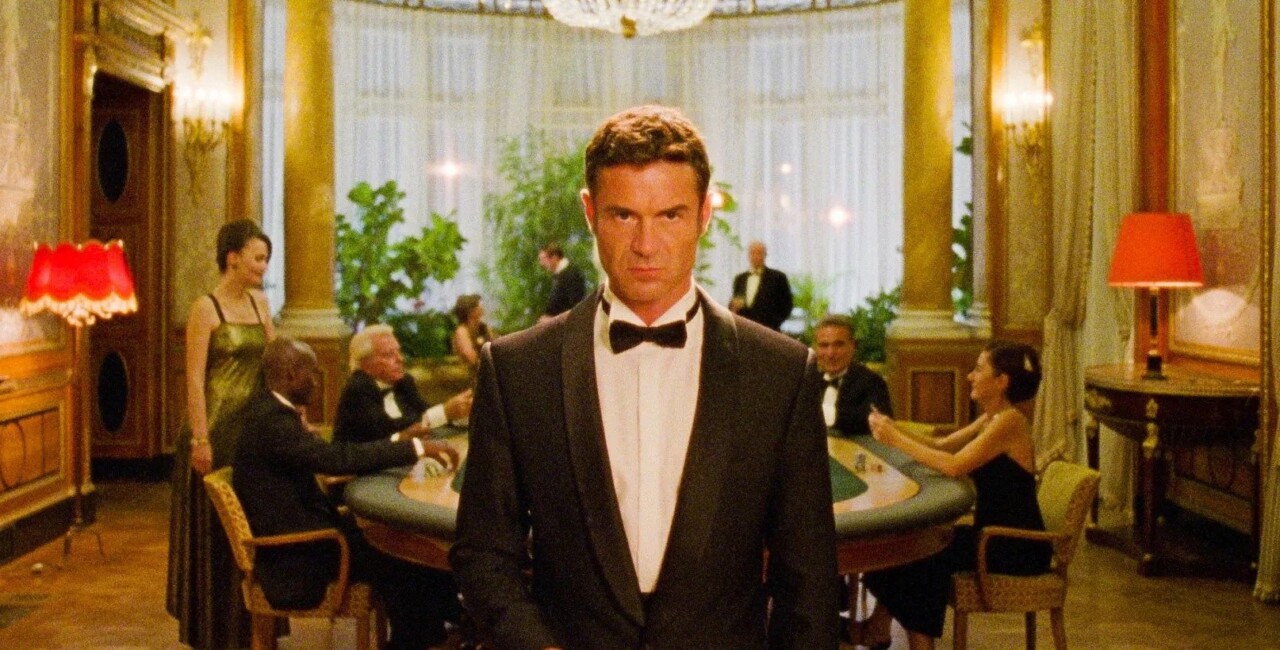

Characteristic of Cattet and Forzani, they strip the spy movie down to a series of provocative, stylish images. Reflection in a Dead Diamond comes with very little in the way of plot – the above plot description should be regarded as a general outline at best. There is barely any more in the way of dialogue. Everything is told in visual images. Sharp, provocative editing reduces every image to a brief staccato impression accompanied by crisp sound effect, or else makes dazzling editing match cuts between all manner of analogous objects throughout.
We get lots of scenes set in and around the glorious old hotel located around France’s Côte d’Azur region. Fashion photography shots of cocktails (martinis, of course), espressos, roulette tables, even a game of table football at one point. There is a great deal of diamond imagery throughout from the hero named Diaman (the French for diamond is diamant) to trays of diamonds, a large diamond ring with a poison tip that features throughout, Celine Camara wearing a dress made of mirrored glass circles, which niftily converts into scythes to kill a mass of attackers and she keeps leaving with video messages on, to people covering their bodysuits with diamonds and broken glass and using these to attack.
The film is filled to the brim with visual homages to other films in the genre. There is a nifty little scene as John goes to the opera that bursts into a montage of animated dancing figures and bodies with slides projected across them that recall they heyday of Maurice Binder’s credits sequences for the Bond films. There is a good deal of appealing gadgetry, including Yannick Rennier wielding a ring that acts as an x-ray device when placed up over his eyes, and naturally a car chase sequence where his cars spouts missiles and assorted gadgets. There is an absurdly over the top parody of the lifelike masks of the Mission: Impossible films that reveals that Serpentik hides behind multiple masks, each beneath the other, to the point her identity is unknowable. There is an appealing line up of villains, although the costume of the villain Serpetik with black skintight vinyl all except for a small band around the eyes reminds very much of the Italian comic-book anti-hero Diabolik, who appeared in films such as Danger: Diabolik (1967) and Diabolik (2021) – something that is confirmed by John D. blatting about in an E-type Jaguar, which was Diabolik’s signature vehicle.
Reflection in a Dead Diamond even turns into an appealing meta-fiction that is constantly reminding of the cinematic artificiality of the form. The most entertaining of the villains is the one called Kinetic who hypnotises their victims to believe they are in a film, where the appearance of the word ‘Fin’ (End) ends up killing them. The film pulls back at various points to show us John D’s exploits as books, comic-book panels and even him watching a movie version of his story up on the screen played out by another actor. In one scene, Yannick Rennier attempt to corner a woman he believes is Serpentik before a pull back to reveal the scene is one being filmed by a film crew.
(Winner for Best Cinematography, Nominee for Best Directors (Helene Cattet and Bruno Forzani) at this site’s Best of 2025 Awards).
Trailer here