

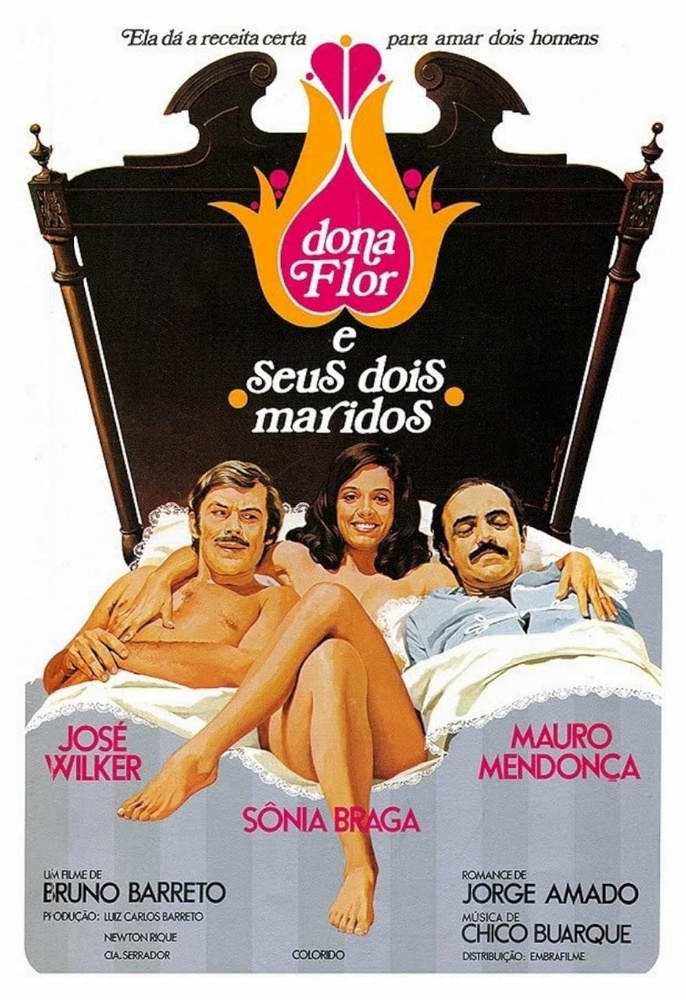
Crew
Director – Bruno Barreto, Screenplay – Eduardo Gutinho & Leopoldo Serran, Based on the Novel Dona Flor e Seus Dois Maridos/Dona Flor and Her Two Husbands (1966) by Jorge Amado, Producers – Luis Carlos Barreto, Newton Rique & Gia. Serrador, Photography – Murilo Salles, Music – Francis Hime, Special Effects – Manoel de Araujo, Production Design – Anisio Madeiros.
Cast
Sonia Braga (Florípides ‘Dona Flor’ Guimarães), Jose Wilker (Vadinho Guimarães), Mauro Mendonça (Dr. Teodoro Madureira), Haydil Linhares (Norminha Moreira), Dinorah Brillanti (Rozilda), Lourdes Coimbra (Dionisia), Rui Resenda (Cazuza), Nelson Xavier (Mirandao), Arthur Costa Filho (Carlinhos), Francisco Dantas (Dr Argemiro), Francisco Santos (Father Venancio)
Plot
Bahia, 1943. Vadinho Guimarães falls dead in the street in the midst of carnival celebrations. His wife Florípides or ‘Dona Flor’ mourns him but theirs was also a troubled marriage where she was frequently left at home while Vadinho went out gambling, drinking and womanising. After some time, she is courted by the pharmacist Teodoro Madureira and agrees to his proposal of marriage. Teodoro is careful and attentive, the exact opposite of Vadinho. After Dona Flor marries Teodoro, she begins to long for Vadinho whereupon his ghost appears to her.
Dona Flor and Her Two Husbands is a classic of Brazilian Cinema – it was apparently the most popular Brazilian-made film ever made at the box-office for two decades. The film was adapted from a 1966 novel, the most famous work of the celebrated writer Jorge Amado. Dona Flor was the second film of director Bruno Baretto who was only twenty-one at the time. Boretto has gone on to a line of other comedies and dramas, primarily Brazilian films but with a couple of ventures to Hollywood, although no other genre works.
The assumption I made before watching Dona Flor and Her Two Husbands was that it would be another work of Magical Realism and that what we would get would come out akin to the larger-than-life romantic whimsy in the Latin American tradition along the lines of works like the Mexican Like Water for Chocolate (1992) or the Cuban Life is Whistling (1998).
That doesn’t turn out to quite be the case and the film is largely a straightforward work of grounded domestic realism. If anything, the tone of the film is that of a mid-period Pedro Almodovar and the frothy melodramas and comic conundrums that he favoured during the 1990s, although even then the film is played for far less of a comedy focus than you expect it to be going in. In a US version of the story, you would expect it to be pumped up more ghostly appearances to come out something like Topper (1937) and sequels or Over Her Dead Body (2008).
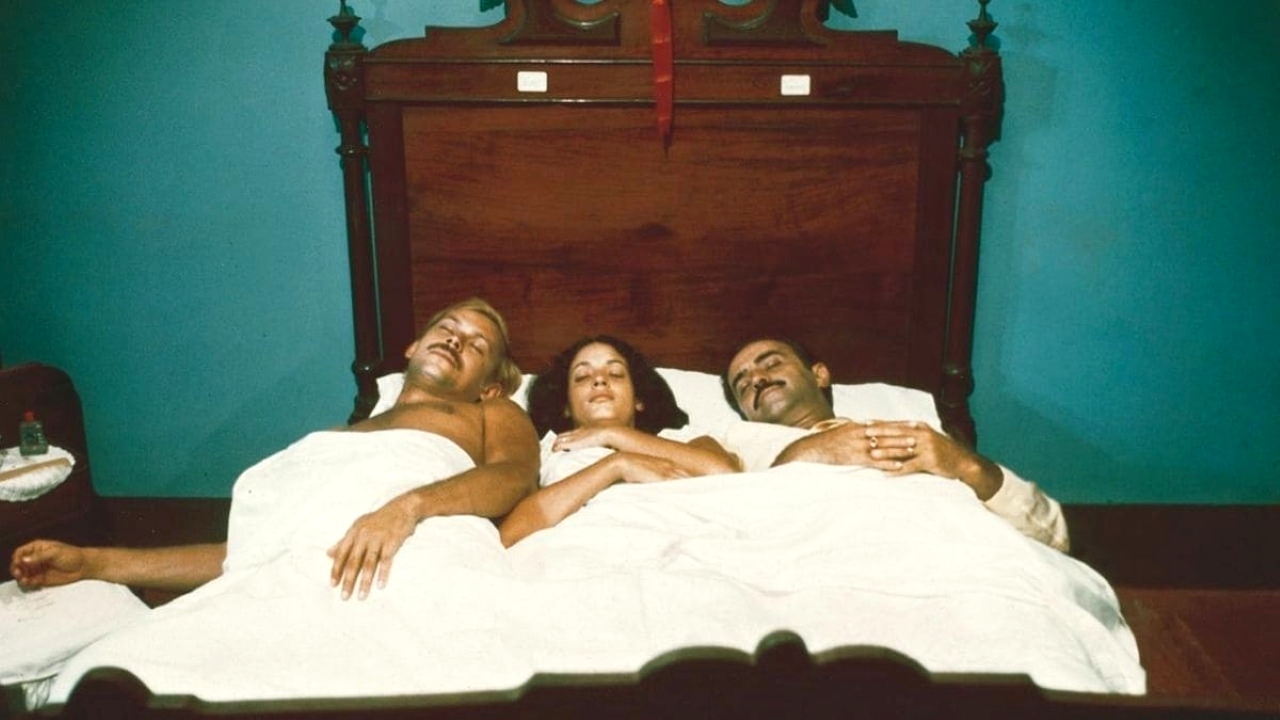
The focus throughout is on Dona Flor’s romantic complications – first with her husband Vadinho (Jose Wilker) who is a cheat, a compulsive gambler and dismissive of her – nearly an hour is taken up by the flashback to the tell the story of the first marriage – before we move on to Teodoro (Mauro Mendonça) who is exactly the opposite – dull, reliable and very devoted to her. At the centre of it all, Sonia Braga is the heart of longsuffering innocence – this was the role that gained her international recognition.
The point of this is to set up a film of contrasts to arrive at the point where Sonia Braga has a live husband who is dutiful but is missing the passion of her late husband, whereupon Vadinho pops back into her life as a ghost, seemingly wished up by her. That does not occur until 90 minutes out of the film’s 100-minute running time. At which point the film adopts a tone of whimsical fantasy. Nothing prior to that point sits within genre material. The final scenes, which have Sonia Braga in bed with one husband on either side and the final shot of her walking down the street with Mauro Mendonça on one arm and an invisible, completely nude Jose Wilker on the other and nobody noticing, are perfectly charming.
The film underwent a remake as Dona Flor and Her Two Husbands (2017). It was also adapted into a Brazilian tv series in 1998 and a Mexican telenovela of 65 episodes in 2019, as well as several plays adaptations, even a Broadway musical. The film later underwent an English-language remake as Kiss Me Goodbye (1982) with Sally Field as the wife, James Caan as the dead husband and Jeff Bridges as the new suitor.
Trailer here