
Crew
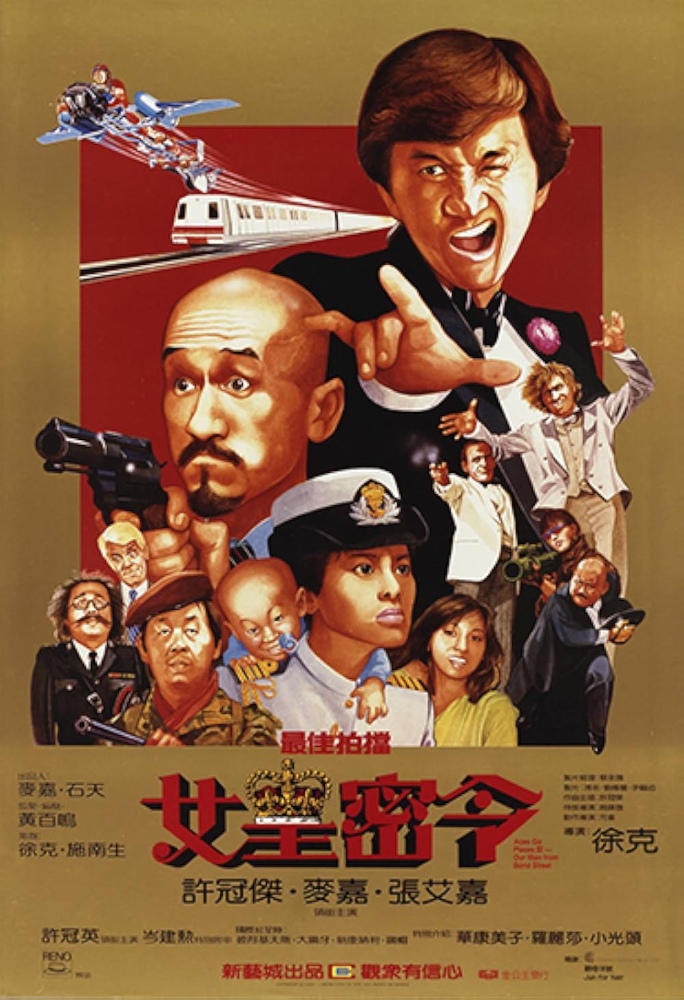
Director – Tsui Hark, Screenplay – Raymond Pak-Ming Wong, Producer – Raymond Wong, Photography – Joe Chan & Billy Wong, Music – Sam Hui, Noel Quinlan & Taag Siu-lam, Production Design – Oliver Wong. Production Company – Cinema City & Films Co.
Cast
Sam Hui (King Kong), Karl Maka (Albert ‘Baldy’ Au), Sylvia Chang (Superintendent Nancy Ho), Naomi Otsubo (Agent 701), Ricky Hui (Puffer Fish), Jean Mersant (Mr Bond), Richard Kiel (Big G), Tsuneharu Sugiyama (Oddjob), Sau-Man Wong (Maid’s Daughter), Huguette Funfrock (Queen of England), John Shum (Police Chief), Peter Graves (Tom Collins), Jay Koch (Ronald Reagan)
Plot
In Paris, King Kong flees from attackers on the Eiffel Tower. Upon diving into the Seine, he is swallowed by a submarine. Inside, he encounters Britian’s top agent and the Queen of England who implore him to undertake a mission. The British Crown Jewels have been stolen and only he is capable of getting them back. He is paired with the beautiful Agent 701. Back in Hong Kong, King Kong has to steal the jewels that are being held in a vault at police headquarters. He gets 701 to distract his friend, police inspector Baldy at a restaurant so that he can sneak into the police station and conduct an elaborate heist. Afterwards, Baldy is puzzled as to how King Kong could have done this, but King Kong deflects questions by raising the issue of Baldy being unfaithful to his wife Superintendent Nancy Ho. King Kong has to become involved in even more elaborate heists to obtain the remaining jewels from another location.
The Aces Go Places series, known as the Mad Mission series in US release, was a popular series of Hong Kong action films. The series began with Aces Go Places (1982), which introduced Samuel Hui as the thief King Kong and Karl Maka as the police inspector Baldy and their pairing up on a caper involving stolen diamonds. This featured a series of entertaining action sequences, but the series went into orbit with the first sequel Aces Go Places II (1983) and even crazier with Our Man from Bond Street/Mad Mission III: Our Man from Bond Street. These would be followed by Aces Go Places 4: You Only Die Twice/Mad Mission 4: You Only Die Twice (1986) and Aces Go Places V: The Terracotta Hit (1989), all featuring Sam Hui, Karl Maka and Sylvia Chang. The series was revived with a different cast in 97 Aces Go Places (1997).
Tsui Hark is the legendary director of works like Zu: Warriors from the Magic Mountain (1983), Once Upon a Time in China (1991) and Green Snake (1993) – see below for Tsui’s other films. In Aces Go Places II, Tsui had an acting part as a mental patient who believed he was an FBI agent, while here he inherits the director’s chair. Our Man from Bond Street would be the first film that Tsui made directly after the gamechanger that was Zu: Warriors from the Magic Mountain.
Tsui Hark takes the madcap level of the previous films and pushes it even further. This is evidenced by the opening scene that has Sam Hui in Paris. It starts with an assassination attempt and a bazooka going off target because of another assassin, where the girl makes a getaway by whipping her costume off to reveal a marching girl uniform and ducking into a parade passing by below. Meanwhile, Sam Hui is left fighting around the sides of the Eiffel Tower and one of its gondolas with lookalike henchmen from the James Bond films before snatching a parachute and jumping off, cutting the cords and landing in the Seine where his sneakers handily convert into jets to propel him along. However, his getaway is halted as he is swallowed up by a shark-shaped submarine. Inside proves to be a James Bond lookalike in white tuxedo who wants to recruit him for a mission. The two fight but Mr Bond (as he is credited) ducks Hui’s thrown knives by revealing his tuxedo covered torso is actually a shield and pulling a gun from beneath. Her majesty herself then steps out of a portrait of the Queen to appeal to Sam Hui – while speaking perfect Cantonese!
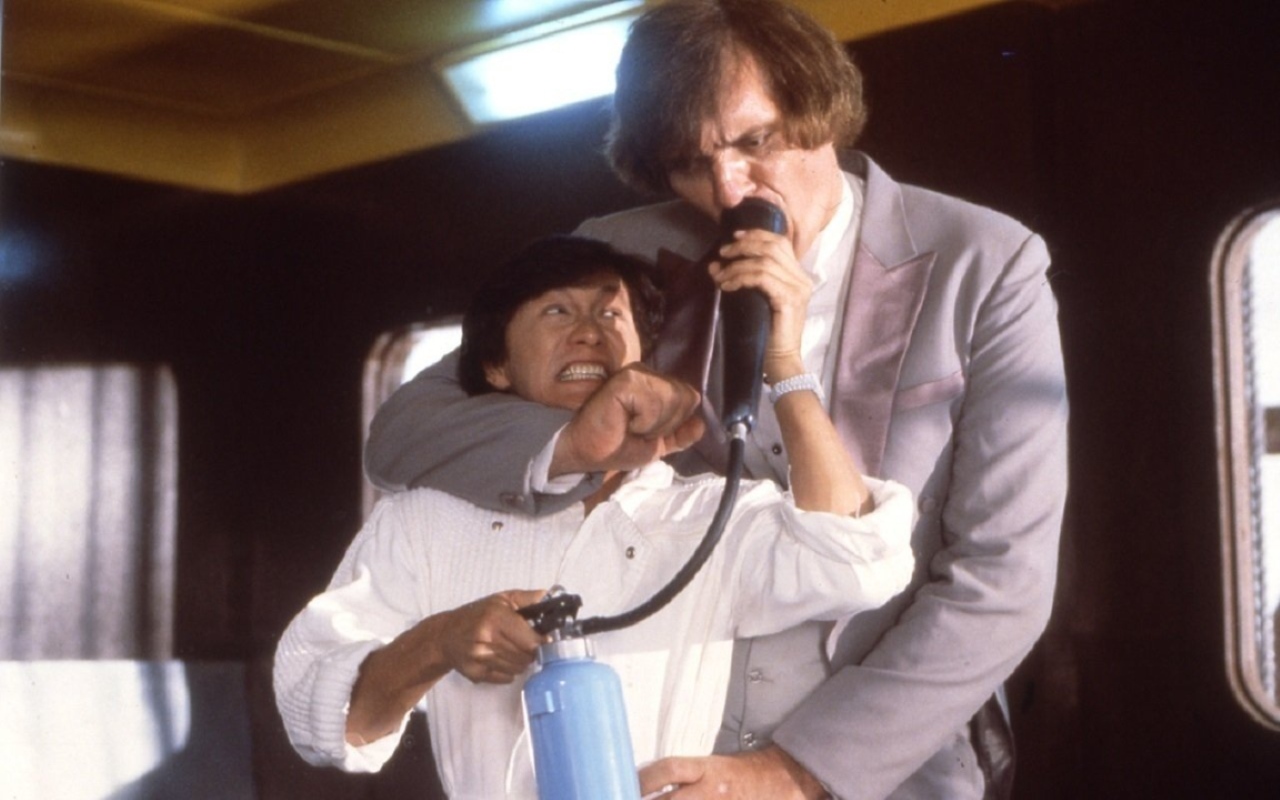
The action scenes are sensational. Sam Hui breaks into the police station using a briefcase that turns into a springboard that propels him up several stories; cables are fired through a laser tunnel that are then used to run a box made of mirrored metal containing Hui along so as not to break the circuit; an electronic tic-tac-toe game is used for an electronic lock; and Hui then makes a getaway on a jet-propelled skateboard pursued by dozens of cops cars, which includes him riding the skateboard along the roofs of cars that are caught in a traffic jam.
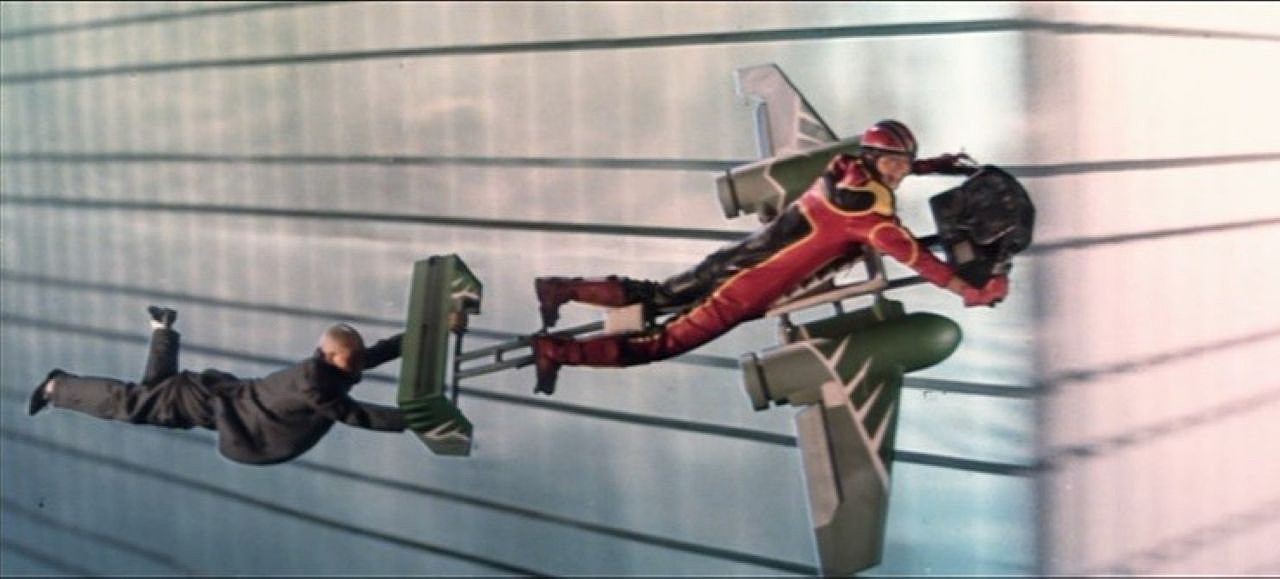
The maddest of the sequences is the second diamond heist that involves:- a break-in in the midst of an exhibition by a dozen or more Santas who get away on rocket jetpacks; their landing on a rooftop and getting away from there on motorcycles that they use to jump to the building across the street where the window shutters open in unison to let them in; Sam Hui flying through the streets and even down into the subway on a rocket sled with Karl Maka hanging off the back; Naomi Otsubo making an escape in a futuristic car that is designed to ride along a tunnel and then exits underwater to convert to a submarine. The only thing that undercuts the effectiveness of the sequence is the flying scenes having thick matte lines around the vehicles.
Our Man from Bond Street has a great deal of indebtedness to the James Bond films. There is French actor Jean Mersant as a balding Bond lookalike (not Sean Connery’s brother Neil who starred in Operation Kid Brother (1967) as is frequently misreported, including at the IMDB). There is also an appearance from Richard Kiel, the steel-toothed giant Jaws from The Spy Who Loved Me (1977) and Moonraker (1979). There is also a lookalike of Oddjob from Goldfinger (1964) tossing a steel bowler hat and wielding a steel claw, although this is not played by Harold Sakata, the original Oddjob, who passed away in 1982, but a lookalike Tsuneharu Sugiyama. Later we get an appearance from Peter Graves from tv’s the original Mission: Impossible (1966-73). And that’s not counting the Ronald Reagan lookalike who turns up right at the end.
The action set-pieces are what you come to see. In between, there is a good deal of the goofy slapstick that Hong Kong cinema loves. There is a scene that goes on and on with Karl Maka and the babysitter Sau-Man Wong where he gets his fly unzipped by the baby and his tie stuck in the back of her dress and has to hide behind the couch just as wife Sylvia Chang comes home. There is also a sequence in the restaurant with Sam Hui luring Karl Maka there with luscious spy Naomi Otsubo and leaving a set of fake arms holding a newspaper while he goes off to break into the police station. There is a lot of drawn out slapstick in a sequence that has both Hui and Maka being placed inside a lie detector machine that punches the person on the head with a glove if they tell a lie.
There is not a whole lot of plot hanging everything together. It is kind of hard to buy the scheme that Sam Hui is recruited into – about the point where he is told that he has to break into a police station vault to get the stolen diamonds would surely be a point that anyone else’s red flags might be going up. And then surely it would for certain by about the point where he has to steal the supposedly stolen jewels back from where they are on public display.
Tsui Hark’s other genre films as director are:- The Butterfly Murders (1979), We’re Going to Eat You (1980), Zu: Warriors from the Magic Mountain (1983), Green Snake (1993), Butterfly Lovers (1994), Zu Warriors/The Legend of Zu (2001), Black Mask 2: City of Masks (2002), Missing (2008), Flying Swords of Dragon Gate (2011), Detective Dee and the Mystery of the Phantom Flame (2010), Young Detective Dee: Rise of the Sea Dragon (2013), Journey to the West: Demon Chapter (2017) and Detective Dee: The Four Heavenly Kings (2018). Tsui Hark has also produced A Chinese Ghost Story (1987), The Laser Man (1988), Roboforce/I Love Maria (1988), A Chinese Ghost Story II (1990), Swordsman (1990), A Terracotta Warrior (1990), A Chinese Ghost Story III (1991), The King of Chess (1991), New Dragon Gate Inn/Dragon Inn (1992), Swordsman II (1992), Iron Monkey (1993), The Magic Crane (1993), Swordsman III: The East is Red (1993), Wicked City (1993), Burning Hell in Paradise (1994), Black Mask (1996), A Chinese Ghost Story: A Tsui Hark Animation (1997), Master Q (2001), Vampire Hunters/The Era of Vampires (2002), Sword Master (2016) and The Thousand Faces of Dunjia (2017).
Trailer here