


USA. 2024.
Crew
Director/Screenplay – Jane Schoenbrun, Producers – Ali Herting, Sam Intili, Dave McCary, Emma Stone & Sarah Winshall, Photography – Eric K. Yue, Music – Alex G, Visual Effects – The-Artery (Supervisor – Yuval Levy), Special Effects Supervisor – Brian Walsh, Makeup Effects – Spectral Moton (Creature Effects Supervisor – Mike Elizalde), Production Design – Brandon Tonner-Connolly. Production Company – Fruit Tree/Smudge Films/Hypnic Jerk Productions.
Cast
Justice Smith (Owen), Brigette Lundy-Paine (Maddy Wilson), Ian Foreman (Young Owen), Helena Howard (Isabel), Lindsey Jordan (Tara), Danielle Deadwyler (Brenda), Fred Durst (Frank)
Plot
In 1996, Owen befriends Maddy, a girl two grades above him in school, when he comes across her reading an episode guide to the tv series The Pink Opaque. They connect over the show and its mythology. Owen is not allowed to stay up to watch the show so Maddy gets him to pretend he is sleeping over with a friend and come to her place instead, while on other occasions she records videotapes for him. Maddy then says she wants to run away and asks Owen to join her but he cannot go through with it. She then disappears, coincidentally at the same time as The Pink Opaque is cancelled. Eight years later, Owen is working a dead end job at a cineplex when Maddy reappears to him, saying that she has been living inside the world of The Pink Opaque.
I Saw the TV Glow has been gaining quite a bit of buzz on the indie film circuit. It has even prematurely been heralded as a cult classic. It was the third film for trans director Jane Schoenbrun who had previously made A Self-Induced Hallucination (2018) and the horror film We Are All Going to the World’s Fair (2021). It is an A24 release, a company that gaining a cult following for their championing of offbeat indie films. It even comes produced by an A-list actress Emma Stone.
It is often hard to get a handle on the film. Jane Schoenbrun says she was inspired by 1990s shows growing up such as Twin Peaks (1990-1), The X Files (1993-2002) and Buffy the Vampire Slayer (1997-2003). And as such, The Pink Opaque is like a deliberately kitsch parody of a 90s era children’s tv series, replete with a shot-on-video look and effects.
For a long time, I never quite connected with what was going on. I Saw the TV Glow is like a Coming of Age story turned on its head – an anti-Coming of Age story if you like – one that is not about the triumphs and adversities of childhood but the retreats from an overwhelmingly grim reality. Maddy is not happy and seeking only to run away, while Owen’s idea of sex and relationships seem to fill him with revulsion and yet he turns away (twice) from Maddy’s offers to escape from the dreary dull life in the town and settled into the mindless detached reality it offers him. Both seek a solace in the larger-than-life reality offered by The Pink Opaque.
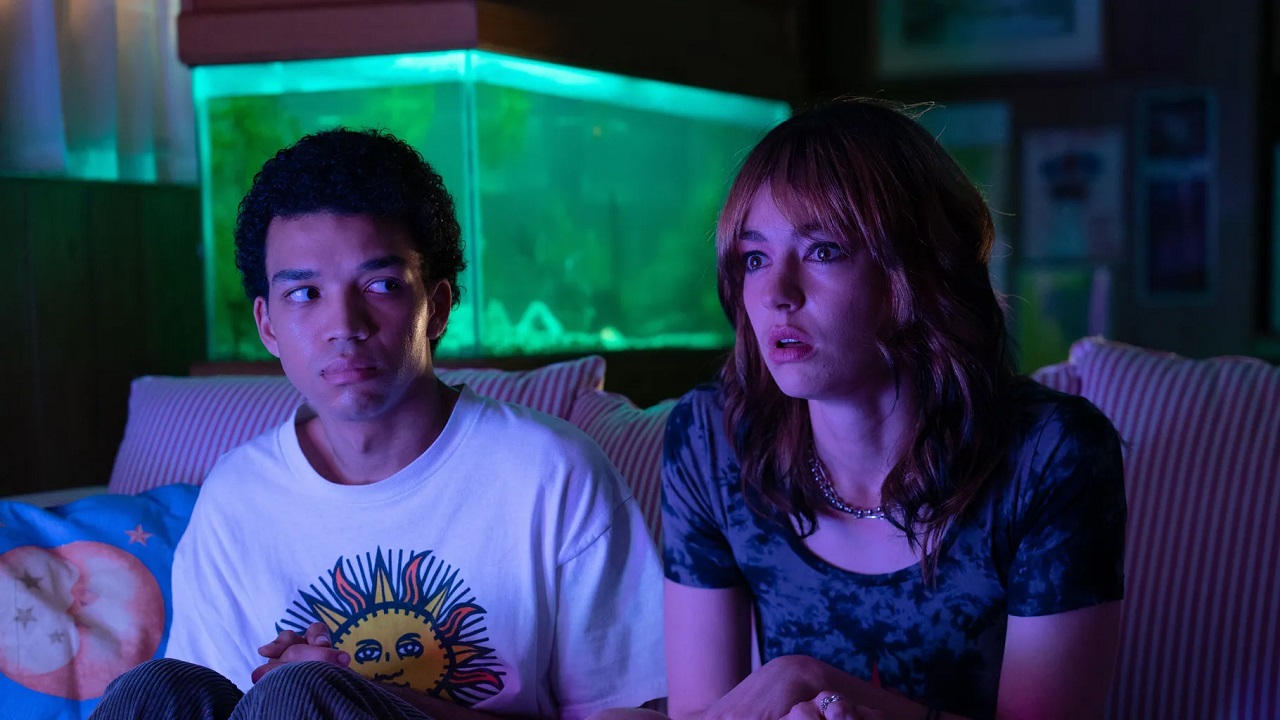
You go along with this dreary, alienated anomie because I Saw the TV Glow seems perpetually on the edge of exploding out into the really weird film without ever quite doing so. It is lo-fi David Lynch maybe around the point of Lost Highway (1997) without Lynch’s bursts of surreal strangeness. The most wildly enervated it gets is a diversion to a bar where we get some fine performances from alt.girl bands Sloppy Joe and especially a wild number from King Woman.
Then however we come to the third act where all the alienated weirdness finally slips into place. The scenes where Brigette Lundy-Paine reappears to Justice Smith is quite uncanny. She has an intense and eerie scene where she stands in a planetarium and tells Justice how she was buried alive, which seems to be channelling pure Lynch. Although the real effect comes when Justice Smith runs away from her offer to go to The Pink Opaque and settles back into his life, before thinking maybe he has made the wrong choice. The final scenes with him screaming in a room of frozen faces amid a birthday party, followed by him blankly, robotically stumbling through the arcade apologising hold perhaps one of the most frightening visions of someone trapped in a nowhere dead end job and lifestyle imaginable.
In interviews, Jane Schoenbrun talks about how I Saw the TV Glow represents a trans coming out. In her interpretation, the film is a metaphor of bodily alienation and the realisation of a sense of intense wrongness about gender identity and of Justice Smith supposedly coming to terms with/rejecting his true identity. They key takeaway is when Schoenbrun says that both Owen and Maddy are allegorical parts of themself, one cautionary, the other aspirational. I am not trans so this interpretation was not one that occurred to me, but when you read it it allows the film to click into place in terms of meaning.
Trailer here