


Crew
Director – Hideki Takeuchi, Screenplay – Yuichi Takunaga, Based on the Manga Cells at Work! (2021) by Akane Shimizu, Producers – Atsuyuki Shimoda & Ikumi Tageuchi, Photography – Sohei Tanikawa, Music – Face 2 Fake, Visual Effects Supervisor – Yu Nagasaki, Production Design – Chihiro Hamada & Masumi Miura. Production Company – Flag Pictures/Kodansha.
Cast
Mei Nagano (Erythrocyte/Red Blood Cell AE3803), Takeru Satoh (Neutrophil/White Blood Cell U-1146), Mana Ashida (Niko Urushizaki), Sadawo Abe (Shigeru Urushizaki), Koji Yamamoto (Killer T Cell), Rihito Itagaki (New Red Blood Cell AA2153), Riisa Naka (NK Cell), Seishiro Kato (Shin Takeda), Shota Sometani (Helper T Cell), Wakana Matsumoto (Macrophage), Ryo Kato (Senior Red Blood Cell), Takashi Tsukamoto (Dr Neutrophil)
Plot
Trillions of cells busily work away in the body of teenager Niko Urushizaki. AE3803 is a red blood cell who is assigned to transport oxygen to different parts of the body. New on the job, she is nervous and clumsy but makes a friend in the white blood cell U-1146, who is constantly racing off to defend Niko’s body against invaders. In the outside world, Niko forms an attachment to fellow school pupil Shin Takeda. Niko is also constantly trying to get her father Shigeru to improve his health. The cells in his body are struggling against his rundown condition and regular consumption of cigarettes and alcohol. Following a fall at school, Niko develops leukaemia and has to be hospitalised. As Niko struggles to keep going, AE3803 notices that all the red blood cells in Niko’s body are disappearing. She and U-1146 then fight against a baby white blood cell who has mutated into something lethal.
This is a live-action film based on Cells At Work! (2015-8), a manga from Akane Shimizu that appeared in Monthly Shonen Sirius magazine. This was then adapted into an anime series Cells At Work (2018-21) for two seasons of 21 episodes.
The obvious point of comparison to Cells At Work would be Osmosis Jones (2001), the part live-action, part animated film about the cells in Bill Murray’s body coming together to combat his slob’s existence (as we sort start to get here with Sadawo Abe as the father). Perhaps if you can imagine Osmosis Jones reimagined in terms of the one of the various live-action adaptations of various anime/manga we have had in recent years – see the likes of Parasyte Part 1 (2014), Attack on Titan (2015), Fullmetal Alchemist (2017), JoJo’s Bizarre Adventure: Diamond is Unbreakable – Chapter 1 (2017), Tokyo Ghoul (2017) and Bleach (2018), among others – then you might have an idea of where Cells At Work lands.
The other source of inspiration might have been the more recent Pixar film Inside Out (2015) with the depiction of the parts of a girl’s personalities as beings with a life of their own. Or perhaps even more so than that would be the What Happens During Ejaculation? segment of Woody Allen’s Everything You Always Wanted to Know About Sex * But Were Afraid to Ask (1972), which rather hilariously features a group of talking sperm cells ready to go into action while their host is on a date.
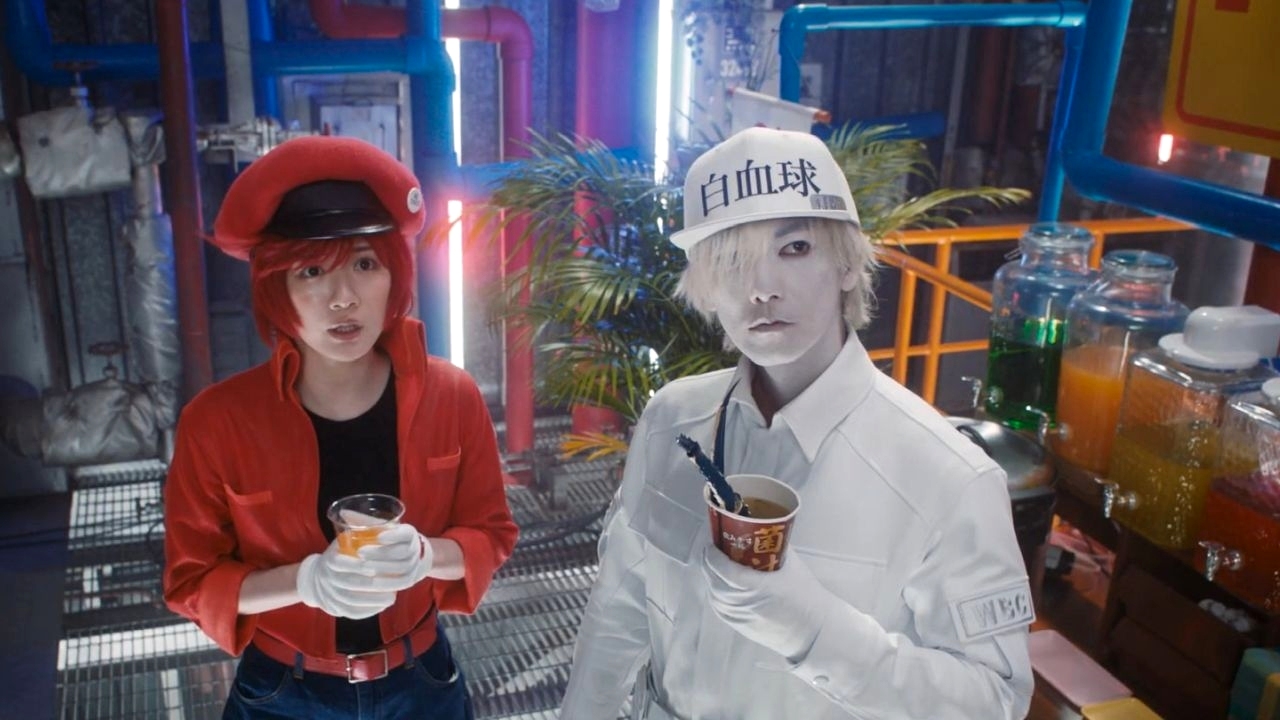
Cells At Work is a lot of fun when it comes to the interpolations it makes in terms of how the functions of a human body on a cellular level would work as enacted by people. Mei Nagano is the red blood cell whose task is to constantly carry needed supplies of oxygen all around the body. Takeru Satoh is the white blood cell heroically going into action to defeat threats – at one point, an invading virus is imprisoned by him and then placed aboard a rocket and launched for it to be expelled as a sneeze. We meet the child platelets who come together to form the healing over a wound, which is represented as a big hole in the pavement. The endorphin release as Mana Ashida is attracted to Seishiro Kato comes as a wild dance party in the streets. The leukaemia scenes turn the inside of her body into a barren wasteland where the chemotherapy is represented by a green band of radiation sweeping across and killing cells. By contrast, the scenes taking place in the father’s body show overworked cells in a dense industrial plant filled with smoke. When it comes to the transfusion, we see a giant metal tube appear in the sky and the cells below swept up into it.
The funniest scene is the venture down to his anus where a new red blood cell (Rihito Itagaki) is caught up in the efforts to hold back a discharge. On the outside we the father’s frustrations in trying to find a bathroom, being caught in a traffic jam and then a line-up as a janitor is cleaning the cubicles. On the inside, we see an army of sumo wrestlers form to hold back a mass of faecal matter – along with random pieces of corn flying through the air and even the rupturing of a haemorrhoid. The scene also promises a visit to the testicles that never happens.
The story seems perfectly suited for Japanese culture. While Osmosis Jones is the story of an heroic individual white blood cell, Cells At Work emphasises the nature of sacrifice and duty, of being a good cog in the machine, of individual’s struggle for the greater good making all the difference. Although the idea of cells seeming to have male and female genders does leave you wondering.
Cells At Work comes from Hideki Takeuchi, a director who has mostly worked in tv. He made the popular Nodame Cantabile films. In genre material, he has also made Terumae Romae (2012) and sequel where a Roman bathhouse architect is transported into the present day, the fantasy film Color Me True (2018), the manga adaptation Fly Me to the Saitama (2019), and What if Shogun Ieyasu Tokugawa was to Become the Prime Minister? (2024) that involves the resurrection of dead Japanese politicians.
Trailer here