
Crew
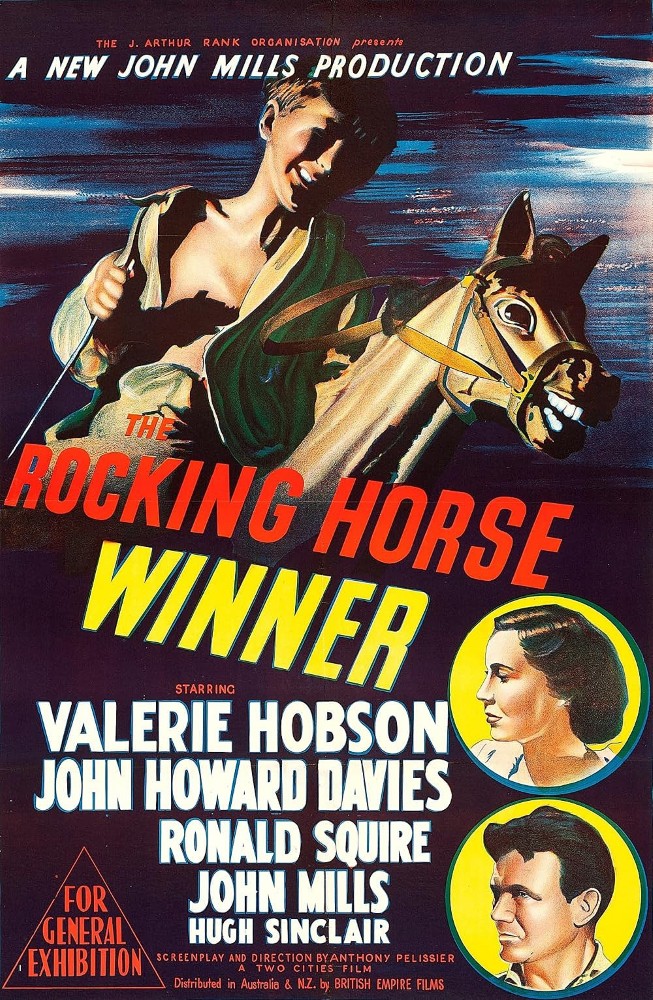
Director/Screenplay – Anthony Pelissier, Based on the Short Story The Rocking Horse Winner (1926) by D.H. Lawrence, Producer – John Mills, Photography (b&w) – Desmond Dickinson, Music – William Alwyn, Conductor – Muir Mathieson, Special Effects – Francis Carver, Art Direction – Carmen Dillon. Production Company – Two Cities Films Ltd.
Cast
John Howard Davies (Paul Grahame), Valerie Hobson (Hester Grahame), John Mills (Bassett), Ronald Squire (Oscar Cresswell), Hugh Sinclair (Richard Grahame), Charles Goldner (Tsaldouris), Susan Richards (Nanny), Cyril Smith (Bailiff)
Plot
Young Paul Grahame receives a rocking horse as a Christmas present. The new groundsman Bassett used to be a jockey and Paul eagerly learns about horse racing and betting from him. Paul’s mother Hester has a problem with spending, which far exceeds the amount that Paul’s father Richard brings in. Richard then loses his job and soon debt collectors and bailiffs are at the door. At the same time, Uncle Oscar discovers that Paul has an uncanny ability to predict the name of the horse that is going to win that week’s race after riding on his rocking horse. Oscar places various bets on Paul’s predictions and wins several thousand pounds. As Oscar feeds the money back into the household to alleviate Paul’s parents’ finances, this only becomes the cause of Hester’s further extravagant spending. Paul starts to hear the walls of the house whispering about more money and becomes increasingly stressed as he tries to come up with the name of the next winning horse.
The Rocking Horse Winner is a classic British film. It is adapted from The Rocking Horse Winner (1926), a short story by D.H. Lawrence (1885-1930), best known for classic novels of English literature such as Sons and Lovers (1913), Women in Love (1920) and Lady Chatterly’s Lover (1928). In fact, this was the first D.H. Lawrence work to be adapted to film.
The film keeps surprisingly good faith with the D.H. Lawrence short story. It replicates it on all points with the addition of some further detail at the start to bulk out the family’s background and financial difficulties, as well as scenes seeing Paul receive the rocking horse for Christmas and where the mother (Valerie Hobson) must deal with debt collectors and humiliate herself to go and sell some of her dresses. The mother is also not an artist in the film as she was in the short story.
The Rocking Horse Winner was very much a film of post-War anxiety. At the time it was made, Britain was just emerging from World War II and the country was still crippled by shortages and the imposition of rationing, meaning that D.H. Lawrence’s message about financial stress now gains a whole new level of significance. In this period, going to the movies was regarded as a middle and working class thing, whereas the upper-classes believed that the theatre and opera was where the cultured went. In that the audience for The Rocking Horse Winner would have been mostly middle and working class as opposed to the upper-classes, it is a film about how a family tear themselves apart by the mother’s aspirations to live at a higher class level than their income can afford.
It is certainly unusual to see a fantasy film of this period dealing with so much in the way of economic realities. One can speculate if The Rocking Horse Winner had been made as an American film it would easily have slotted into the predominating fad for Light Fantasy Films of the era – where there would have been a greater emphasis on comedy and the boy’s abilities would have been shown in a more magical vein, rather than the far grimmer world it is here. Indeed, many of the scenes in the last twenty minutes of the film almost verge on horror treatment with the walls of the house suddenly turning into looming shadow and the rocking horse being shot in an underlight that emphasises it in a hideously sinister way.
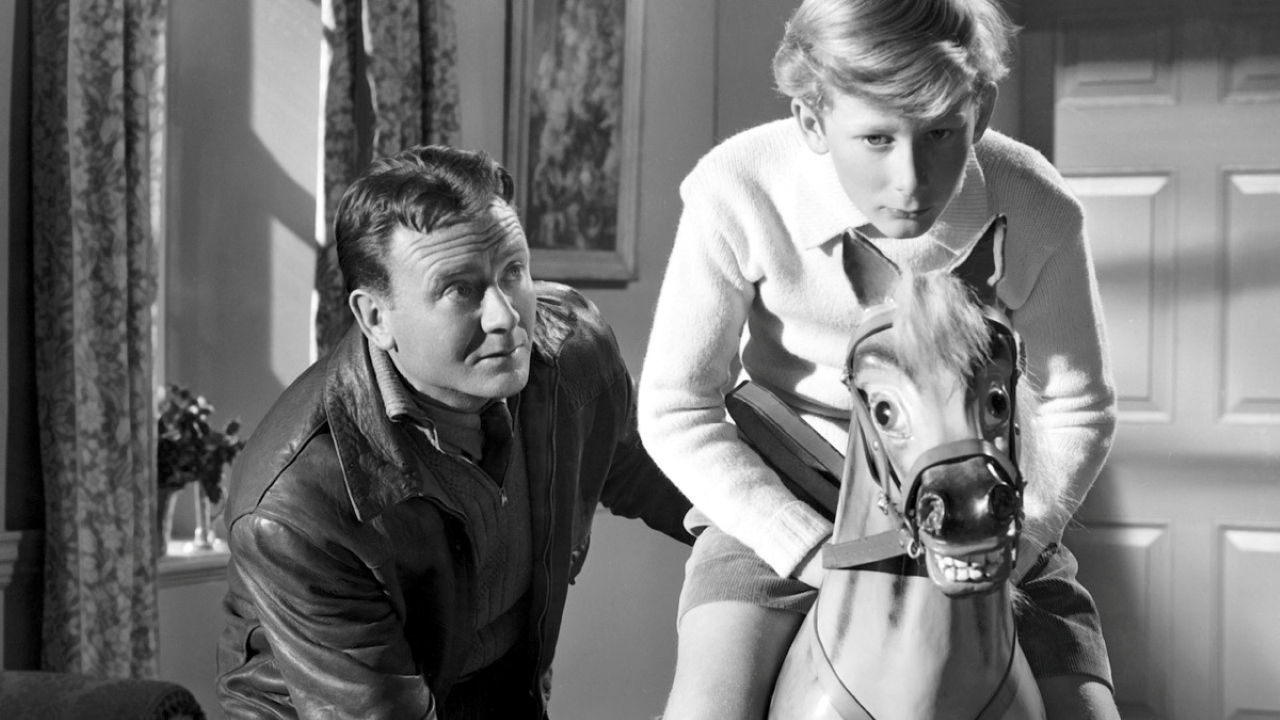
Director Anthony Pelissier adopts some striking directorial effects. For one, the film is shot in high-contrast black-and-white. There are some vivid scenes where John Howard Davies rides the rocking horse – Pelissier gives these a furious, possessed drive with Davies whipping the horse in a frenzy and even a scene where the camera takes his point-of-view on the rocking horse and we see the entire room swinging back and forward.
The Rocking Horse Winner is interestingly produced by actor John Mills (1908-2005). Mills came to fame with leading roles in popular Wartime films, including In Which We Serve (1942), Waterloo Road (1945), The Way to the Stars (1945), Great Expectations (1948) and Scott of the Antarctic (1948), later winning an Academy Award for his role as the intellectually handicapped Michael in Ryan’s Daughter (1970) and appearing in the fourth televised incarnation of Professor Quatermass in Quatermass (1979). He had previous appeared for Anthony Pelissier in the adaptation of H.G. Wells’ The History of Mr Polly (1949) and personally took a producer’s role to shepherd in The Rocking Horse Winner.
Valerie Hobson was an actress who had had a small Hollywood career, including roles as Elizabeth in Bride of Frankenstein (1935) and WereWolf of London (1935). She later gave up acting to raise a family but attained fame in the 1960s when the man she married, British MP John Profumo, was caught in a call girl scandal that outraged the country. John Howard Davies who plays the boy Paul never acted much elsewhere but has since become a celebrated producer and sometimes director of British comedy including for series such as Steptoe and Son (1962-74), The Goodies (1970-81), Monty Python’s Flying Circus (1969-75), The Good Life (1975-8), Fawlty Towers (1975-9) and Mr Bean (1990-5).
Anthony Pelissier (1912-88) made a number of other films, including an adaptation of H.G. Wells’ non-genre novel The History of Mr Polly (1949). His only other genre work was Meet Mr Lucifer (1953) where The Devil comes to make people miserable via tv.
Full film available here