


Crew
Director/Screenplay – Mamoru Hosoda, Producers – Yuichiro Saito, Nozomu Takahashi & Toshimi Tanio, Music – Taisei Iwasaki. Production Company – Studio Chizu/Nippon Television Movies.
Plot
Denmark, the end of the 16th Century. The princess Scarlet returns home to find that her Uncle Claudius has branded her father, the king Amleth, a traitor and sentenced him to execution. Claudius then marries Scarlet’s mother Gertrude and claims the throne for himself. Scarlet starts training with a sword with the intention of killing Claudius herself. However, at a ball, Claudius gives her a cup of poisoned wine. Scarlet comes around in a desert wasteland that is the afterlife. She learns that her uncle is also there in an area known as the Infinite Lands. Joined by Harajiri, a paramedic from the present day, she sets out across the wasteland to find Claudius and take revenge.
In recent years, Mamoru Hosoda has emerged at the forefront of Japanese anime directors. He first appeared as a director on the tv series Digimon: Digital Monsters (1999-2003) and co-directed the film spinoff Digimon: The Movie (2000) and another tv spinoff with One Piece: Baron Omatsuri and the Secret Island (2005). His name grew with the film The Girl Who Leapt Through Time (2006) and gained increasing acclaim with the likes of Summer Wars (2009), Wolf Children (2012), The Boy and the Beast (2015), Mirai (2018), the latter being nominated for Best Animated Film at the Academy Awards, and Belle (2021).
I did a double take when I first read about Scarlet – the utterly bizarre notion of an anime version of William Shakespeare’s Hamlet (c1600-1). The play concerns the titular prince who returns to Denmark after his father’s death. His father’s ghost appears and tells Hamlet that he was murdered by his uncle Claudius. Hamlet becomes obsessed with taking revenge in a series of schemes that climax with everybody dead. The play has been filmed multiple times before – the most well-known versions are the Laurence Olivier directed/starring Hamlet (1948), Franco Zefferelli’s Hamlet (1990) with Mel Gibson, and Kenneth Branagh’s directed/starring Hamlet (1996).
Scarlet is a version of Hamlet that Shakespeare would barely recognise. There is no character called Scarlet in the play. The play’s hero is the titular Hamlet and he is the prince heir whereas the Hamlet/Amleth we have here takes on the role of Hamlet’s father, who is killed by his brother Claudius. Claudius fairly much fulfils the role he does in the play and takes the throne and marries the protagonist’s mother Gertrude. There are the names of one or two other characters from the play – Polonius, Voltemand, Laertes – but these bear little resemblance to their Shakespearean counterparts. Rosencrantz and Guildenstern turn up but are turned into thuggish lackeys of Claudius.
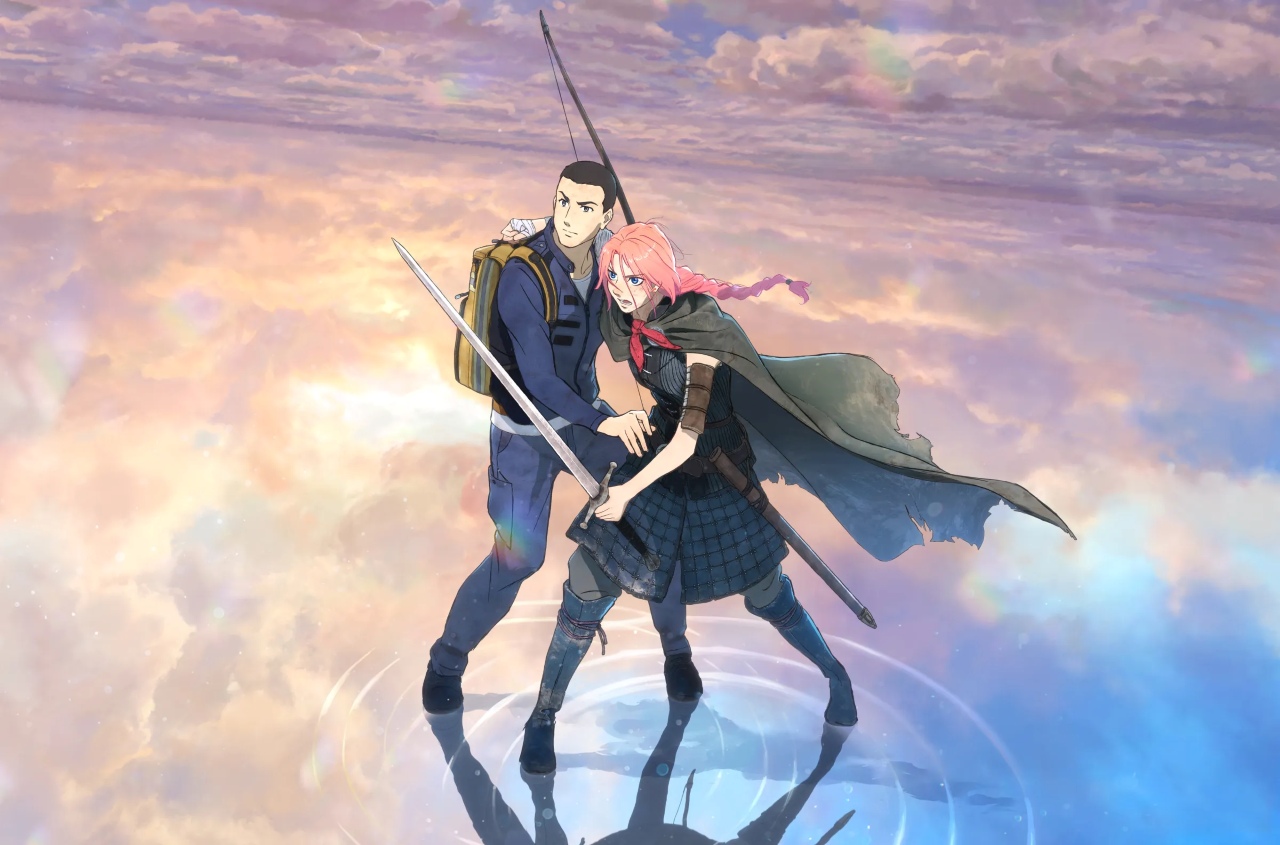
Certainly, the one thing that Hamlet is not is what Scarlet primarily is – about a heroine conducting a journey across a desert wasteland that is in the Afterlife. It can very tenuously mayyyybe be considered that there is very slight justification for this in Hamlet during the famous “to be or not to be” speech where Hamlet refers to “in that sleep of death what dreams may come//when we have shuffled off this mortal coil” and “The undiscovere’d country, from whose bourn//No traveller returns.” (Note the surprising number of other genre works that draw their titles from this speech). To me though, the speech reads as flowery metaphor rather than the Hamlet describing an actual place – the whole point of the speech is that what comes after death is unknown ie. ‘the undiscovere’d country’. To give context, this is also a speech where Hamlet is feeling twisted in all directions by uncertainty of choice and is idly wondering aloud whether death is a better option than to keep enduring “the slings and arrows of outrageous fortune.”
This is also where Scarlet comes aground. I spent the first half of the film’s nearly two-hour runtime going – “what the heck does this have to do with Hamlet?” – and the second half going – “Is this ever going to be about anything dramatically?” Most of the journey across the wasteland makes Scarlet in effect another film that takes place in a Fantasy Otherworld. It comes with its own peoples and culture. There is even a dragon that looms through the skies and sends occasional lightning bolts down to blast people. There is the journey towards and arrival at a very fantasy sounding place called the Infinite Lands, which are guarded by a massive gate.
Only there is no real drama in any of this. There are various incidents – a stopover with the nomads, a few swordfights with people encountered along the way. Certainly, these scenes are where Manori Hosoda’s quietly impressive animation comes into its greatest strength with crowd shots where each individuals has their own life or seeing massive fireballs of destruction being rained down. And Scarlet has a certain througline in terms of seeking revenge and then finding her father urging her to “forgive.” This has vaguely similarity to the vacillation and flip-flopping that Hamlet does throughout the Shakespeare play about seeking vengeance against his uncle (which notedly ends without any forgiveness).
Trailer here