
Crew
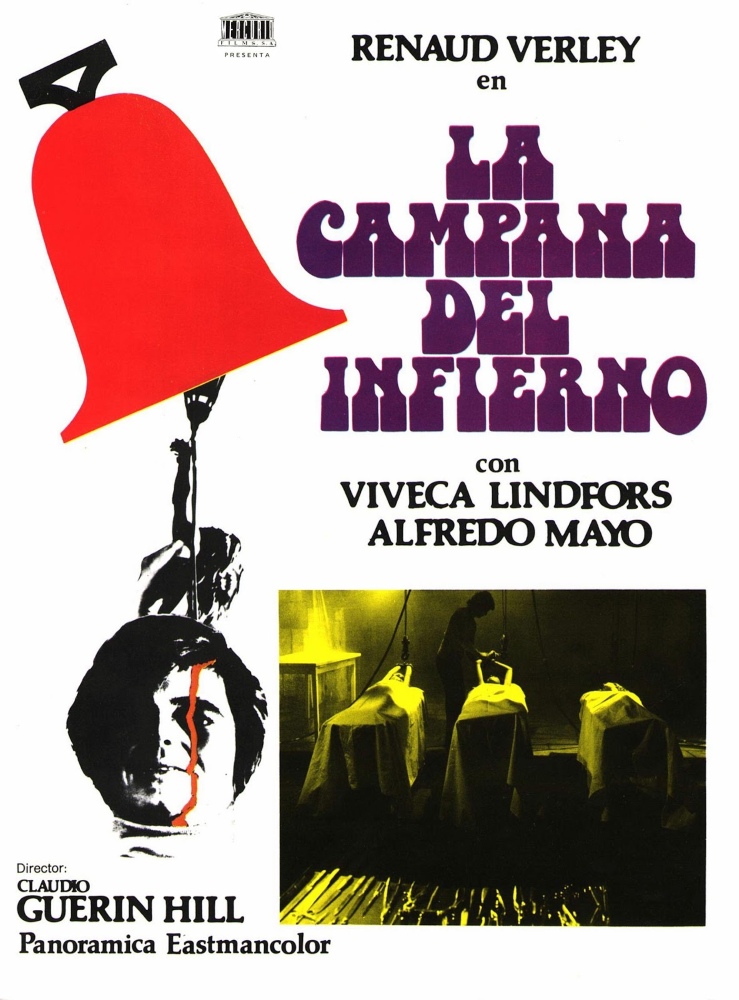
Director/Producer – Claudio Guerin Hill, Screenplay – Santiago Moncada, Photography – Manuel Rojas, Music – Adolfo Waitzman, Makeup – Julia Ruiz, Art Direction – Eduardo Torre de la Fuente. Production Company – HeSperia Films S.A./Les Films la Boetie.
Cast
Renaud Verley (Juan), Viveca Lindfors (Marta Avelio), Alfredo Mayo (Don Pedro), Maribel Martin (Esther Avelio), Nurea Gimeno (Teresa Avelio), Christina Betzner [Christina von Blanc] (Maria Avelio), Saturno Cerra (The Shepherd), Erasmo Pascual (The Priest)
Plot
Juan is released after being incarcerated in an asylum for several years. He travels back to his hometown and visits his aunt Marta who has become the executor of his late mother’s estate. Juan settles into the old house. He takes a job at a slaughterhouse and then quits after he learns its methods. He then sets out to take revenge against Marta and her daughters for having had him locked away.
The Bell from Hell is a film that has gained a minor cult reputation. It was the second full-length film from Spanish director Claudio Guerin Hill who previously made an episode of the anthology The Challenges (1969) and the full-length The House of the Doves (1972), neither being genre works. The film gained a certain notoriety when Guerin died after falling from the bell tower on the last day of shooting, aged only 34. The film was completed by Juan Antonio Bardem.
I came to The Bell from Hell after reading about its reputation and felt somewhat disappointed. I was also at a disadvantage of watching a film that appears to have been cut for English-language release – the original is listed by the IMDB as running 106 minutes, while the only version available around the web runs to 91 minutes. Some cutting is evident in scenes like where Renaud Verley has the girls imprisoned on a hoist or Nurea Gimeno is attempting to seduce him where the shot appears to cut whenever there is the likelihood of a bare breast entering the frame. The most we ever see is a few side nipples and some shots from the black-and-white photographs that are projected early in the show. The Bell from Hell is a film that seems well overdue a dvd restoration.
I did like Claudio Guerin Hill’s sense of place. There is a great dreamy evocation of the landscape as Renaud Verley is driving through the countryside on his motorcycle, entering the town and then the old, abandoned house. Even better are the scenes with him riding down a beach towards a castle, both of which are nearly obscured by mist. It gives The Bell from Hell a wonderfully moody sense of Continental Gothic, even if it is a modern-day set work.
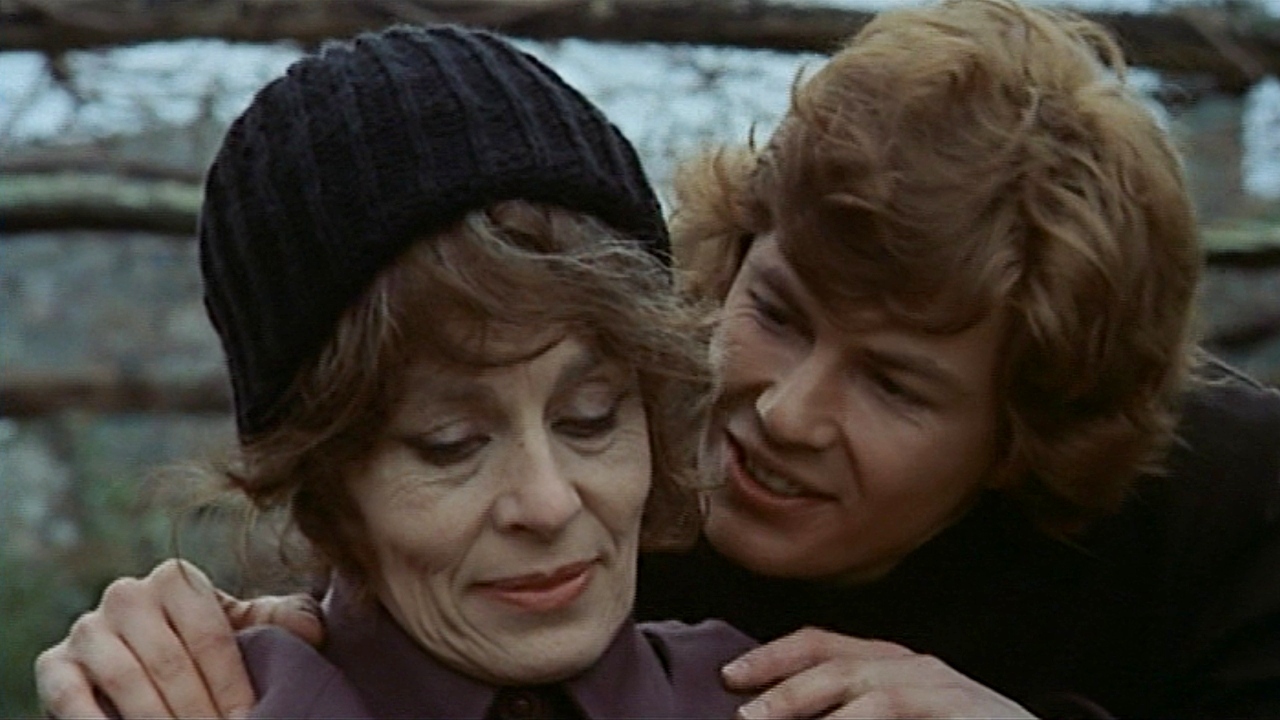
To remind us we are in modern horror, Guerin Hill throws in a montage of scenes with Renaud Verley taking a job at a slaughter plant where we see unflinching scenes of cattle being killed, gutted and carved up – not something that should be watched on a full stomach. There is also a grotesquely funny sequence in mid-film where Renaud Verley tells Viveca Lindfors he has been a bad boy and offers to pull his eyes out and then proceeds to do so, exposing gorily gouged eye sockets, before revealing it is a prank and these are joke prostheses.
There is a particularly eerie story that Renaud Verley tells to a guest to the house that aunt Viveca Lindfors likes to stay in the hall with the main door open because her three girls went missing at sea and she lives in the hope that they will return. The aunt comes to join them, while the door remains open letting the mists in. Singing can then be heard, followed by three shadowy figures approaching through the mist. The effect is quite spooky, before it is all revealed as another practical joke pulled by Renaud.
The main issue I had with The Bell from Hell was that it is not clear what is going on. There is a long time spent on Reynaud’s return home, his setting up in the old house. It is not clear until about halfway through that he is conducting a Revenge scheme. The horror element doesn’t emerge proper until towards the end where [PLOT SPOILERS] the locals imprison and brick up Renaud Verley to be hung as counterweight during the commencement ceremony for the new church bell. It is only here that the significance of the bell in the title is made clear. That is followed by a section where lights appear to be on in the old house and a villager investigates but it is not clear of Verley is still alive or this is one of his practical jokes being conducted by someone else.
Full film available here