
Crew
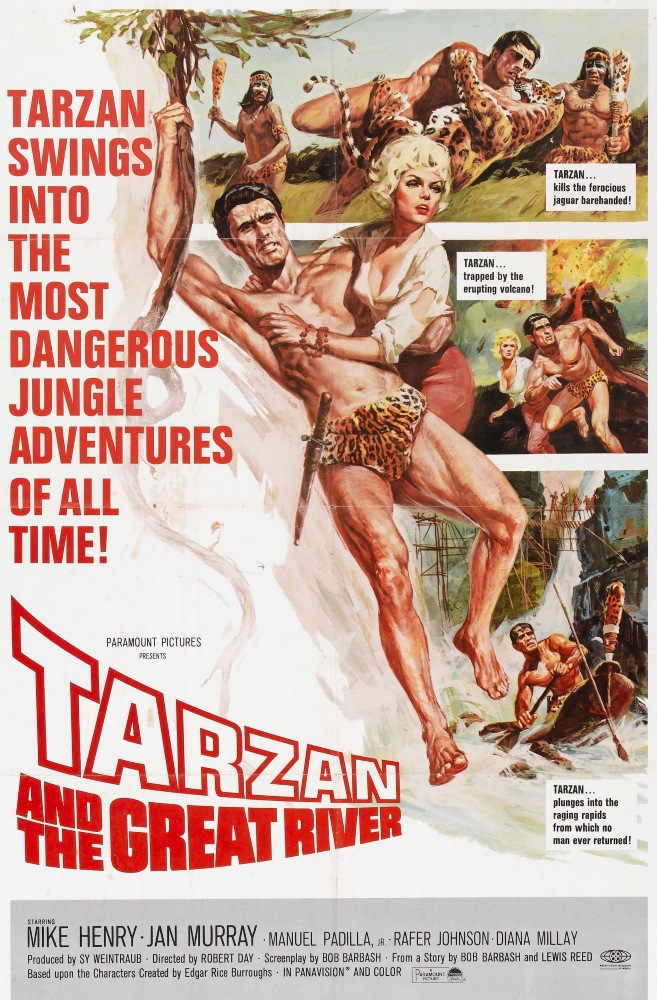
Director – Robert Day, Screenplay – Bob Barbash, Story – Bob Barbash & Lewis Reed, Producer – Sy Weintraub, Photography – Irving Lippman, Music – William Loose, Special Effects – Ira Anderson. Production Company – Allfin A.G..
Cast
Mike Henry (Tarzan), Jan Murray (Captain Sam Bishop), Manuel Padilla, Jr. (Pepe), Diana Millay (Dr. Ann Phillips), Rafer Johnson (Barcuna), Paulo Grazindo (Professor)
Plot
Tarzan arrives in Brazil at the behest of a zoology professor friend. He tells Tarzan he is concerned about the revived Barcuna cult who are moving across the jungle region, massacring other villages and enslaving their people. While Tarzan is reuniting with his animal friends Cheeta and the lion Baron where they are caged at the zoo, the professor is killed by Barcuna cultists. Tarzan sets out to region where the Barcuna are, hitching a ride with riverboat captain Sam Bishop and his native orphan sidekick Pepe who have been hired to deliver a shipment of vaccine to a village. Tarzan has raised the ire of the Barcuna leader who sends his men out to stop them.
Tarzan was the iconic hero created by Edgar Rice Burroughs (1875-1950). Tarzan’s first appearance was in the novel Tarzan of the Apes (1912) that was initially published in All-Story Magazine. Following its success, Burroughs went on to publish a further twenty-six Tarzan novels. Tarzan’s career on the screen began not long after with the silent Tarzan of the Apes (1918) starring Elmo Lincoln. There have been dozens of other Tarzan films since, most famously with the series at MGM and then RKO Radio Pictures starring Johnny Weissmuller that began with Tarzan the Ape Man (1932).
The best Tarzan films were the ones made between 1959 and 1968 by producer Sy Weintraub (1923-2000). These consist of Tarzan’s Greatest Adventure (1959) and Tarzan the Magnificent (1960) starring Gordon Scott as Tarzan; Tarzan Goes to India (1962) and Tarzan’s Three Challenges (1963) with Jock Mahoney; and Tarzan and the Valley of Gold (1966), Tarzan and the Great River and Tarzan and the Jungle Boy (1968) with US footballer Mike Henry cast as Tarzan; as well as the tv series Tarzan (1966-8) starring Ron Ely. These made a virtue of shooting in real world locations – Africa, Thailand, India, Mexico and Brazil – rather than the usual studio backlots and featured some fantastic action scenes for the day.
Tarzan and the Great River starts in extremely well from the opening scene – an attack by the Barcuna on a native village, a scene that is filled with violence, bloodshed and villages aflame – the sort of thing you never would have seen in the cosy banality of a Johnny Weissmuller film. The shot on location material gives you a sense of actually being there. When you see Mike Henry and Cheeta swinging on the vines, there is a great sense of them doing so in a real jungle rather than a studio backlot. (The only thing that got me was seeing lions and crocodiles in South America, a continent where neither live in the wild).
Tarzan and the Great River also seems to be making an effort to restore elements from the Weissmuller films. There is the reintroduction of Cheeta and Tarzan’s lion as companions on his adventure (who for some reason Tarzan has seen fit to have placed in a zoo in Brazil because the plot needs it), although at least we are spared the pandering to comic relief elements that Cheeta increasingly became in the 1940s films. There is also the introduction of an annoying kid (a nauseatingly cute and smartass performance from Manuel Padilla, Jr.), who recalls something of what Boy used to be in the Weissmuller films. (Padilla went on to become Jai, the equivalent of Boy in the Weintraub-produced Ron Ely Tarzan series around this same time).
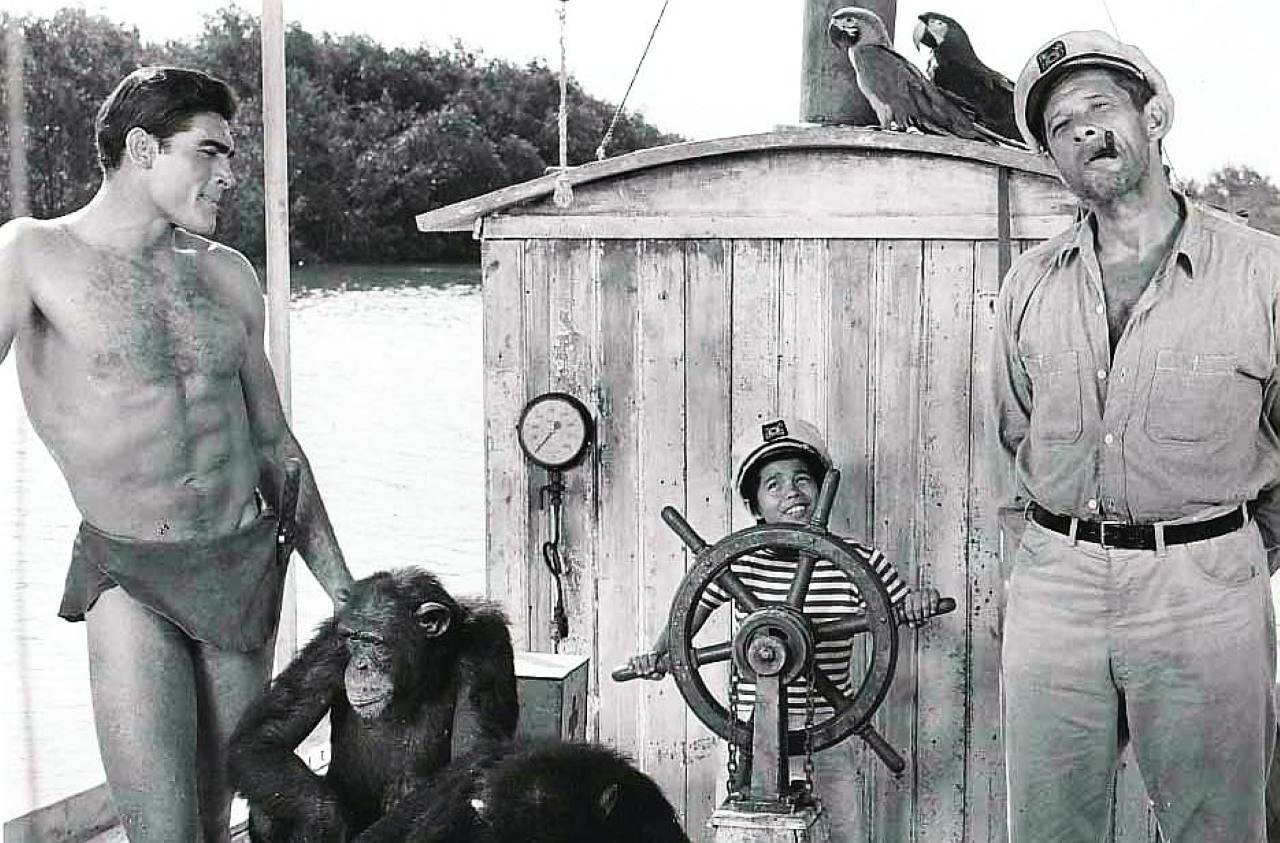
I have quite a liking for Mike Henry’s Tarzan. Unlike Gordon Scott who seemed unsure of himself and Jock Mahoney who just didn’t look like a Tarzan at all, Mike Henry projects a physical confidence in his own body and a certainty about himself as he goes into action. Among other things, Weintraub gives us a Tarzan fully conversant with the modern world – just as Edgar Rice Burroughs had him. When we are first introduced to Henry’s Tarzan here, we see him wearing a suit.
Sy Weintraub has consistently been the best producer of Tarzan films from Tarzan’s Greatest Adventure, Tarzan the Magnificent, Tarzan Goes to India and reaching an absolute peak with the immediate predecessor to this, Tarzan and the Valley of Gold. These were the best Tarzan films since the first two Weissmuller entries – Tarzan the Ape Man and Tarzan and His Mate (1934) – back in the early 1930s.
However, after these highs, Tarzan and the Great River feels like a comedown. The high adventure aspect that made the abovementioned such thrilling works is absent for the most part and the film a rather laidback and none too eventful journey down a river accompanied by an irritatingly cute kid. Aside from the exciting attack on the village at the beginning, we only get a couple of scenes – Tarzan overturning the boats of a flotilla of Barcuna attackers and wrestling with a crocodile – before things build to an okay climactic showdown between Tarzan and the Barcuna chief (Rafer Johnson) as they fight on a bridge.
Director Robert Day (1922-2017) made a number of other genre films, including two early British horror films The Haunted Strangler/Grip of the Strangler (1958) and Corridors of Blood (1962), as well as the British science-fiction film First Man Into Space (1959) and Hammer’s H. Rider Haggard adaptation She (1965). His other Tarzan films include – Tarzan the Magnificent (1960), Tarzan’s Three Challenges (1963), Tarzan and the Valley of Gold (1966) and Tarzan and the Jungle Boy (1968). The majority of Day’s work in the 1970s and beyond was in television, where he made a number of genre tv movies including Ritual of Evil (1970) and The Initiation of Sarah (1978).
Trailer here