

USA. 2007.
Crew
Director/Producer – Jeffrey Schwarz, Photography – Adam Cindric, Steve Coleman, Robert Elfstrom, Matt Faw, David M. Ford, Lilla Fulmi, David Hallinger, Chris Meagher, Jim Newport, Mark Putnam, Matt Stell & Clay Westervelt, Music – Michael “The Millionaire” Cudahy. Production Company – Automat Pictures.
With
Forrest J. Ackerman, John Badham, Diane Baker, Sidney Balkin, Steve Bickel, Budd Boetticher, Bob Burns, Terry Castle, Roger Corman, Joe Dante, David Del Valle, Donald F. Glut, Stuart Gordon, Anne Helm, Darryl Hickman, Marilyn Nash Hill, Norman Horowitz, William Immerman, Richard Kahn, Hawk Koch, John Landis, Marcia Scully Little, Barrie Lorie, Leonard Maltin, Marcel Marceau, Steven North, Fred Olen Ray, Thomas Page, Paul Sammon, Michael Schlesinger, Jacqueline Scott, Ruth Scully, Jeannot Szwarc, Bob Thomas, John Waters, Pamela Lincoln Yergen
William Castle (1914-77) was a genre director/producer who is almost invariably associated with the promotional stunts he devised for his films. Castle started out directing in the 1940s. After a brief move into television, Castle made the first of his own films with Macabre (1958). An inveterate showman, Castle created the first of his gimmicks for that film by taking out an insurance policy with Lloyd’s of London against audiences dying of fright. This was a stunt that served to make Macabre into a hit.
The success of Macabre was something that set Castle onto a new career path. Castle’s use of promotional gimmicks made him into a cult figure. With each film, he would devise increasingly more outrageous promotional schemes – with House on Haunted Hill (1959), a glow-in-the-dark skeleton was winched across the theatre; with The Tingler (1959), it was promised that the title creature would get loose in the theatre and seats were wired up with electric buzzers to zap patrons; 13 Ghosts (1960) was filmed in a process where audiences could put on a pair of coloured Ghost Viewers glasses to see the ghosts on the screen; Homicidal (1961) featured a Fright Break where those too faint of heart could retreat to the Coward’s Corner in the lobby and receive a refund; and Mr Sardonicus (1961) where audiences could vote on the fate of the title character. (See below for Castle’s other films).
Spine Tingler! The William Castle Story is a Documentary about Castle from Jeffrey Schwarz who has directed and produced hundreds of Making Of extras for dvd release. Spine Tingler takes us chronologically through Castle’s life and covers all his main films. It takes us back to a very young age when Castle saw Bela Lugosi in a stage production of Dracula and wangled his way backstage to see him. He took a job doing theatrical promotions. It was here that the hucksterism of his later cinematic career had its beginnings with stunts such as having a nurse on hand or a hearse rolling up to the theatre and a coffin being wheeled out of it. As he moved to stage, initially becoming an actor without much success, he changed the family name from Schloss to the Americanised Castle.
In 1939, Castle persuaded Orson Welles to give him the lease of the Stony Creek Theatre in Connecticut. There Castle put on a play Das ist Nicht für Kinder (This is Not for Children) starring German actress Ellen Schwanneke and contrived a scheme where he claimed that she had been called back to Germany by Hitler and Castle had had to write and refuse the Führer, saying she couldn’t be let out of her contract. He then graffitied the theatre with Swastikas and protest symbols, all to create a fake furore to drum up business.
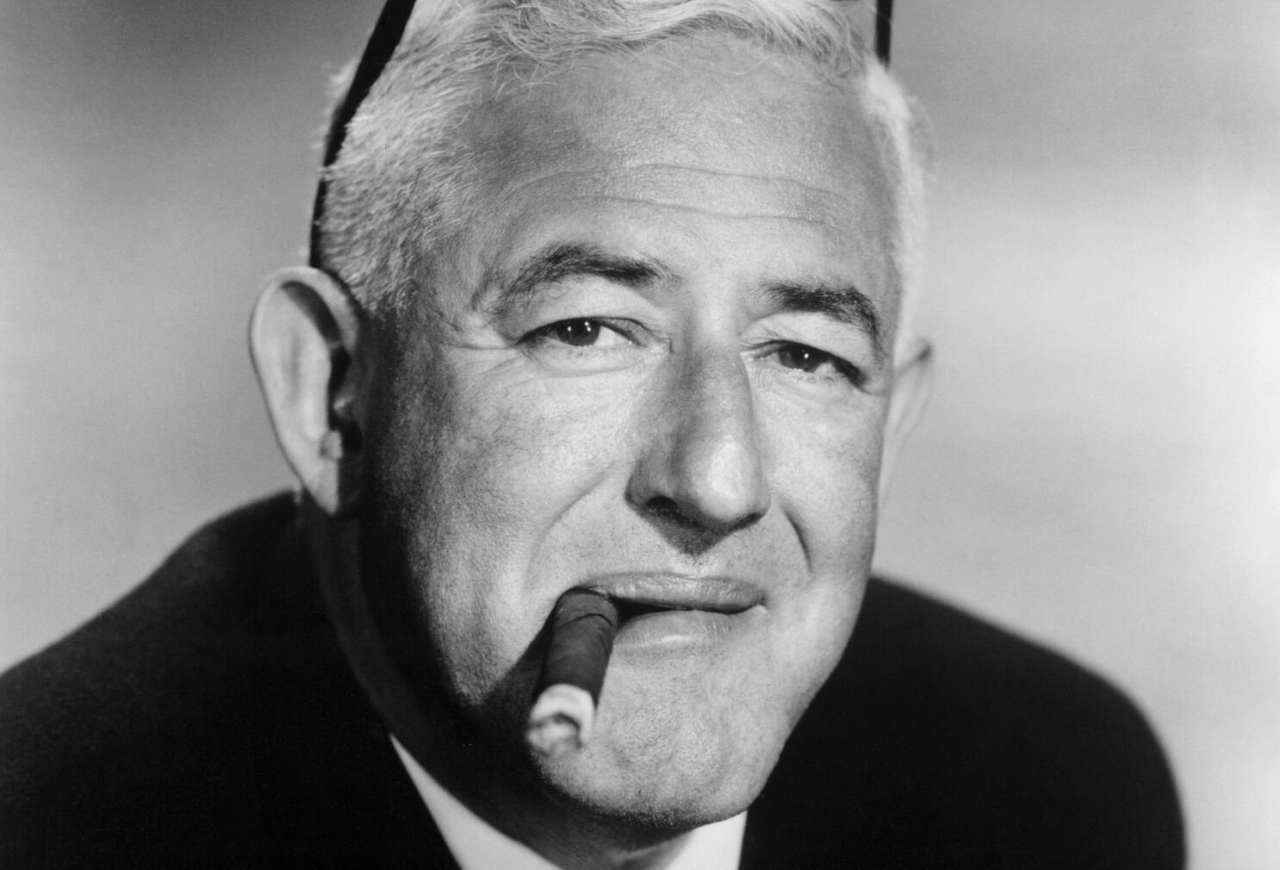
Castle was then taken on under the notoriously difficulty Harry Cohn, head of Columbia Pictures, and ended up working on everything he could, eventually rising to direct several of their films, including several entries in the Crime Doctor and The Whistler series’, as well as the odd Western. Castle was adamant about adapting the book If I Die Before I Wake (1938) by Sherwood King and purchased the rights, only to see it taken over at the studio and handed to Orson Welles to direct as The Lady from Shanghai (1947). It is said that it was from Welles that Castle developed his trademark cigar with which he was always associated.
Castle gained his inspiration after seeing the French Les Diaboliques (1955) and wanted to branch out and make his own Psycho-Thrillers, which came about with Macabre (1958). As is told, he mortgaged his house to raise the budget to do so. Fearful that the film would not earn its money back, he came up with the gimmick of insuring it with Lloyd’s of London, offering $1000 to any audience member who died of fright during the film. (Nobody ever claimed on the policy). The mediocre film on display put said to any possibilities of that but the gimmick ended up making Macabre a box-office success.
This set Castle on his path making horror films that all came with promotional gimmicks. Various people recount their experience of sitting in a theatre watching House on Haunted Hill and pelting the skeleton with candy as it was winched across. We then come to Castle’s magnum opus The Tingler and its’ wonderfully meta scenes where Vincent Price announces that the tingler is loose in the theatre and the screen goes blank. John Waters is one of the few who actually experienced sitting in one of the electrified chairs. A surprising number of the interviewees bring out their own copies of the Ghost Viewer glasses from 13 Ghosts.
It is often understated, considering how much his films are dismissed as just being B movies (especially when seen today), how popular Castle’s films were and how successful he was at branding his own name. He would go on the road to promote the films and even created a fan club at one point. Spine Tingler makes some comparison between Castle and Alfred Hitchcock – both made cameos in their films and appear to introduce their own trailers. Hitchcock’s gimmick with Psycho (1960) of ensuring that nobody was let into the theatre after the film started and urging audiences not to give away the ending is seen as having been borrowed from Castle. Immediately after the success of Psycho, Castle turned to copying Hitchcock with Homicidal. This was promoted with a money back guarantee. When the studio balked about this, Castle came up with the idea of the Coward’s Corner where those who wanted their money back had to sit and be jeered at.
We then move to Strait Jacket (1964). What was fascinating for me to learn was how Castle lured Joan Crawford to make another Grand Dame Guignol film a la the recent hit of What Ever Happened to Baby Jane? (1962) that she had starred in. To obtain her, he essentially allowed her control over the film, acceding to everything from her demand for a dressing room with bar and maid, approval over script, cast and cameraman to firing the original supporting actress to changing the ending so that she was in more of the scene.
With Rosemary’s Baby (1968), Castle bought the Ira Levin book and took it to Paramount only to have his desire to direct overridden by their choice of Roman Polanski. Castle went in determined to hate Polanski but ended up soon warming to him, all to the film’s enormous success. The interesting aftermath was that Castle was very much a believer in the film’s reputed curse – that the deaths of Krzysztof Komeda, the murder of Polanski’s wife Sharon Tate and the spell of bad health that Castle experienced afterwards were due to their messing with forces they shouldn’t have.
Spine Tingler does skip over several of Castle’s lesser (and non-gimmick) films of the 1960s such as Zotz! (1962), The Night Walker (1965), I Saw What You Did (1965), the non-genre comedy The Busy Body (1967) and the ghost comedy The Spirit is Willing (1967). I would have been fascinated to hear more about the circumstances of his collaboration with Hammer Films on The Old Dark House (1963). The last section deals with Castle’s final film the Marcel Marceau-starring Shanks (1974), a flop that the studio failed to believe in, to sudden interest by other directors who cast him in cameos in films such as Shampoo (1974) and Day of the Locust (1975), before his eventual death of a heart-attack at home in 1977.
William Castle’s other films of genre note as producer-director are:– as director of Crime Doctor’s Manhunt (1945), the sixth in a series of Columbia crime thrillers, of which Castle directed several, featuring a forensicologist against a split-personalitied killer; the psycho-thriller Macabre (1958); House on Haunted Hill (1959); the classic The Tingler (1959), probably Castle’s best film; the haunted house film 13 Ghosts (1960); the psycho-thriller Homicidal (1961); Mr. Sardonicus (1961) about a man with his face caught in a grotesque frozen smile; the juvenile comedy Zotz! (1962) about a magical coin; the remake of The Old Dark House (1963) for Hammer; the Grand Guignol psycho-thriller Strait-Jacket (1964) with Joan Crawford; The Night Walker (1965), a psycho-thriller about a dream lover; the prank phonecall psycho-thriller I Saw What You Did (1965); the psycho-thriller Let’s Kill Uncle (1965); the ghost comedy The Spirit is Willing (1967); the reality-bending sf film Project X (1968); as producer of the classic occult film Rosemary’s Baby (1968) for Roman Polanski; as producer of the anthology series Ghost Story (1972-3); Shanks (1974) with Marcel Marceau as a puppeteer who can resurrect the dead; and as producer of the firestarting insect film Bug! (1975).
Trailer here