

Crew
Director – Ric Roman Waugh, Screenplay – Mitchell LaFortune & Chris Sparling, Producers – Brendon Boyea, Gerard Butler, Basil Iwanyk, Erica Lee, Sebastien Raybaud, Alan Siegel, Ric Roman Waugh & John Zois, Photography – Martin Ahlgren, Music – David Buckley, Visual Effects Supervisor – Marc Massicotte, Visual Effects – Alchemy 24 (Supervisor – Alain Lachance), Crafty Apes (Supervisor – Nick Sparks), Hybride (Supervisor – Olivier Beaulieu) & Pixomondo (Supervisor – Kunal Ghosh Dastider), Special Effects Supervisor – Terry Glass, Production Design – Vincent Reynaud. Production Company – Thunder Road Films/Anton/G-Base/Cinemachine.
Cast
Gerard Butler (John Garrity), Morena Baccarin (Allison Garrity), Roman Griffin Davis (Nathan Garrity), Amber Rose Revah (Dr Casey Amina), William Abadie (Denis Laurent), Nelia Valery Da Costa (Camille Laurent), Trond Fausa Aurvåg (Adam Shaw), Sophie Thompson (Mackenzie Matthews), Ken Nwosu (Obi), Peter Polycarpu (Dr Haugen), Tommie Earl Jenkins (General Sharp)
Plot
It is five years following the collision with the Earth by the comet Clarke. John Garrity, his wife Allison and their son Nathan remain with the survivors in the bunker at Thule Airbase in Greenland but supplies are running low. Outside the air is poisonous and the atmosphere wrought by radiation and electrical storms. At the same time as they discover other survivors they are obliged to help but cannot support, the bunker is struck by earthquakes and they are forced to evacuate. John and his family are one of the few that get away on lifeboats before tsunamis claim everybody else. They make it to a devastated England that is recovering in small pockets. Along with them is Dr Casey Amina who firmly believes that the crater where Clarke impacted in France will have become a valley that is sheltered and allowed conditions to have returned to normal. However, the journey there is a perilous one.
Greenland (2020) was a big-budget Disaster Movie. It was very standard material for this type of mass destruction spectacle. The film came out during the midst of Covid lockdowns and ended up being released to video-on-demand and sporadic theatrical venues. Despite this, it did manage to earn $52 million at the box-office, a reasonable amount given the theatrical closures. It is clearly this that the same production personnel are banking on when it comes to making this sequel. The publicity machine refers to the film as Greenland 2: Migration but the only title that appears on screen is Greenland: Migration.
Greenland was a disaster movie about an oncoming astral body in the lineage of films like Meteor (1979), Armageddon (1998) and Deep Impact (1998). By the time of Greenland: Migration, we now have a very different type of film. Here it has switched over to be a Post-Apocalyptic work on the familiar theme of survivors emerging out of the fallout shelter to greet a very different world to the one they knew that has emerged in the ruins.
This is all familiar stuff. The thing is that director Ric Roman Waugh still approaches this as a mass destruction spectacular. And so at regular intervals we get scenes with massive electrical clouds sweeping across the landscape; tsunamis; more comet debris in orbit coming down and striking. There is also an absurd scene where Gerard Butler and family try to cross the wasteland that used to be the English Channel, which requires them to have to clamber across a series of perilously placed ladders and rickety rope bridges while being scoured by winds and collapsing rock that wipes out everybody else except Butler and family. It all feels like wannabe Roland Emmerich without really being able to summon the epic scope that Emmerich does.
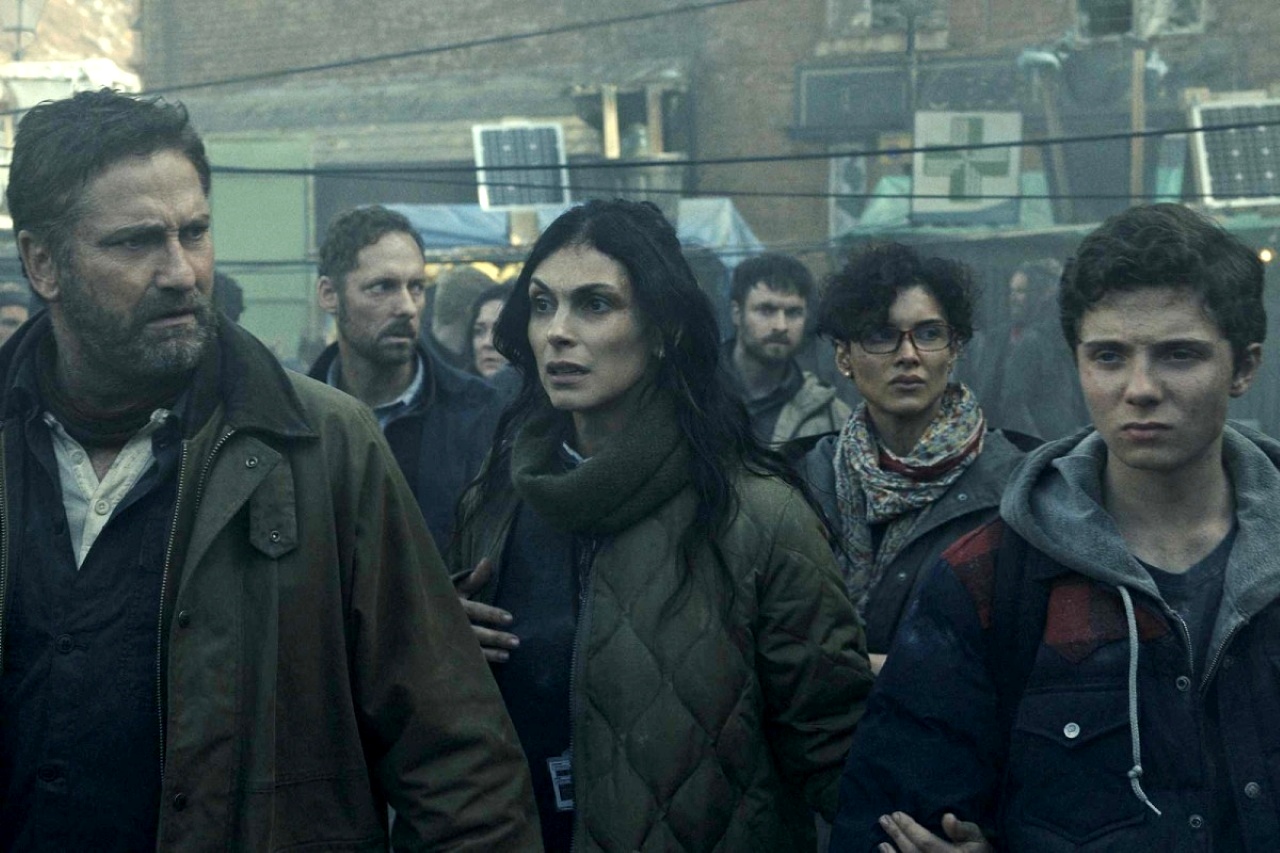
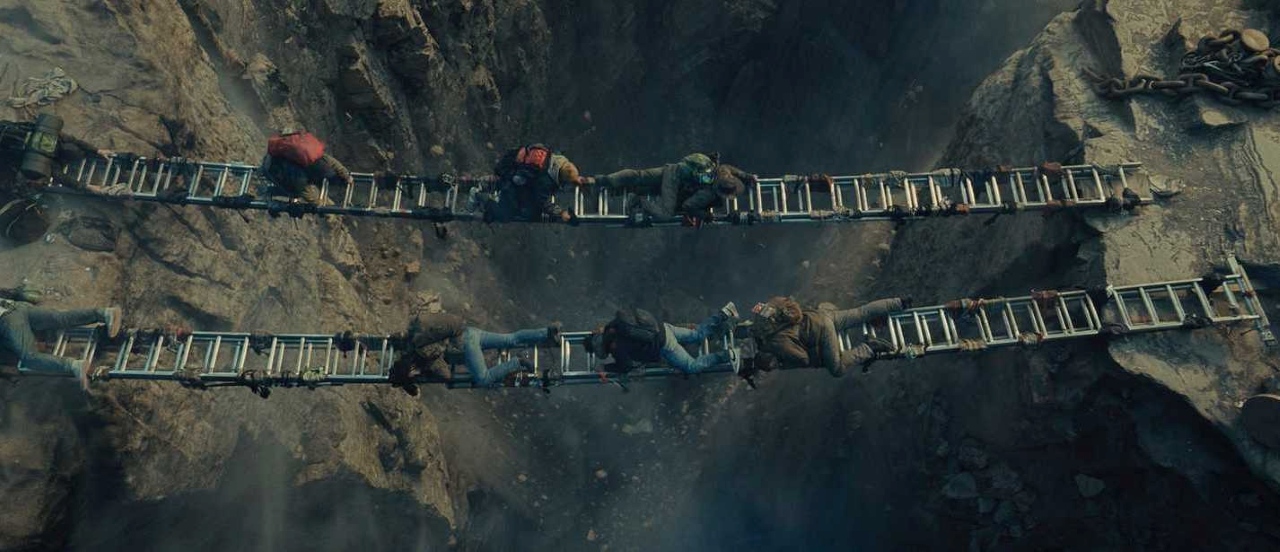
There have been a lot of post-apocalyptic films and I don’t think that Greenland: Migration is very good example. The script shuffles around a series of generic elements from these – shantytowns, heavily armed military, small pockets of survivors, armed marauders in the wasteland – but none of the sequences in particular end up engaging. They are just things that happen without affect. Like the rickety traversal of the English Channel, it often feels like a series of dramatic peaks designed to thrill the audience, where the characters are propelled from one dramatic sequence to the next without any deeper affect beyond that.
And then there is the absurdity of the ending. The film posits a scenario where the impact crater has become a paradise that is free from all the devastation in the surrounding world – where apparently the storms, winds and radiation magically don’t come there, it is not struck by the other orbiting cometary debris and is a valley full of greenery, sunlight and waterfalls. The view of it feels positively utopian. It is the kind of absurdly optimistic ending that plagued films like Damnation Alley (1977) and I Am Legend (2007).
Trailer here