


Crew
Director/Screenplay – Bernardo Britto, Producers – Benjamin Cohen, Patrick Donovan & David Hinojosa, Photography – Ava Benjamin Shorr, Music – Kaitlyn Aurelia Smith, Visual Effects Director – Ray Tintori, Visual Effects – Pretend (Supervisor – Ben Brewer) & Studio X (Supervisor – Jason Patnode), Production Design – Caity Birmingham. Production Company – 2AM/Lou Filmproduction.
Cast
Mary-Louise Parker (Zoya Lowe), Ayo Edebiri (Paula Campos), Carlos Jacott (Donald), Hannah Pearl Utt (Jayne), Chris Witaske (Morris), Harris Yulin (Professor Dulseberg), Fern Katz (Sandra Lowe), Riley Elise Fincher-Foster (Young Zoya)
Plot
Zoya Lowe wakes up in a hospital in Miami, having been diagnosed with a small black hole growing inside her chest. She is given five days left to live. Her husband and children take her home. However, Zoya keeps waking up back in the hospital bed and going through everything again by taking a pill that allows her to rewind time by five days. During one of these rewinds, she bumps into physics student Paula Campos. Zoya, who was a physics student herself, goes back to the same day and persuades Paula to help her analyse the make-up of the pill, which she has been using since she was a child.
The premise for Omni Loop – “A woman from Miami, Florida decides to solve time travel in order to go back and be the person she always intended to” – didn’t do much to enthuse me. It sounded like a variant on Peggy Sue Got Married (1986) or an SF version of woman’s positivity story about someone going back and making over their life choices. The surprise about the film is that it turns out to be a variant on Groundhog Day (1993), albeit with Mary-Louise Parker travelling back in a five-day loop to try and perfect scientific research about time travel.
Omni Loop is an okay variant on the Timeloop Film. I was kind of hoping it might hit the same madcap creativity that Everything Everywhere All at Once (2022) did but it lacks that film’s wild conceptual dexterity. Indeed, after developing a promising interest after about the point that Ayo Edebiri is introduced, the film slows right down in the latter half, loses interest in its time travel theme and becomes a paean to living the ordinary life and its pleasures. Certainly, the film gets good performances from its two leads, Mary-Louise Parker and Ayo Edebiri, during these sections.
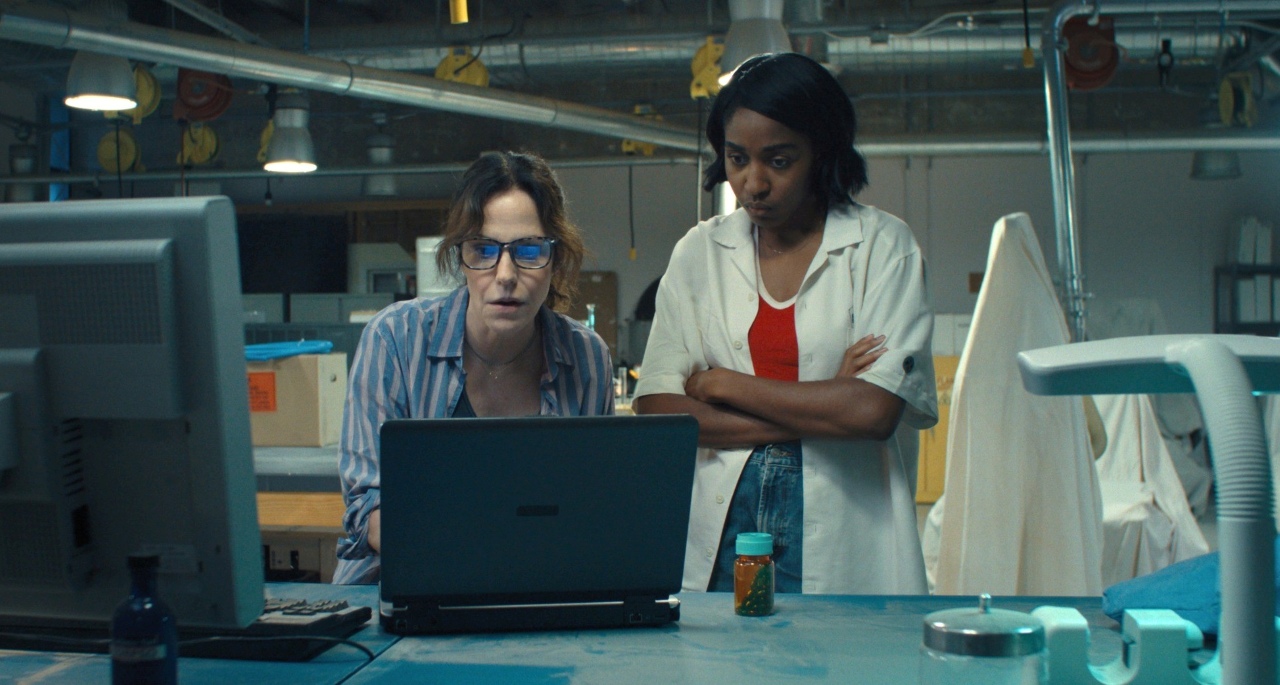
There also seems to be some parts of the plot that skip you by. Not too much is gone into explaining Mary-Louise’s lifelong use of the pills, including she at one point explaining how she became a physics A student by going back and taking the exam over multiple times until she aced it. You feel like her introduction to the pills and lifelong use of them should have been given more emphasis than it is in the story, given how much of a central feature it is.
Not to mention when Omni Loop opens and the doctors explain to Mary-Louise Parker that she has a small black hole in her chest. When eventually seen the black hole seems to be about the size of a small ball. A stellar body that would compact to a black hole of such size would have had to have an original mass about ten times the size of Earth. If Mary-Louise had a black hole of such a size inside her, doctors should be less concerned for her general health and well-being than the fact that it would be a complete extinction level event for the Earth within the space of about five minutes that would promptly see all of the Earth’s atmosphere, water and landmass be sucked inside the black hole like water going down a plughole.
Omni Loop was the second film for Bernardo Britto who had previously directed the non-genre Jacqueline Argentine (2016).
Trailer here