
Crew
Director – Pierre Coffin, Co-Director – Patrick Delage, Screenplay – Pierre Coffin & Brian Lynch, Producers – Chris Meledandri & Bill Ryan, Music – John Powell, Animation Directors – Hichem Arfaoui & Pierre-Francois Duhamel, CGI Supervisors – Nicolas Brack & Boris Jacq. Production Company – Illumination.
Voices
Pierre Coffin (The Minions), Jeff Bridges (Frank and Elwood), Christoph Waltz (Max), Jesse Eisenberg (Dort), Allison Janney (Olivia), Trey Parker (Goomi), Zoey Deutch (Debbie), Bobby Moynihan (Phillips), Phil LaMarr (Howard), George Lucas (Himself)
Plot
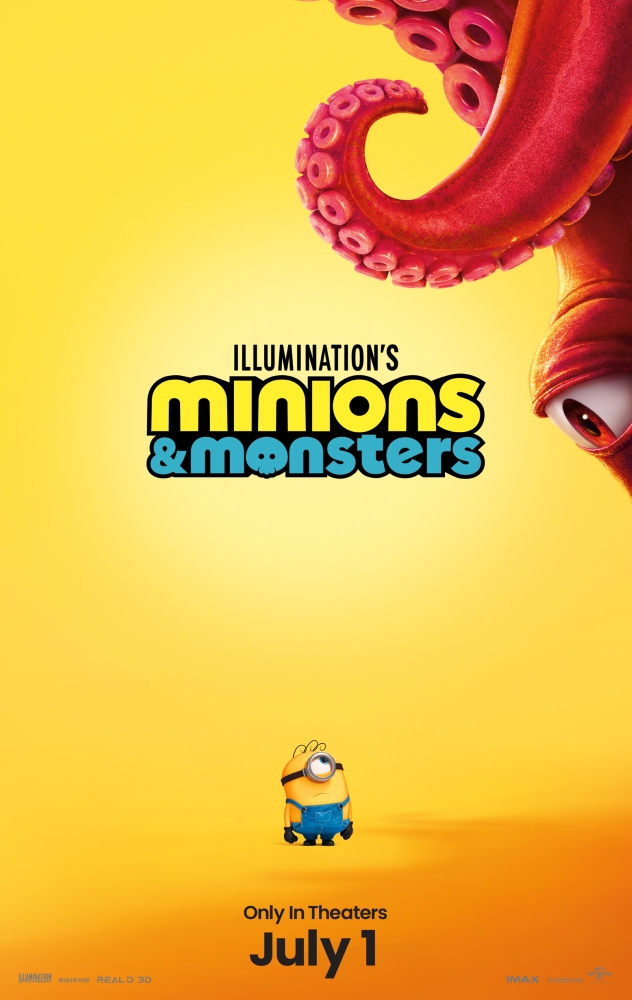
Throughout history, the Minions have sought to find the most evil master that they can serve. Arriving in Hollywood in the 1910s, they eagerly join a bandit who is conducting a train robbery unaware that it is being filmed as part of a movie. The director Max feels that his film has been ruined until the Bright Brothers studio executives see the footage and want more of the Minions. The Minions become stars – until the coming of sound where their unintelligible babble switches audiences off. One of the Minions James comes up with the idea of a film where the Minions fight monsters. Max gifts them a movie camera but they have no resources. James and several others decide to obtain their own monsters by conjuring them from a book of spells, but this summons a monster that proceeds to go amok. Meanwhile, the other Minions find a new master to serve in Dort, a robot arrived on Earth.
The Minions are a pop culture phenomenon. They first appeared in Illumination Entertainment’s debut film Despicable Me (2010). Their small cute size, manic antics and unintelligible babble of dialogue hit on with audiences in a big way. They have appeared in all of the sequels Despicable Me 2 (2013), Despicable Me 3 (2017) and Despicable Me 4 (2024). After the second of these, Illumination clearly felt the Minions had developed a critical mass sufficient that they were able to spin them off in their own film Minions (2015), which hit the Box-Office Top 10 for the year and led to a follow-up Minions: The Rise of Gru (2022). Although by that point, it started to feel like Illumination were being stretched thin in the search for some creativity to spin on the formula.
I had assumed that the whole Minions phenomenon had quietened down due to it not seeming as prevalent as it had in the last few years. That said, Minions & Monsters still sits in the box-office Top 10 of 2026 and has earned some half-a-billion dollars worldwide, so my assumption that it has died down any seems to be wrong. The Minions’ manic babble and slapstick pratfalls still settle in with both a familiarity and an amusement that it takes a heavy degree of cynicism to resist.
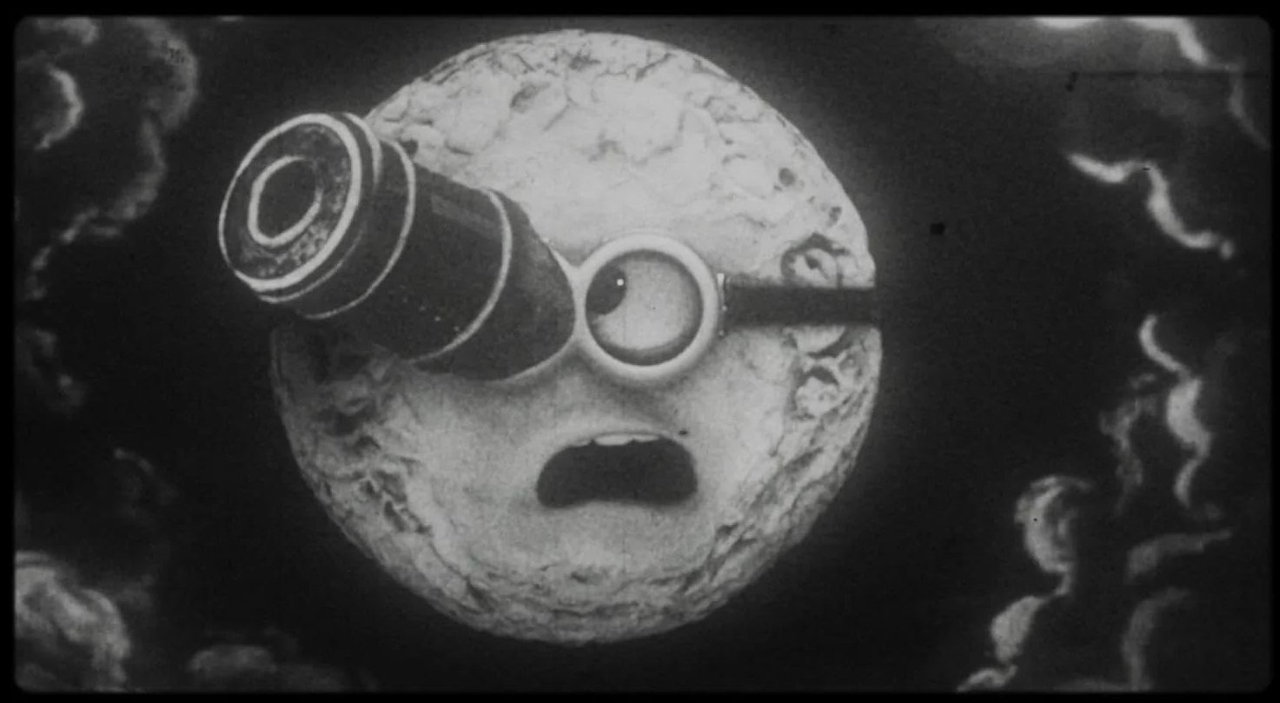
With Minions & Monsters, the Minions take on Hollywood or at least film history. The opening credits sequence wittily has them invade the early silent films of Eadweard Muybridge, the train platform in The Lumiere Brothers’ The Arrival of a Train (1895) and the factory of Workers Leaving the Lumiere Factory (1895), or joining the chorus girls loading the bullet in Georges Melies’ A Trip to the Moon (1902), while Melies’s Man in the Moon’s face is replaced by a Minion head.
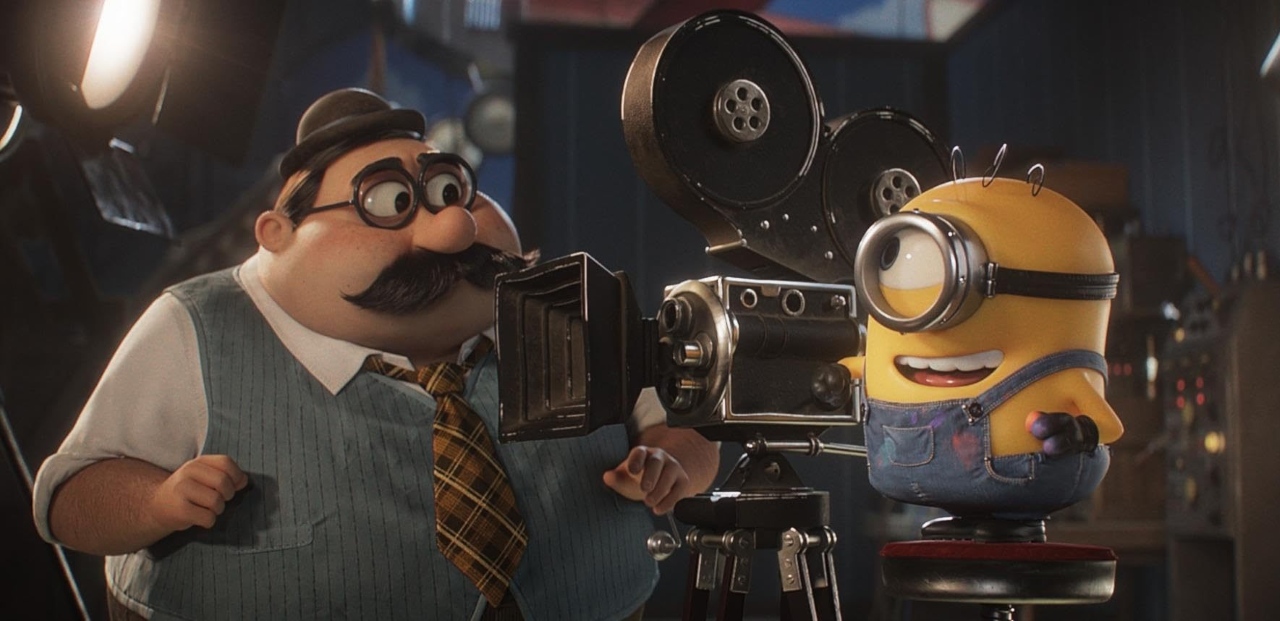
Later in the film there are throwaway background gags about Harold Lloyd hanging from the clock in Safety Last! (1923), the house falling down on top of Buster Keaton in Steamboat Bill, Jr (1928), the factory of Charlie Chaplin’s Modern Times (1936), plus a number of film posters in the tour of the Hollywood museum at the start. There is even a very odd gag during the tour of the museum about George Lucas (who voices himself) being kept a prisoner in a glass case.
My main issue with Minions & Monsters is the same one I had with the first film. Both films have a long montage preamble before getting to the main story showing the Minions in various eras throughout history. This somewhat off-balances the main story. In both cases, these scenes are made up by a variety of slapstick set-pieces. Here we get extended scenes where they cause chaos with a cyclops including getting a makeshift Lego block stuck up its ass; with a wizard they sign on with; and of a runaway train careening through the streets of Hollywood. All before the main story starts. Fun and all as these are, they feel like sequences that are designed to play to the single digit age groups in the audience.
The main plot, which does not start until about forty minutes in, has two strands. One of these is where several of the Minions decide to create their own monster movie and summon monstrous entities. The entities are modelled on H.P. Lovecraft – see Lovecraftian Themes – as witness the characters being called Howard and Phillips. As long as one can imagine Lovecraft’s comic horrors brought down to the level of completely harmless and inoffensive children’s movie characters who would hurt nobody – the film’s major climactic threat is of a blob that resembles a giant puddle of orange sherbet gone amok.
The other plot strand involves the rest of the Minions signing on with Dort, a robot who has clearly been modelled on Gort from The Day the Earth Stood Still (1951). This does offer the amusing idea of seeing the Gort robot in a domestic setting, but is mostly run over with more Minions gags. A good percentage of this part of the plot sits in a place of ambiguity as to whether Dort is just a cosplayer or the real article, before he and the Minions appear as the cavalry in a series of one-man flying saucers to defeat the blob monster at the climax.
Trailer here