
Crew
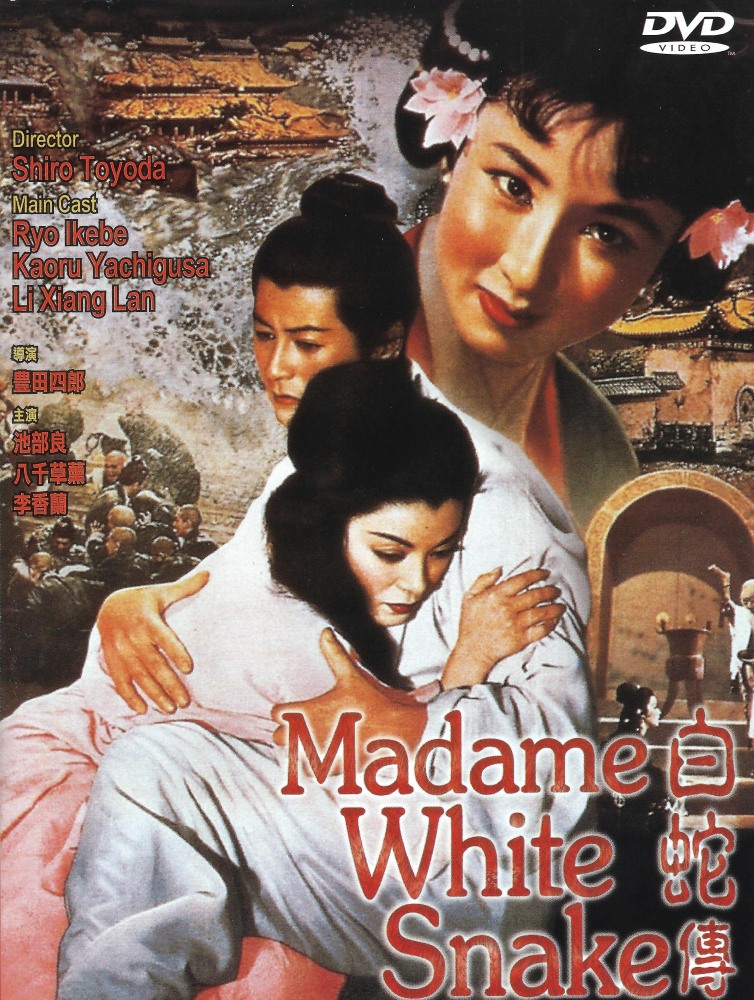
Director – Shiro Toyoda, Screenplay – Toshio Yasumi, Based on the Chinese Folktale Legend of the White Snake and Madam White’s Witchcraft by Fusao Hayashi, Producer – Tomoyuki Tanaka, Photography – Mitsuo Miura, Music – Ikuma Dan, Special Effects Supervisor – Eiji Tsuburaya, Production Design – Makoto Sono. Production Company – Shaws Production.
Cast
Ryo Ikebe (Xu-Xian), Shirley Yamaguchi (Bai Niang), Kaoru Yachigusa (Xiao-Qing), Kichijiro Ueda (Wang Ming), Musei Tokugawa (Taoist Priest)
Plot
The poorly Xu-Xian is lent an umbrella by Bai Niang. He later visits her to return it where she proposes marriage. He is too ashamed to accept because he is so poor. Bai Niang’s servant Xiao-Qing gives Xu-Xian 500 taels. However, these have been stolen and when Xu-Xian shows them to his brother-in-law, he turns Xu-Xian in to the authorities. Xu-Xian is freed and gets a job at an inn in Suzhou. However, Bai Niang and Xiao-Qing turn up. She pleads with him and they agree to marry. Xu-Xian is happy until a Taoist priest comes, persuading him that Bai Niang is a demonic snake goddess and must be banished.
The Legend of the White Snake is one of the great Chinese folk tales. The various versions of the story date back to at least the 9th Century and concern the mortal Xu Xian and his falling for Bai Suzhen, a woman clad in white, who turns out to be a snake goddess. There have been various retellings of the story and adaptations into opera and stage musical. There have been numerous film adaptations dating back to the silent era. The most well-known of these have been Tsui Hark’s Green Snake (1993), Ching Siu-Tung’s The Sorcerer and the White Snake (2011) and the animated White Snake (2019), as well as a musical Madame White Snake (1962) from the Shaw Brothers. This is a Japanese production taken from a series of folktales written down by the Japanese novelist Fusao Hayashi.
Madame White Snake holds up surprisingly well today. It has an exquisitely dreamy feel to it. For one, it is made in colour when other Japanese contemporaries like the esteemed Akira Kurosawa and the first Godzilla (1954) were still shooting in black-and-white. The early scenes are all pastel colours, people in formal costume, petals drifting on lakes, ponds filled with koi fish. There is the weepy romanticism to it that 1980s/90s Hong Kong cinema made into a visual style of its own – all that seems missing is the gauzed-out lens.
The story works extremely well too. It taps both the dreamy romanticism and the horrible choices that Ryo Ikebe makes to marry Shirley Yamaguchi unaware that she is a snake goddess. The film throws in complications with the introduction of the Taoist priest (Musei Tokugawa) and his determination to convince Ryo Ikebe that Shirley is a snake demon. Perhaps the only outdated aspect is just what a subservient traditional wife that Shirley Yamaguchi’s snake godddess becomes once she is married.
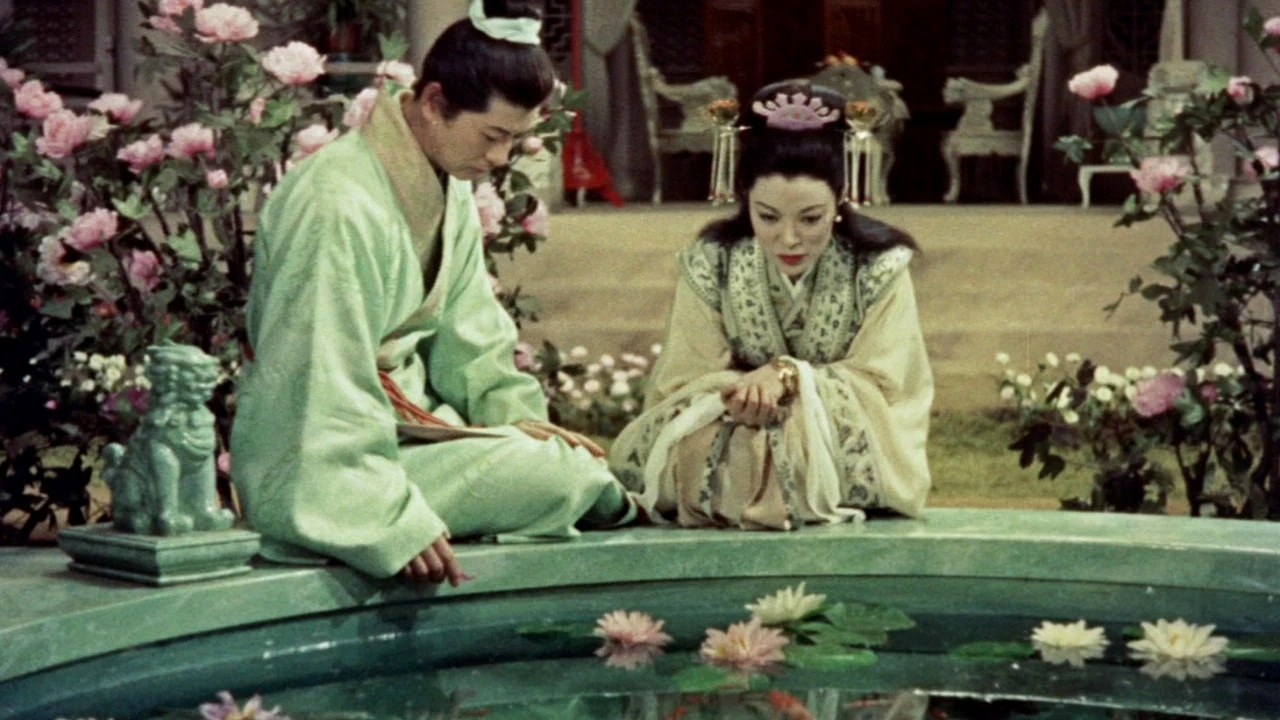
Fantasy elements in film were not that well developed during this era but Madame White Snake has a great sense of such. In one scene, Bai Niang comes upon the Taoist priest praying and blasts him through the air until he is hanging from the spire of a temple in the distance. In another, she travels all the way to heaven to plead with the gods while travelling on a miniature cloud. The only effect that falls down is the one where Shirley Yamaguchi becomes miniaturised that fails through some shoddy and obvious blue screen opticals (which comes from no less than Godzilla effects man Eiji Tsuburaya). The climactic scenes where a flood is unleashed are certainly capable and up there with the best Godzilla films of this era.
Director Shiro Toyoda (1906-77) made sixty films in a career between 1929 and his death. Most of these are regular domestic dramas or romances. He made two other ventures into genre material with the ghost story Illusion of Blood (1965) and the horror film Portrait of Hell (1969).
Trailer here