

Crew
Director – Arne Mattsson, Screenplay – Lars Forssell & Eva Seeberg, Based on the Ballad Mannen och Dockam by Lars Forssell, Producer – Lorens Marmstedt, Photography (b&w) – Åke Dahlqvist, Music – Ulrik Neumann, Production Design – Harald Garmland. Production Company – Florafilm.
Cast
Per Oscarsson (Lundgren), Gio Petré (Skyltdockan/Mannequin), Tor Isedal (Fredriksson), Malou (Annie Hakansson), Elsa Prawitz (Ms Karlberg), Bengt Eklund (Hakansson), Dagmar Olsson (Mrs Hakansson), Rick Axberg (Robert Hakansson)
Plot
Lundgren is a night watchman at a department store in Stockholm. He lives in an apartment building and feels completely alone. When he drives away two burglars from the store, Lundgren takes the opportunity to steal a beautiful mannequin and blame it on the thieves. He takes the mannequin home to his room. There it comes to life. He lovingly tends the mannequin but it soon becomes demanding, insisting that he does not leave. Meanwhile, the neighbours begin to gossip among themselves and wonder who Lundgren has in his room.
The Doll was one of the films of Swedish director Arne Mattson (1919-95). Mattson made over sixty films between the 1940s and 1990s, mostly comedies, dramas and gaining a reasonable popularity for his mystery thrillers. Mattson’s only other ventures into genre material were the remake of The Phantom Carriage (1958) and The Lady in Black (1958), a ghost story that has a mundane resolution. Mattsson did also make a thriller Mannequin in Red (1958), although this is a mundane work that concerns the murder of a model. The Doll was written by and based on a ballad by Lars Forsell, an acclaimed and award-winning Swedish writer, poet and lyricist.
There have been assorted works about mannequins coming to life – The Twilight Zone episode The After Hours (1960) and the inane romantic comedy Mannequin (1987) and its sequel Mannequin on the Move (1991), but these have been in a light fantasy vein. The one film that does seem to have taken its inspiration from The Doll is Love Object (2003), which has many similarities to the story here, but where the mannequin is replaced by a sex doll.
The Doll sits in a similar arena to these but pushes everything into a definite area of Disturbed Psychology. There is the opening with Per Oscarsson wandering the streets, looking in on mannequins in storefront windows and telling us how lonely he is. This is spelt out directly by the song that plays over the opening credits with lines such as “There was a man, he never was happy/Even though he was born in the happiest of towns/He became bitter, like bitter chocolate/If he couldn’t play with dolls.”
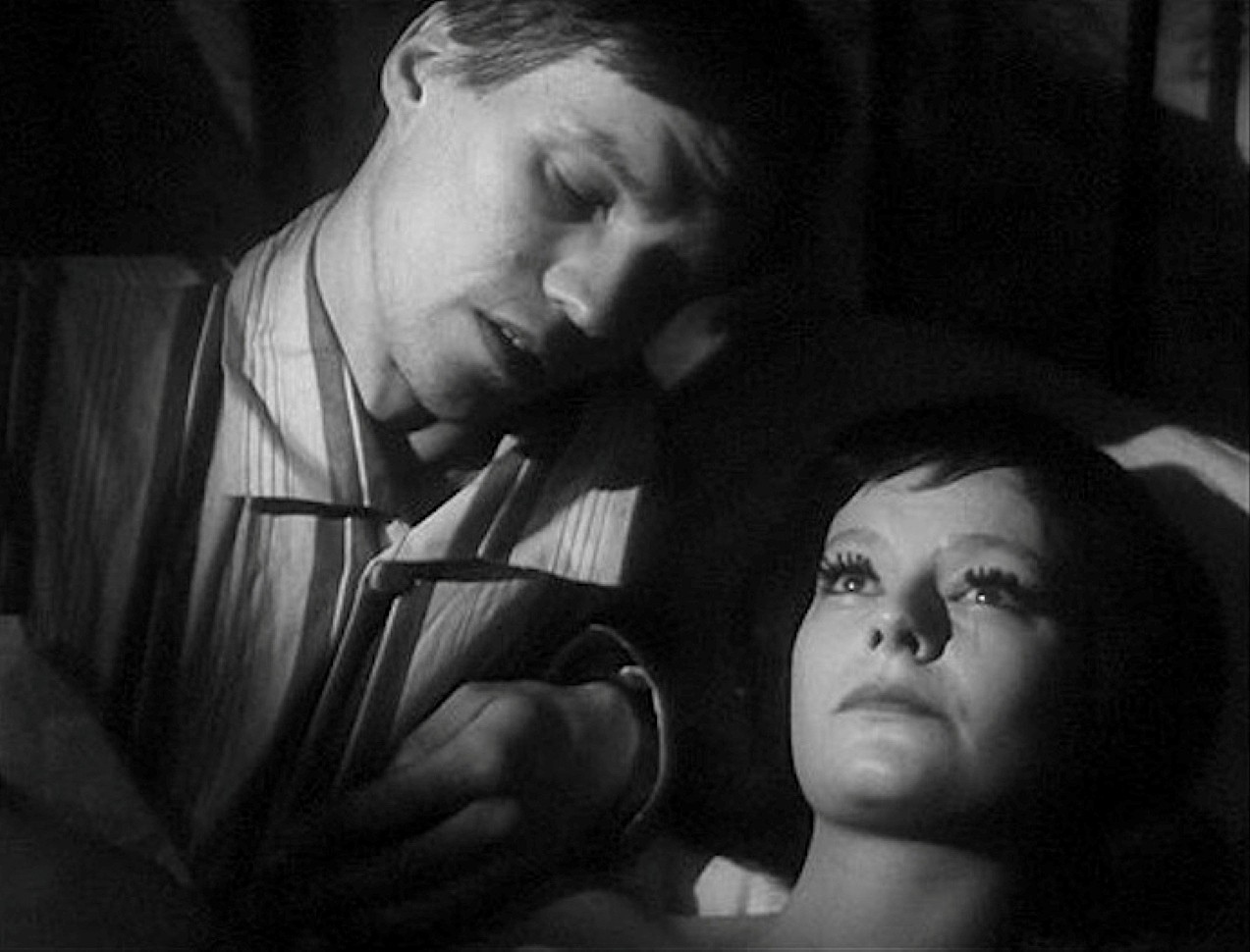
The film enters into quite a disturbed mental space. A considerable part of its effectiveness lies in Arne Mattsson treading a careful line of The Ambiguously Fantastic throughout. We watch Per Oscarsson bring the mannequin back to his apartment. And then when he is gluing its hand back on, there is the undeniably effective moment where the mannequin suddenly says “ouch” and it seems like there is a tear in her eye. Not long after, he is kissing her goodnight when the mannequin’s hand comes up to caress his face.
You can’t help but have sympathy for poor downtrodden Per Oscarsson as the mannequin gains increasing life and then starts to exert its own will. This comes first in its determined desire to go outside and refusal to quieten down. Most chillingly is when he presents her with a purloined fur coat and she dismissively turns on him for bringing her a fake fur.
This comes in contrast to the other people living in the house and their assorted domestic issues. As the film goes on, the others gather outside Per’s room, wondering who he is talking to. Here we get the clear impression that everything is in his mind and he is talking to somebody imaginary. Even though we see the mannequin come to life and walking around the apartment, whenever someone knocks or calls out she has become a mannequin again. This of course leads to Per Oscarsson’s climactic breakdown and then the perfectly chilling final twist that comes after that.
The Doll is shot is black-and-white, which was still common in the era. Director Arne Mattson makes strong use of this – much of the frame is occluded by shadow. Almost the entire film takes place in a rented house and Per Oscarsson’s tiny apartment where the stairs are restricted and narrow, allowing only angular shots. Everything looks cramped and dingy and attains a kitchen sink obsessiveness.