

Crew
Director – Werner Klinger, Screenplay – Ladislas Fodor & R.A. Stemmle, Based on the Film The Testament of Dr Mabuse (1933) Written by Thea von Harbou, Producer – Artur Brauner, Photography (b&w) – Albert Benitz, Music – Raimund Rosenberger, Production Design – Paul Markwitz & Helmut Netwig. Production Company – CCC Filmkunst GmbH.
Cast
Gert Frobe (Commissioner Lohman), Wolfgang Preiss (Dr Mabuse), Charles Regnier (Mortimer), Walter Rilla (Professor Pohland), Helmut Schmid (Johnny Briggs), Senta Berger (Nelly), Leon Askin (Flocke), Harald Juhnke (Kruger), Ann Savo (Heidi)
Plot
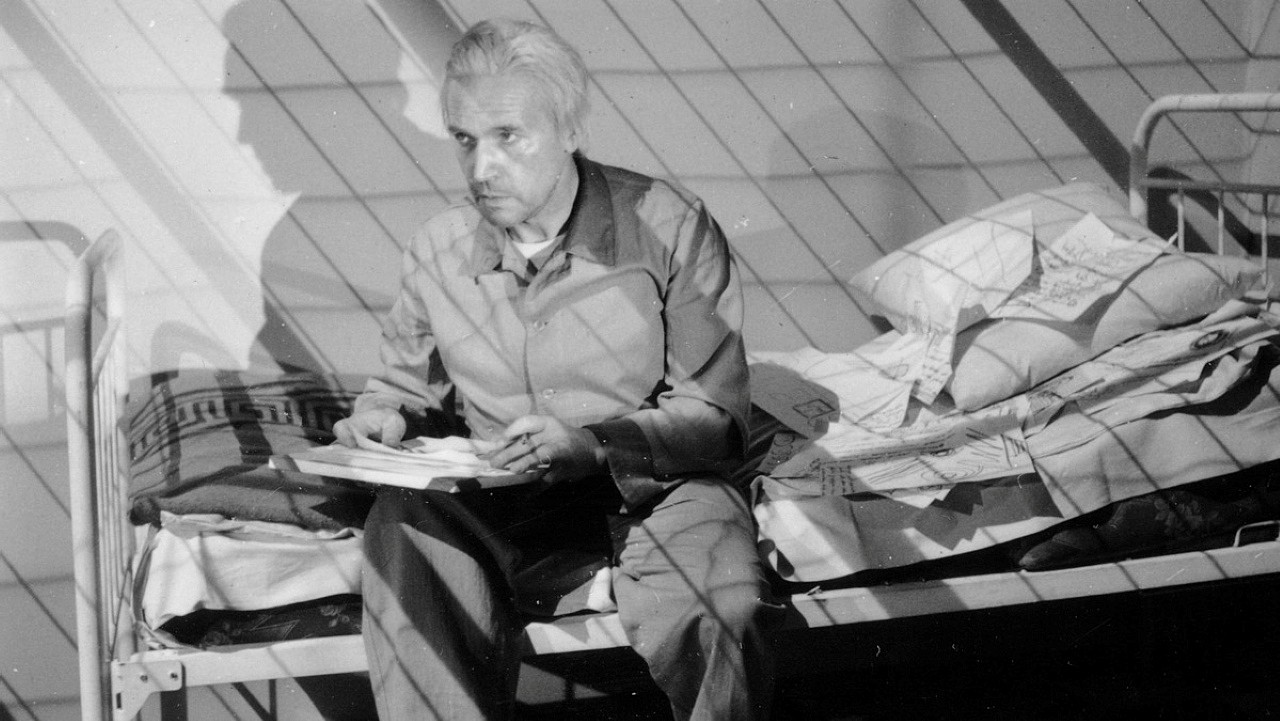
Commissioner Lohman deals with a wave of crimes – the heist of a gold bullion van, the break-in to a diamond exchange and a bank, as well as a counterfeiting operation. He is certain that the mastermind behind these is his old nemesis Dr Mabuse whom he helped bring down. However, Mabuse has been imprisoned in the asylum headed by Professor Pohland where he sits locked in his cell all day, feverishly writing plans and communicating with nobody. Lohman puzzles over how Mabuse is managing to influence the new wave of crimes and comes to believe that Mabuse is controlling the minds of others with telepathy.
Dr Mabuse is one of the great cinematic Super-Villains. Mabuse first appeared in Fritz Lang’s Dr Mabuse, The Gambler (1922), adapted from a novel by Norbert Jacques, where Mabuse (a fierce performance from Rudolf Klein-Rogge) was a psychologist who manipulated individuals with his powers of hypnotism. Lang and Klein-Rogge returned to Mabuse with the sound era sequel The Testament of Dr Mabuse (1933), but this incurred the disfavour of the Nazis and forced Lang to leave Germany. 28 years later, after a successful career making thrillers in the US, Lang returned to West Germany to make a third Mabuse film with The 1000 Eyes of Dr Mabuse (1960).
After that point, the rights to the series were inherited by the German company CCC Filmkunst who went on to make a further five Dr Mabuse films beginning with The Return of Dr Mabuse (1961). The Testament of Dr Mabuse was the second of these and would be followed by The Invisible Dr Mabuse/The Invisible Horror (1962), Dr Mabuse vs Scotland Yard (1964) and The Death Ray of Dr Mabuse/The Secret of Dr Mabuse (1964).
The Testament of Dr Mabuse is the only of the non-Fritz Lang Dr Mabuse sequels that directly ties back to his original films and is in fact a remake of the 1933 film. The remake follows the path of the original script in general terms. There is the same plot of a string of crimes being committed while Mabuse is locked in an asylum. Gert Frobe’s Inspector Lohmann investigates and puzzles over how the imprisoned Mabuse does what he does, before it is found that Mabuse is mentally influencing the asylum head to act on his behalf. There are the replication of some scenes – the message found scratched on the glass by the dead person; the young acolyte in the organisation (Helmut Schmid) and his girlfriend (Senta Berger) who are abducted and brought before the mastermind; and the climactic car chase. There are some differences – the 1933 film has Mabuse’s ghost influencing the asylum head, whereas here he uses ‘mental telepathy’ and there are scenes using a pendulum to hypnotise.
The Testament of Dr Mabuse also sits outside the continuity of the other 1960s Mabuse films. While Gert Frobe plays the same detective character he did in the previous film (but confusingly an inspector with a different name to the one that he played in 1000 Eyes), the previous two films had him believing Mabuse believed dead and long gone, whereas this has the inspector having arrested Mabuse in a prior case and Mabuse being placed in an asylum, perfectly alive.
Director Werner Klinger creates a number of fine directorial scenes. The scene with the asylum head (Walter Rilla) hypnotising Wolfgang Preiss’s Mabuse using a pendulum contains some fine atmosphere, made all the better for the scene where Mabuse turns the tables and reveals he has been controlling the doctor’s mind all along. There is a great scene where Helmut Schmid and Senta Berger are taken to the lair in the graveyard and break through the curtain to find the silhouetted leader is only a cardboard cutout and to then become caught in a maze of mirrors where even the screen breaks up and their reflections are refracted around them.
What The Testament of Dr Mabuse does well is create a sense of pulp thriller plotting with extravagant plot devices, secret doors and criminal underworlds. This is especially so in the scenes where Charles Regnier goes off to the graveyard, enters through a crypt that has bank vault door inside it to a room where he meets the mastermind of the operation who hides as a silhouette seated as a table behind a screen. A little later, one lackey tries to open the curtain only to end up being electrocuted. The gang conduct a marvellous scheme where they hijack a bullion delivery van by diverting it to a side road where they have dug a pit in the ground and covered it and then move in with guns to steal the shipment, departing and tossing the guards a coin for the bus fare home. In another scene, the disgraced detective (Leon Askin) turned spy is found and cornered in a phone booth and given a gun by Charles Regnier to shoot himself – only for him to turn it on Regnier who calmly states “but you won’t do it” and it to turn out to be a reverse gun where Askin shoots himself.
Director Werner Klinger (1903-72) had a career between the mid-1930s and late 1960s in both Wartime and post-War Germany making assorted dramas and crime thrillers. Apart from The Testament of Dr Mabuse, his only other genre work is the Edgar Wallace adaptation The Secret of the Black Trunk (1962).
Trailer here