

USA. 1989.
Crew
Director – Paul Wendkos, Teleplay – William Bleich, Based on the Novel Walkers (1980) by Gary Brandner, Photography – Bernd Heinl, Music – Gil Melle, Production Design – Penny Hadfield. Production Company – Shadowplay Films/Phoenix Entertainment Group.
Cast
Lindsay Wagner (Joanna Darby), Bruce Boxleitner (Peter Langford), Robin Thomas (Glen Eastman), Robert Prosky (Dr Walter Hovde), Merritt Butrick (Rick), Diahann Carroll (Maggie), Joanne Linville (Dr Ann Morgan), Rita Zohar (Elena), Peter Jason (Hank Jackson), Christian Hoff (Davey), Doug MacHugh (Truck Driver)
Plot
In Los Angeles, clothing designer Joanna Darby is attending a party when she trips and falls into the pool. As she drowns, she travels up a tunnel of lights into the afterlife and sees shadowy figures reaching out to her, before she is dragged out of the pool and revived. In the aftermath, she is subject to a series of terrifying incidents where people suddenly try to kill her. She finds that each of her attackers has been recorded as being dead but has gotten up afterwards to come after her. This is a recognised phenomenon and doctors refer to these risen dead as Walkers. When her fears are dismissed by her husband Glen, Joanna returns to her more sympathetic ex, anthropology professor Peter Langford, in a determination to put a stop to the curse of the Walkers.
Paul Wendkos (1925-2009) is a genre director who I have always maintained never fully received his due. His one moment of pure stylishness was the occult film The Mephisto Waltz (1971). Wendkos made several other theatrical films, little of note, except perhaps for the hit of the teen film Gidget (1965) and two of its sequels. Almost all Wendkos’s work was in television in a five-decade career beginning in the 1950s and covering episodes of many classic tv series such as The Untouchables (1959-63), Dr Kildare (1961-5), I Spy (1965-8) and The Invaders (1967-8). He has made a sizeable number of tv films, including the classic The Brotherhood of the Bell (1970) and several genre offerings including Fear No Evil (1969) about a ghostbusting duo, the deathdream fantasy Haunts of the Very Rich (1972), The Legend of Lizzie Borden (1974), the possession film Good Against Evil (1977) and a remake of The Bad Seed (1985).
From the Dead of Night was a TV Mini-Series that aired in two two-hour slots on NBC. It is adapted from the novel Walkers (1980) by Gary Brandner (1930-2013), a writer who specialised in mostly horror fiction since the 1970s up until his death. Brandner’s most famous work was The Howling (1977), which had undergone a successful film adaptation as The Howling (1981), albeit one that threw out most of the book. At the same time as The Howling film produced a string of cheap sequels, Brandner wrote two unrelated book sequels. The only other of his books to be adapted to film was Cameron’s Closet (1988), although he did write the novelisation for the remake of Cat People (1982).
Everything about From the Dead of Night is shot with a tv destination blandness. There is nothing here that stands out from a conveyor belt tv episode of the day. The lighting, the pace of the drama to the commercial breaks, even the cast all feel like they belong in a tv movie of the week. Everything takes place with an utter predictability. Moreover, the story is dragged out to a 192-minute length when you cannot help but feel that a feature film version would have tightened the plot and gone more for the dramatic throat. As it is, people with black bags under their eyes leering at Lindsay Wagner like would-be zombies is just not that scary.
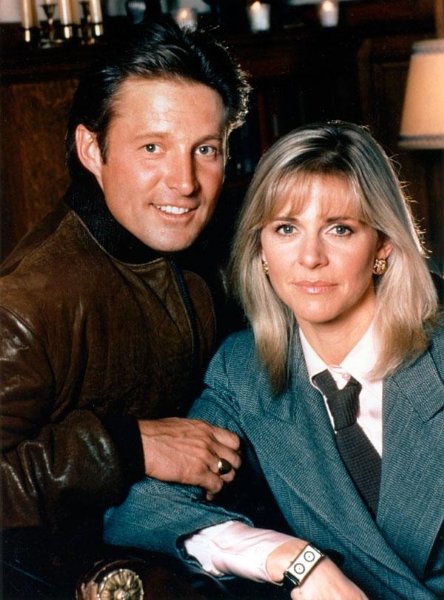
Nor is it that clear exactly what happens – Lindsay Wagner has a near-death experience and is then the recipient of something like a curse where people all around her are afflicted by an alarmingly prevalent condition where they die but then get up and come after her. It is not clear why this is happening only to her as opposed to anybody else who has near-death experiences. In many ways, From the Dead of Night is almost a work that looks forward to Final Destination (2000) and sequels, which were founded around people being killed for cheating death.
You also have a sneaking suspicion that with the number of people the Walker phenomenon occurs to throughout that knowledge of it would become more widespread than it is. As it is, everything is laughably signposted when it comes to the fate of victims – Robert Prosky’s doctor pops heart-pills, Merritt Butrick has addiction issues, and a kid (Christian Hoff) turns up riding a skateboard for the sole reason that he gets to be mowed down and then resurrected.
Paul Wendkos uses terrible cliché set-ups – the tarot reading that turns up the Death card, the setting among the Mexican Cinquo de Mayo where local masks and traditions are seen as sinister. Lindsay Wagner’s journey up into The Afterlife rather laughably comes with the image of her passing through a backlit laser-light tunnel as shadowy hands reach out of the sides of the frame towards her, an effect that became overused since. It is also a journey to the afterlife where she apparently goes off to her eternal fate wearing a glowing white pantsuit. I have been making my way through Paul Wendkos’s tv movies but there seems precious little to any of From the Dead of Night that stands up to the style of his earlier work with The Mephisto Waltz and on The Invaders.
Indeed, nothing signals made-for-tv more so than the idea of a horror film starring Lindsay Wagner. Now, I do think Wagner is a halfway reasonable actress. She came to fame as tv’s The Bionic Woman in The Six Million Dollar Man (1973-8) where the popularity of the character was such that she was brought back and then given her own show The Bionic Woman (1976-8), which she played with a breezy, natural brightness. Ever since then, Wagner’s career has been in appearing in tv movies and mini-series with weepie Disease of the Week or Lifetime Channel Christmas titles. It is a career marked by safe, easy and thoroughly unexceptional work. Outside of this, Wagner has promoted a series of alternate healing therapies.
Trailer here
Full mini-series available here