

Crew
Director/Screenplay/Visual Effects – Dick Mays, Producers – Dennis Coburn, Bruce Downs, Dr James Green, Ash Hamilton, Kirk Mays & George Wentworth, Photography – Richard Sandborn, Makeup Effects – Ondie Daniel. Production Company – Mays Brothers/Indie Rights Movies.
Cast
Ash Hamilton (Sheriff Rainy Lawson), Rudy Eisenzopf (Deputy Poole), Holly Morris (Jackey James), Adam Boyer (Dr Adams), Roxzane Mims (Detective Bev Tyler), Quinn Bozza (Deputy Chapman), Christina Leidel (Rachel), Christian Brunetti (Frankie), Carter Burch (Tommy Douglas), Will Cone (Agent Morris), Michael Colley (Wheelchair Veteran), Denise Hillis (Gladys), Chris Burns (Joey), Noah Boyer (Montel James), Andrew Crane (Backseat Girl), Caleb Burke (Frontseat Boy), Dennis Burns (Clem), Berklee Milligan (Little Girl on Trike), Richard Lanford (Redneck Husband), Wendy Sutton (Redneck Wife)
Plot
Rainy Lawson is the first female sheriff in Gibson County in North Georgia, a position that was held by her late father. Rainy comes in to investigate after a veteran in a wheelchair is run down outside a gas station following an argument with the bullying Joey. She and her department begin a search for all vehicles matching the description that are missing a hubcap. Meanwhile, the veteran’s blood has spilled on the hubcap, causing it to gain a life of its own. Rainey and her deputies are then faced with a series of deaths as the hubcap moves about town, killing those who abuse others.
Hubcap was the first feature film for director/writer Dick Mays, who had previously made a handful of short films. Mays had also directed one other horror film with Nat-ter-n back in 2017, but this does not appear to have a release as of this writing.
Any film about a killer hubcap bears immediate comparison to Quentin Dupieux’s side-splitting Rubber (2010) about a killer car tire. I made the immediate assumption that Hubcap would be something akin to Rubber – a parody of a monster movie as the hubcap went around town killing people. This is something that the film’s pitch – “In a conservative mountain town, Rainy Lawson, Georgia’s first female sheriff, investigates a supernatural killer rumoured to be a hubcap, while juggling romantic prospects, her traumatic past and a cunning foe who stirs racial tensions” – leads you to expect.
However, Hubcap never quite turns out to be that sort of film at all. All the complications of Rainy Lawson’s life are there but the killer hubcap turns out to be more of a supernatural avenger who stands up to kill crude and crass men in particular, as opposed to a typical movie monster that goes for random victims. Surprisingly, the killer hubcap fails to even place the film in a Horror Comedy vein.
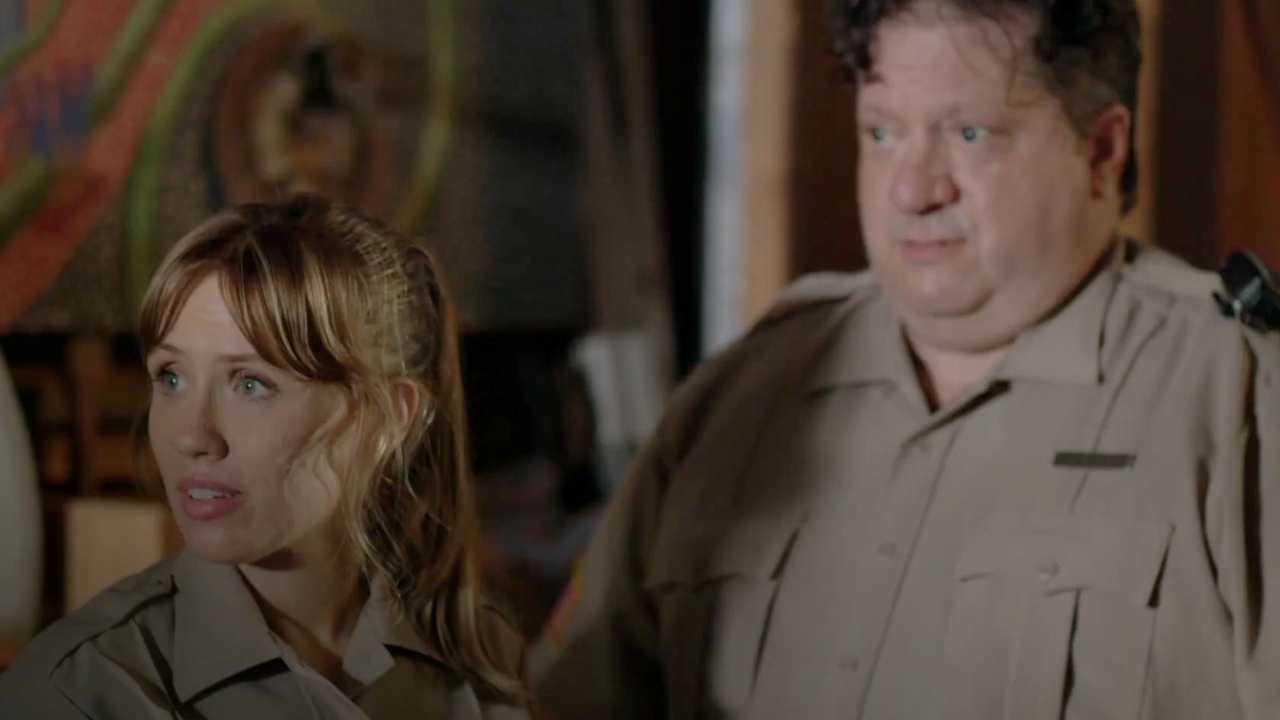
What Hubcap does fairly well is its crosscut of a smalltown – in actuality, Auburn, Georgia, which is about forty miles northeast of Atlanta. Dick Mays is not afraid to get political but he does so in interesting ways. His is a portrait of a small town post the Trumpian divide – a traditional conservative community trying to cling to its identity in the face of encroaching liberalism, such as the hire of the first woman sheriff, the first African-American on the force and gentle hints for people to hold back on ethnic slurs. What I did like about this is that while the film’s point-of-view character Rainy places her feet on one side and is a declared Democrat, the politics are not an ardent Us vs Them, it is more a portrait of a group of different people all trying to get on together for the most part. All involved give reasonable performances.
My criticism of Hubcap would be that Dick Mays creates a sufficiently absorbing depiction of the small town and the assorted characters that the actual hubcap often gets pushed to the backburner. It is not a particularly strong threat. Moreover, as it develops a sense of justice in its choice of victims, it comes to seem more like a sympathetic avenger than a monster. As a result, there is little of the dramatic struggle to stop it that you might get in a regular monster movie. In addition, the hubcap ends up being removed from the action around three-quarters of the way through. It is brought out again in the very final scene. However, the rest of the film’s denouement comes down to being about the far more mundane drama of the story’s smalltown divides, politics and crimes from the past.
Trailer here