

Crew
Director – Rob Reiner, Screenplay – William Goldman, Based on the Novel Misery (1987) by Stephen King, Producers – Rob Reiner & Andrew Scheinman, Photography – Barry Sonnenfeld, Music – Marc Shaiman, Special Effects Supervisor – Phil Cory, Makeup Effects – K.N.B. EFX Group, Production Design – Norman Garwood. Production Company – Castle Rock Entertainment/Nelson Entertainment.
Cast
James Caan (Paul Sheldon), Kathy Bates (Annie Wilkes), Richard Farnsworth (Buster), Frances Sternhagen (Virginia), Lauren Bacall (Marcia Sindell)
Plot
At the Silver Creek Lodge in Colorado, Paul Sheldon, author of the best-selling Misery Chastain historical romances, completes the draft of his latest novel. He sets off to deliver the manuscript to his agent only for his car to be caught in a snowstorm and crash off the road. He comes around at the farmhouse of Annie Wilkes, who has rescued him. She is a nurse and reader of the Misery books where she claims to be Paul’s Number One Fan. Bedridden with two broken legs, Paul is unable to be taken out to hospital because the road and phone lines are out with the snowstorm. Forced to stay there, Paul becomes increasingly disturbed by Annie’s wild mood swings. When she reads the manuscript of his new book and finds he has killed off her beloved character of Misery, Annie flies into a psychotic rage. She burns the manuscript and then demands that Paul write a new book, smashing his legs to prevent him from escaping.
The film version of Misery was taken on by Rob Reiner. Rob Reiner is the son of famous comic and sometimes director Carl Reiner. Rob first came to notice as an actor – his most notable part was as Archie Bunker’s son Meathead in tv’s All in the Family (1971-8). Rob made his directorial debut with the hilarious rock spoof This is Spinal Tap (1984) and followed that with the standout teen film The Sure Thing (1985) and the superb childhood nostalgia film Stand By Me (1986), based on a Stephen King novella. This solidified Reiner’s career as a director and he went on to The Princess Bride (1987) based on the novel by William Goldman (who writes the script for Misery), which has become an enormous fan favourite. Since then, up until his murder in 2025, Reiner directed popular works such as When Harry Met Sally (1989), A Few Good Men (1992) and The American President (1996), among others, as well as one further genre entry with the fantasy film North (1994). Reiner’s production company Castle Rock Entertainment, taken from a town in King’s books, is a regular producer of material – see below for their other films.
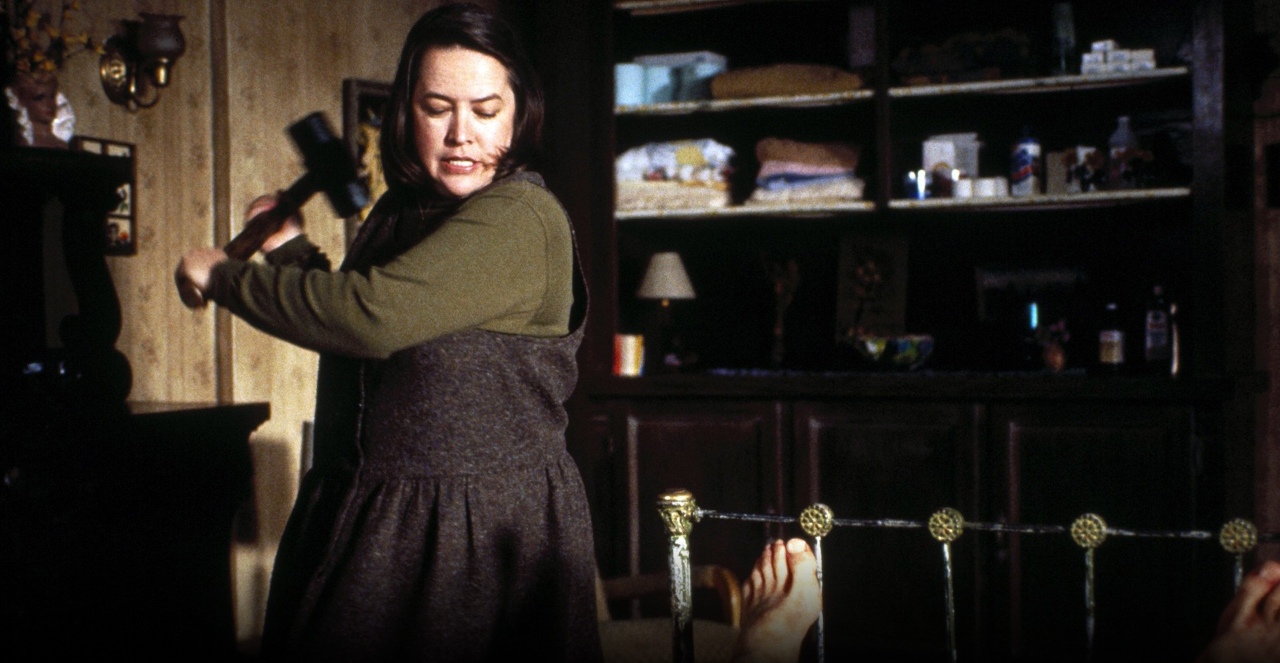
Rob Reiner previously adapted Stephen King material with Stand By Me, which still stands up as the finest of all King adaptations after nearly forty years. With Reiner’s return to King material with Misery, the oft-abused filmic workings of Stephen King seem to be in good hands. Employed to ensure such is Oscar-winning screenwriter William Goldman (see below for Goldman’s other genre credits). And the care pays off – both Goldman and Reiner pay attention to the process of telling the story. There are changes made over the novel but to the film’s betterment. Most notedly Annie’s torture of Paul is less extreme – in the book, she cuts off his foot with an axe, whereas here she smashes it with a sledgehammer, and the book also has her cut off his thumb, while slight changes are made to the two death scenes that occur near the end, but that is about it.
Misery is the essence of an Imprisonment Thriller. This is the name I have given to a genre of films that emerged in the 1960s with works such as The Collector (1965) and The Fanatic/Die, Die, My Darling (1965). There has grown into quite a reasonable body of thrillers since based around one person abducted and kept prisoner by another where the various films ride the suspense up and down the often slim hopes of their escape and then seeing them thwarted. In this regard, Misery is essentially a two-person play – and indeed, the book was later adapted into a play upon several occasions (see below).
When Rob Reiner gets into the film, he winds the suspense right up. The scenes where James Caan heads out in a wheelchair to explore the house and his desperate scramble to return to his room as Kathy Bates comes back maintains the audience on a fine seat-edge. The imprisonment scenes are interspersed with a well-built B plot as local law enforcement Richard Farnsworth pieces the clues surrounding the disappearance together.
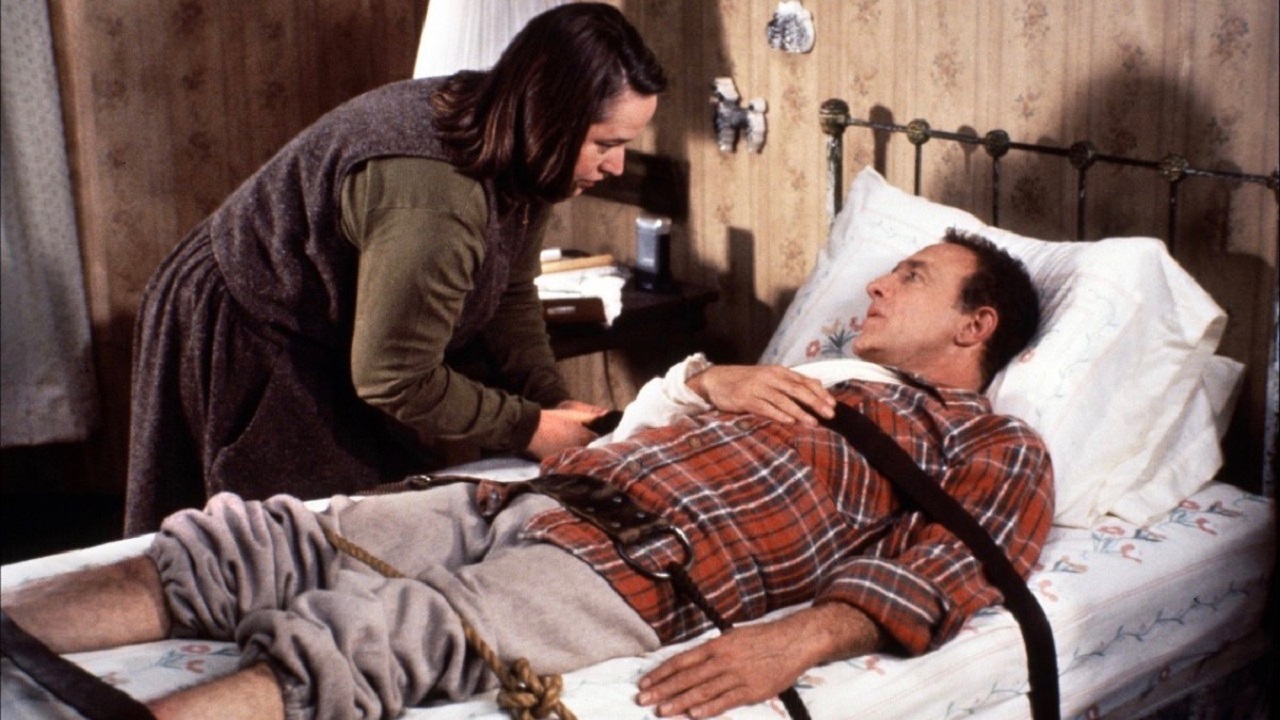
And the shock effects don’t go unwarranted too – the appearance of Kathy Bates in the middle of the night to drug James Caan and the production of the sledgehammer for the hobbling scene are strong stuff. Maybe the ending loses it a little, seemingly unable to avoid one of the just-when-you-thought-they-were-dead climaxes that had been wrought to death in the slasher film during the 1980s, or for that matter a coda of a daydream jump with Kathy Bates turning up in a restaurant.
James Caan with his mug that looks like it has been used as a boxer’s punching bag – and that was before KNB EFX got to work with the makeup cuts and bruises – hardly seems the typical writer, least of all a romance writer. Historical romance works, not dissimilar to what the Misery books are shown as being, have become best-sellers since Misery came out – see writers like Diana Galbadon, Sarah MacLean, Julia Quinn – but for the fact that all the writers in the field are women. (Do a Google on ‘historical romance writers’ and there is not a single male name that comes up). It is not exactly a demanding role and at least one can say that Caan performs all that is demanded of him.
However, it is Kathy Bates, who won the Best Actress Academy Award for the role, who does exceptionally well with the character of Annie Wilkes. She and William Goldman get right to the psychology of the character and it’s creepy to watch the way she leaps right out of the screen at the audience and then retreats back into Midwestern homilies – “heavens to Betsy”, “Mister Man” and the like – peppered with alarming racism – “What’s the ceiling that that dago painted?”. The scaling up and down of her personality swings is great acting to watch.
There has been no remake of Misery so far, although a character called Annie Wilkes appears in the second season of the King-based tv series Castle Rock (2018-9) played by Lizzie Caplan, although is a very different character to the one here. There have been two stage play adaptations of Misery – a British production in 1992 with Sharon Gless as Annie and Bill Paterson as Paul, and a US version in 2015 with script from William Goldman starring Bruce Willis as Paul and Laurie Metcalf as Annie.
Rob Reiner’s other genre films are the fantasy film The Princess Bride (1987) and the absurdist children’s fable North (1994). Reiner’s production company Castle Rock (itself named after a town in Stephen King’s novels) has become a major Hollywood production company and has produced several King adaptations including Needful Things (1993), The Shawshank Redemption (1994), Dolores Claiborne (1995), The Green Mile (1999), Hearts in Atlantis (2001) and Dreamcatcher (2003), and other genre efforts such as the remake of Lord of the Flies (1990), the cryogenic sleeper film Late for Dinner (1991), the time travel comedy The Spirit of 76 (1991) from Rob Reiner’s son, Mel Brooks’ spoof Dracula: Dead and Loving It (1995), Kenneth Branagh’s Hamlet (1996), Lost Souls (2000), Eddie Murphy’s sf flop The Adventures of Pluto Nash (2002), the Sandra Bullock psycho-thriller Murder By Numbers (2002) and The Polar Express (2004).
William Goldman (1931-2018) was an award-winning author and novelist, having written the screenplays for high-profile work such as Butch Cassidy and the Sundance Kid (1969), All the President’s Men (1976) and Marathon Man (1976), among others. Goldman also wrote a surprising number of other genre films, including the adaptation of Ira Levin’s The Stepford Wives (1975), Magic (1978) about a malevolent ventriloquist’s dummy (also from his own novel), Rob Reiner’s The Princess Bride from his own novel, John Carpenter’s Memoirs of an Invisible Man (1992), and two further Stephen King adaptations for Castle Rock with Hearts in Atlantis (2001) and Dreamcatcher (2003). The serial killer comedy No Way to Treat a Lady (1968) was also adapted from William Goldman’s book.
Other Stephen King genre adaptations include:- Carrie (1976), Salem’s Lot (1979), The Shining (1980), Christine (1983), Cujo (1983), The Dead Zone (1983), Children of the Corn (1984), Firestarter (1984), Cat’s Eye (1985), Silver Bullet (1985), The Running Man (1987), Pet Sematary (1989), Graveyard Shift (1990), It (tv mini-series, 1990), a segment of Tales from the Darkside: The Movie (1990), Sometimes They Come Back (1991), The Lawnmower Man (1992), The Dark Half (1993), Needful Things (1993), The Tommyknockers (tv mini-series, 1993), The Stand (tv mini-series, 1994), The Langoliers (tv mini-series, 1995), The Mangler (1995), Thinner (1996), The Night Flier (1997), Quicksilver Highway (1997), The Shining (tv mini-series, 1997), Trucks (1997), Apt Pupil (1998), The Green Mile (1999), The Dead Zone (tv series, 2001-2), Hearts in Atlantis (2001), Carrie (tv mini-series, 2002), Dreamcatcher (2003), Riding the Bullet (2004), ‘Salem’s Lot (tv mini-series, 2004), Secret Window (2004), Desperation (tv mini-series, 2006), Nightmares & Dreamscapes: From the Stories of Stephen King (tv mini-series, 2006), 1408 (2007), The Mist (2007), Children of the Corn (2009), Everything’s Eventual (2009), the tv series Haven (2010-5), Bag of Bones (tv mini-series, 2011), Firestarter (2022),Carrie (2013), Under the Dome (tv series, 2013-5), Big Driver (2014), A Good Marriage (2014), Mercy (2014), Cell (2016), 11.22.63 (tv mini-series, 2016), The Dark Tower (2017), Gerald’s Game (2017), It (2017), The Mist (tv series, 2017), Mr. Mercedes (tv series, 2017-9), 1922 (2017), Castle Rock (tv series, 2018-9), Doctor Sleep (2019), In the Tall Grass (2019), Pet Sematary (2019), The Outsider (tv series, 2020), The Stand (tv mini-series, 2020-1), Chapelwaite (tv series, 2021), Lisey’s Story (tv mini-series, 2021), Mr Harrigan’s Phone (2022), The Boogeyman (2023), The Life of Chuck (2024), Salem’s Lot (2024), the tv series The Institute (2025- ), The Long Walk (2025), The Monkey (2025) and The Running Man (2025). Stephen King had also written a number of original screen works with Creepshow (1982), Golden Years (tv mini-series, 1991), Sleepwalkers (1992), Storm of the Century (tv mini-series, 1999), Rose Red (tv mini-series, 2002) and the tv series Kingdom Hospital (2004), as well as adapted his own works with the screenplays for Cat’s Eye, Silver Bullet, The Stand, The Shining, Desperation, Children of the Corn 2009, A Good Marriage, Cell and Lisey’s Story. King also directed one film with Maximum Overdrive (1986). Stephen King on Screen (2022) is a documentary about King film adaptations.
Trailer here