

USA/France/Italy/Germany. 1990.
Crew
Director – Tony Richardson, Teleplay – Arthur Kopit, Based on the Novel The Phantom of the Opera (1909) by Gaston Leroux, Producer – Ross Milloy, Photography – Steve Yaconelli, Music – John Addison, Production Design – Timian Al Saker & Jacques Bufnoir. Production Company – Hexatel/Saban-Sherick/Starcom/TF1/Reteitalia/Beta-Film/ORF/BR.
Cast
Charles Dance (The Phantom/Erik), Teri Polo (Christine Daae), Burt Lancaster (Gerard Carriere), Ian Richardson (Alain Cholet), Andrea Ferreol (Carlotta Cholet), Adam Storke (Count Philippe de Chagny), Jean-Pierre Cassel (Inspector Ledoux), Jean Rougerie (Jean-Claude)
Plot
The peasant girl Christine Daae arrives in Paris, having been sent to audition with Gerard Carriere, director of the Paris Opera, by Count Philippe de Chagny. However, Carriere has just been fired by the new owner Alain Cholet who seeks to use the opera to promote his wife, the awful diva Carlotta. Christine is forced to take a job in wardrobe. With nowhere to stay, the kind-hearted concierge Jean-Claude lets her in to stay in the basement area. There Christine’s singing attracts the attention of the masked Phantom who comes and offers to tutor her. Cholet dismisses rumours of The Phantom that is reputed to haunt the opera, only for The Phantom to arrange a series of accidents to embarrass Carlotta. The Phantom pushes Christine to sing and she is taken on as the lead in the new opera. However, Carlotta’s attempts to sabotage Christine and Philippe’s romantic rivalry causes The Phantom to become enraged. He responds by abducting Christine down into his lair in the catacombs.
The Phantom of the Opera (1909) was originally a novel by Gaston Leroux and has been filmed numerous times. The classic film version was The Phantom of the Opera (1925) with Lon Chaney [Sr], which still remains the best version of the story a century later. There have been a number of other versions up to this point with the Universal colour remake Phantom of the Opera (1943) with Claude Rains; The Phantom of the Opera (1962), the Hammer version with Michael Gough; and the tv mini-series Phantom of the Opera (1983). (A full list of all other film versions is at the bottom of the page). Just before this version was made, the Andrew Lloyd Webber musical had premiered in 1986 and enjoyed a phenomenally long run on Broadway and other places. It gave a massive new injection of popularity to The Phantom, turning it from a horror story into a weepie musical and making The Phantom a tragic romantic figure.
This tv mini-series, which aired in two two-hour slots, is one of several productions that came out around the time of the Lloyd Webber musical. The success of the musical gave us several variations on The Phantom around the end of the 1980s with The Phantom of the Opera (1989), a slasher version starring Robert Englund, and this mini-series, plus other modernised variants such as The Phantom of the Ritz (1988) and Phantom of the Mall: Eric’s Revenge (1989)
Tony Richardson had emerged out of directing British tv plays in the 1960s to make classic films among the so-called British New Wave with the likes of Look Back in Anger (1959), The Entertainer (1960) and A Taste of Honey (1961), which won multiple Bafta Awards, before Richardson won a Best Director Oscar for Tom Jones (1963). He went on to a number of other works including The Charge of the Light Brigade (1968), Ned Kelly (1970) and The Hotel New Hampshire (1984). The Phantom of the Opera was Richardson’s second-to-last work before he passed away in 1991 and the only genre work he ever made. It was shot on locations at the real Paris Opera House.

The problem with this version of The Phantom of the Opera is that the shadow of the Andrew Lloyd Webber musical hangs over and dominates everything in it. What we end up with is a version of The Phantom that is construed as a romantic figure and where all horror has been bled out of the story. Some of the classic Phantom does belatedly come in towards the end with The Phantom killing off his pursuers, but this is nothing on the Gothic beauty of the 1925 version.
One plus is that the greater running time of the mini-series allows more time in the telling of the familiar story, meaning that minor aspects and supporting characters such as Carlotta and Raoul de Chagny get much more life and time devoted to them. The film also builds out a backstory for Christine and de Chagny as peasant girl and heir to the manor that does not exist in Gaston Leroux. One aspect oddly missing is an unmasking scene for The Phantom. This occurs but Charles Dance keeps his back turned towards the camera and we never get to see his visage, a scene that has been a great moment of horror in other versions.
One of the biggest mistakes the mini-series makes is the character of The Phantom. Rather than any build-up as a mysterious, shadowy figure, he is introduced here within the first ten minutes. He is even seen conversing with Burt Lancaster in normal conversational tones and lines like “Where’s your sense of humour?” Moreover, the role is played by Charles Dance with posh boarding school British accent, making The Phantom not a monster hiding in the dark scared of his appearance but a decent mannered English gentleman who just happens to wear a mask over his tuxedo and cape. His dialogue is far too normal and not tortured enough. If there seems anything designed to rob the character of their mystery, I would be hard-pressed to think what it would be.
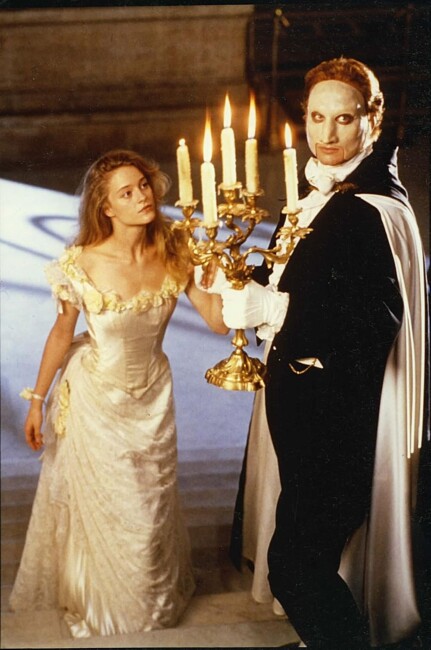
Another big minus is the great British actor Ian Richardson reduced to playing a puffed-up pompous fool with what I took to be a comic Italian accent (even though the character has a French name). Far better is Andrea Ferreol as his wife Carlotta who plays to the hilt in a full-blown performance. At least, Teri Polo is the absolute soul of pure hearted innocence in the role of Christine.
Certainly, this is one of the most lushly produced of all versions of The Phantom of the Opera. The production makes exceptional pictographic use of the staircase, the proscenium and backstage at the opera house, even the exteriors with gargoyles looking down. The best sections of the show are the ones where The Phantom takes Christine down to his lair, replete with its own lake across which he rows a gondola, and filled with old discarded props from the opera and a forest with stuffed animals amid which they picnic. (The latter scenes are slightly undone by the cramped sets where the gondola seems in danger of bumping into the banks of the river which seem only a few feet wide, barely enough for the boat to turn around).
Other versions of the story are:– The Phantom of the Opera (1925), starring Lon Chaney; Phantom of the Opera (1943) starring Claude Rains; The Phantom of the Opera (1962), the Hammer version starring Herbert Lom; Phantom of the Opera (1983), a tv movie starring Maximillian Schell; The Phantom of the Opera (1989), a slasher film starring Robert Englund; The Phantom of the Opera (1990), a tv mini-series starring Charles Dance; Dario Argento’s The Phantom of the Opera (1998) starring Julian Sands; and The Phantom of the Opera (2004), the adaptation of the Andrew Lloyd Webber musical starring Gerard Butler. Love Never Dies (2012) was a filmed version of a performance of Andrew Lloyd Webber’s sequel set ten years later. Other variations on the story are The Phantom of the Paradise (1974), a satirical version that sets the story to rock music; a pornographic version Phantom (1998); Angel of Music (2008) about a modern reporter conducting an investigation into the truth of the story; Phantom of the Theatre (2016), a Chinese version that conducts some radically different takes on the story; and modernisations like The Phantom of Hollywood (tv movie, 1974), The Phantom of the Ritz (1988), Phantom of the Mall: Eric’s Revenge (1989) and a Disney Channel children’s tv movie The Phantom of the Megaplex (2000), which had the Phantom haunting respectively a movie studio, a movie theatre, a mall and a cinema multiplex, as well as the low-budget The Phantom of the Opera (2014) where the Phantom’s spirit is disturbed by a reality tv crew; and the story even being given an uncredited relocation to another planet in the Doctor Who episode The Caves of Androzani (1984).
Part 1 available here
Part 2 here