

Crew
Director/Story – Umberto Lenzi, Screenplay – Roberto Gianvitti & Umberto Lenzi, Photography – Angelo Lotti, Music – Riz Ortolani, Set Designer – Giacomo Calo Carducci. Production Company – Floria Fim/National Cinematografica/Rialto Film.
Cast
Antonio Sabato (Mario Gerosa), Uschi Glass (Giulia Torresi), Pier Paolo Capponi (Inspector Vismara), Franco Fantasia (Lieutenant Renzi), Marisa Mell (Anna Sartori/Maria Sartori), Rosella Falk (Elena Marchi), Petra Schürmann (Concetta De Rossi), Bruno Corazzari (Barrett), Renato Romano (The Priest), Marina Malfatti (Katy Adams), Aldo Barberiti (Lieutenant Palumbo), Nello Pazzafini (Giovanni Rau), Claudio Gora (Raffaele Ferri), Gabriella Giorgelli (Inez/La Toscana), Enzo Andronico (Hotel Manager), Linda Sini (Wanda)
Plot
Mario Gerosa boards the Rome-Paris Express with his fiancée Giulia Torresi. As Mario steps out of the carriage for a moment, a figure all in black comes in and stabs Giulia, However, the killer is driven away when a conductor comes and she just avoids becoming what would have been their second victim. The police decide to announce that Giulia was murdered but keep her in hiding. Unhappy with the police handling of the search, Mario and Giulia decide to investigate on their own. The killer is nicknamed The Half Moon Killer for their leaving a silver half-moon pendant with each of the victims. Giulia recognises the pendant as belonging to an American who was a guest at the hotel in Vino Betello where she worked at in 1969 before she knew Mario. They realise that each of the women that the killer is targeting are staff and guests who were at the hotel over a period of a few weeks in 1969. They set out in a race to save the women before the killer eliminates them.
The Italian giallo film emerged in the 1960s and its films have gained a cult following. The essence of the giallo genre was formulated, although not created, by Mario Bava with Blood and Black Lace (1964), which created most of the style that would be associated with the genre – of extravagantly colourful lighting schemes; murders with a psycho-sexual focus; and ornate directorial set-ups. Bava made several entries, but the genre’s most famous purveyor would be Dario Argento. (For a more detailed listing see Giallo Films).
Seven Blood-Stained Orchids comes from Umberto Lenzi who worked regularly in the giallo and Italian zombie film, along with other exploitation genres of the day. Lenzi is most famous for having kicked off the notorious Italian cannibal film with Deep River Savages/Man From Deep River (1972), creating a series of films that went to absolute extremes and were banned in most countries. (See below for Umberto Lenzi’s other films).
By the point that Seven Blood-Stained Orchids was made, the giallo film has been well established and was a popular genre niche thanks to assorted international hits from Bava and Argento. By now, the image of the killer in black, including fedora and black leather gloves, and point-of-view shots of them stalking victims had become a cliché. So too is the modish backdrop of art and fashion – Lenzi at one point visits a modernist gallery opening and then follows artist Marina Malfatti back to her apartment where we get stylish shots like spilled cans of paint dropping down off a shelf and the paint blending across her nude murdered body as it lies on the floor.
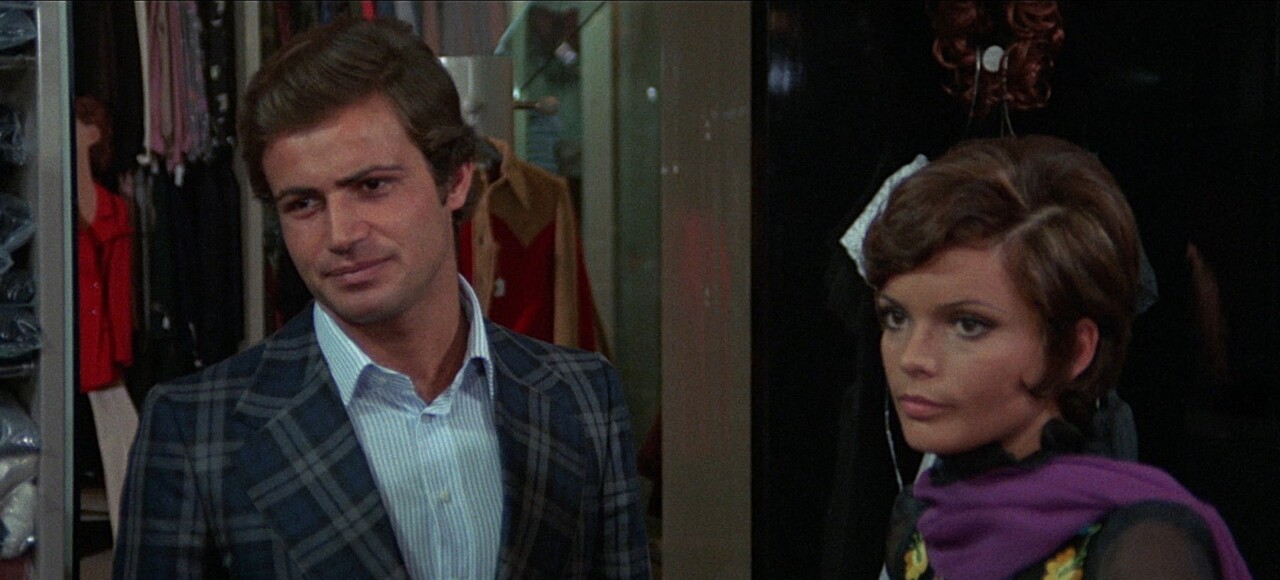
There’s the usual sado-sexual undertow and Seven Blood-Stained Orchids gets most of the women present topless at various points throughout. There is a better thriller plot than most of these giallo films have with the story set around an investigation as Antonio Sabato and Uschi Glass try to deduce the connections and prevent the deaths of the other women. The film even visits an open-air counter-culture group of the day and a hippie party. The eventual revelation of the killer is the same as in Don’t Torture a Duckling (1972), which came out the same year.
Lead actor Antonio Sabato [Sr] appeared in quite a number of Italian exploitation films of the day, including other giallo and crime films. These days his son Antonio Sabato Jr is better known as a male model and actor – the similarity of looks between the two is striking. The bewitchingly beautiful Uschi Glass/Glas was a West German actress brought into the film due to a co-production deal with Germany.
Umberto Lenzi (1931-2017) had a prolific career making low budget films between the 1950s and 90s, working in numerous Italian exploitation genres. His other genre films include:- the superhero film Kriminal (1966); the spy film The Spy Who Loved Flowers (1966); the giallo Orgasmo/Paranoia (1969); the giallo So Beautiful, So Perverse (1969); the giallo An Ideal Place to Kill/Oasis of Fear (1971); the cannibal film Deep River Savages/Man From Deep River (1972); the devil worship film Knife of Ice (1972); the psycho film Almost Human/The Executioner (1974); the giallo Spasmo (1974) and Eyeball (1975); the cannibal film Eaten Alive/The Emerald Jungle (1980); the zombie film Nightmare City (1980); the cannibal film Cannibal Ferox/Make Them Die Slowly (1981); the sword-and-sorcery film Iron Master (1986); the haunted house film Ghosthouse (1988); the occult film Hell’s Gate (1989); the psycho film Hitcher in the Dark (1989); the slasher film Nightmare Beach (1989); and the occult film Demons 3/Black Demons (1991).
Trailer here