
Crew
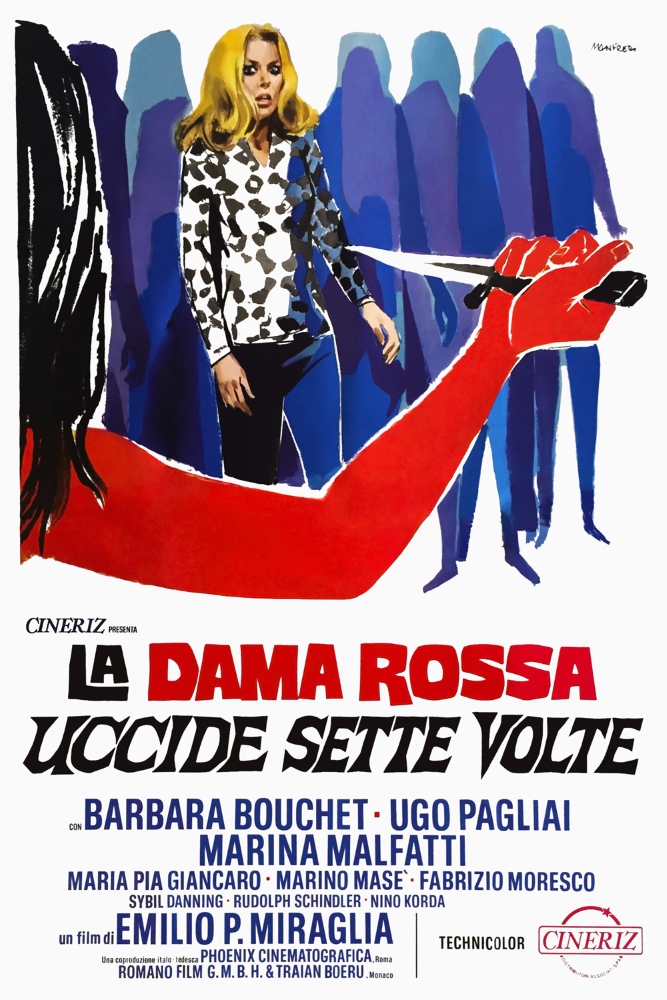
Director – Emilio P. Miraglia, Screenplay – Emilio P. Miraglia & Fabio Pittoru, From an Idea by Fabio Pittoru, Photography – Alberto Spagnoli, Music – Bruno Nicolai, Art Direction – Lorenzo Baraldi. Production Company – Phoenix Cinematografica/Romano Film GmbH/Traian Boeru.
Cast
Barbara Bouchet (Kitty Wildenbruck), Ugo Pagliai (Martin Hoffmann), Marina Malfatti (Franziska Wildenbruck), Marino Mase (Inspector Toller), Rudolf Schindler (Tobias Wildenbruck), Maria Pia Giancaro (Rosemary Muller), Sybil Danning (Lulu Palm), Fabrizio Moresco (Peter), Nino Korda (Herbert Zieler), Bruno Bertocci (Hans Meyer)
Plot
Sisters Kitty and Eveline Wildenbruck grow up at the family castle in Neustein, Germany. Their grandfather Tobias tells them the legend of their ancestors, rival sisters the Black Queen and the Red Queen. The Black Queen murdered her sister only for The Red Queen to return and seek retribution against the Wildenbruck family every hundred years thereafter. The next occasion will be in twelve years’ time in 1972. As 1972 comes, Tobias passes away. The children, all except Eveline who is away in America, are gathered for the reading of the will. In the will, Tobias says he will delay release of the inheritance for one year until the passing of the curse. The figure of a woman dressed in a scarlet cloak then appears and begins to kill people around the fashion magazine where Kitty works. Descriptions of the killer say that it resembles Eveline, but Kitty and her sister Franziska know the truth – that Eveline is dead and they have hidden the body.
The Italian Giallo film emerged in the 1960s and its films have gained a cult following. The essence of the giallo genre was formulated by Mario Bava’s The Evil Eye (1962) and in particular Blood and Black Lace (1964), which built on the Psycho-Thriller that has been brought into prominence by the success of Psycho (1960). Bava originated most of the style that would be associated with the genre – the extravagantly colourful lighting and set dressing schemes; murders with a sado-sexual focus; and ornate directorial set-ups.
The Red Queen Kills Seven Times was one of six films directed by Emilio P. Miraglia (1924-82), who had elsewhere made Italian crime films and Westerns. Miraglia’s one other venture into genre cinema was also a giallo film The Night Evelyn Came Out of the Grave (1971).
The Red Queen Kills Seven Times stirs the basic tropes of giallo cinema – the murders of various women; the masked figure – here in red cloak and black gloves; the fashion house setting. For me, the biggest confusion wasn’t so much the plot, which is far less random than most other giallo films tend to be. The biggest problem is that the film has about four, quite possibly five, identical looking blondes running around and it proves extremely difficult working out which character is which at any point in time.
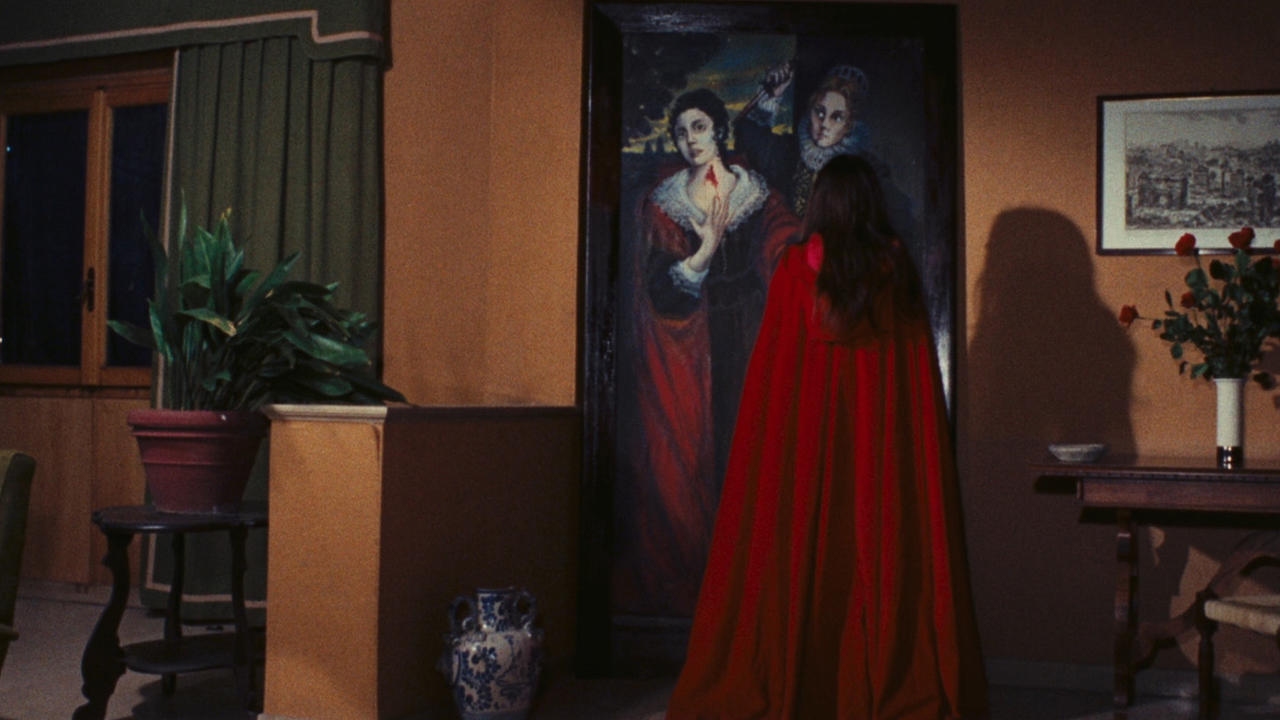
This doesn’t stand out as a particularly great example of giallo cinema. The plot sets up the idea of a family curse but the playing out of it is standard giallo, arriving at an unexceptional denouement and mundane revelation of the killer’s identity. The pace is slow and there is nothing much to any of the set-pieces – Emilio P. Miraglia lacks the extravagance that Bava and Dario Argento gave the genre. The one scene that does stand out is where the drug addict Fabrizio Moresco is killed as he gets his coat caught in the door of Red Queen’s Volkswagen Bug as she drives off, scraping his body along the side of the curb.
The Red Queen Kills Seven Times was made as a West German co-production with many of the exterior scenes being shot in Germany. The German locations lead to a particular impressive castle and its ground that appear in the opening scenes (in reality, the Weikersheim Castle in Baden-Wuerttemberg). There are also several German cast members, including later-to-be cult queen Sybil Danning, who can be seen topless but without the set of massive breast implants she added a few years later.
Trailer here