

Crew
Director/Story/Visual Effects Supervisor – Hasraf ‘HaZ’ Dulull, Screenplay – Gary Hall, Additional Dialogue – Austen Atkinson, Producers – James T. Ryan & Anis Shlewet, Photography – Adam Sculthorp, Music – Michael Stevens, Visual Effects – Filmore (Supervisor – Hans Van Helden), HaZ VFX, Squint VFX & Territory Studio (Supervisor – Paddy Eason), Production Design – Jon Bunker. Production Company – Origin Unknown Films.
Cast
Katee Sackhoff (Mackenzie ‘Mack’ Wilson), Steven Cree (Voice of Arti), Ray Fearon (Sterling Brooks), Julie Cox (Lena Wilson)
Plot
In the year 2030, the first manned Mars mission Mars One crashes as it attempts to land. In the aftermath, all international funding for space exploration is cut back to no more than skeleton staff. Mackenzie ‘Mack’ Wilson has been appointed supervisor at the United Interplanetary Corporation. She is not happy that Mars exploration is now being conducted by unmanned probe. These are controlled by the A.I. Arti where a technological breakthrough that has been achieved by Arti now allows instantaneous faster-than-light communication with the probe. As the newest Mars probe lands, they are startled when it sends back pictures of a giant cube on the surface of Mars. In trying to determine the nature of the cube, they are even further bewildered when it teleports to Antarctica.
The British-born Hasraf ‘HaZ’ Dulull has worked in visual effects since the mid-2000s with credits on films like The Chronicles of Narnia: Prince Caspian (2008), The Dark Knight (2008), Hellboy II: The Golden Army (2008), 10,000 B.C. (2008) and Prince of Persia: The Sands of Time (2010), graduating to a visual effects supervisor/producer on Storage 24 (2012), The Bible (2013) and the tv series The Aliens (2016), among others. Dulull made his directorial debut with the SF film The Beyond (2017), followed by 2036 and he subsequently went on to make Max Beyond (2024).
2036 Origin Unknown has an epic promise – an expedition to Mars that uncovers an alien artefact. This places it into the same territory as 2001: A Space Odyssey (1968), or perhaps more closely to Mission to Mars (2000), which I will argue is a better film than most people give it. The great disappointment of 2036 is that all its promise of being a space movie telescopes down to being no more than a film about Katee Sackhoff in a room arguing with an A.I.. There are only a couple of other people present in the film – one on a screen, the other who appears in person later in the show.
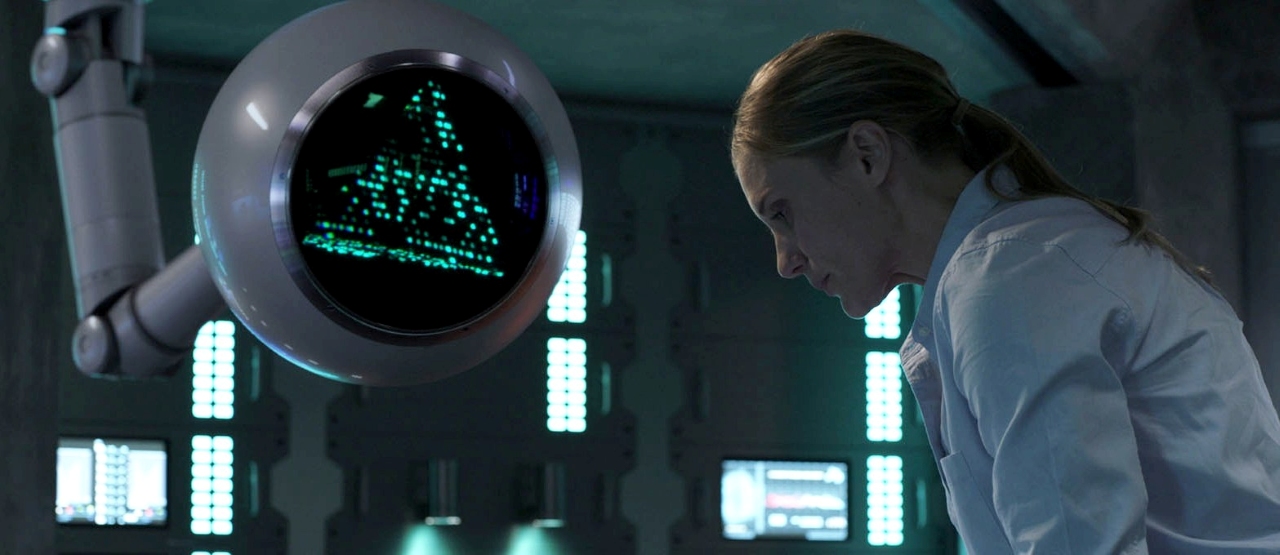
Katee Sackhoff is an actress with a long genre association ever since her breakout role on tv’s Battlestar Galactica (2003-9). She has a lot of natural humour and energy but even she seems to be straining dealing with a static film set in one room where everything that happens takes place either on a screen or via the disembodied voice emanating from an orb-shaped computer screen. Only at the very start and the end does the film venture out beyond taking place in a single room. And dramatically that kills a lot of possibilities that the film has – it is a stretch to even really call it a space film anymore. The Alien Artefact (?) emerges as an okay mystery but there is not quite enough mystique built about it in the same way that 2001 or other such works do due to the fact we only see partial glimpses via grainy video transmissions.
Certainly, when Dulull gets to do what he specialises in – visual effects – the level of these that is far above those of the average film of 2036’s ilk. The film also reaches an ending that left me somewhat confused where [PLOT SPOILER] it appears (?) that there is no alien artefact after all. It comes as a major letdown on a building mystery.
Trailer here
Full film available here