


Crew
Directors – Mahiro Maeda, Katsuichi Nakayama & Kazuya Tsurumaki, Chief Director/Screenplay – Hideaki Anno, Photography – Toru Fukushi, Music – Shiro Sagisu, Production Design – Hiroshi Kato & Tatsuya Kushida. Production Company – Studio Khara/Toho.
Plot
Following the Third Impact, Shinji, Asuka and a cloned version of Rei settle in a community in the ruins of Tokyo where survivors are slowly piecing things together. The community leads a precarious life where the threat beyond is held at bay by force generators. Shinji and Asuka then rejoin The Wunder as they head to Antarctica to strike a NERV base there. Among those at the base is Shinji’s father who has gained powers that take him beyond humanity. Shinji must go in to confront him.
This was the fourth of the films spun off from the cult anime tv series Neon Genesis Evangelion (1995-6), which concerned a group of teenagers who have been recruited to pilot vast Mecha in a war against alien invaders. The series was successfully rebooted by its original creator Hideaki Anno in a big-screen anime outing Evangelion 1.0: You Are (Not) Alone (2007), followed by Evangelion 2.0: You Can (Not) Advance (2009) and Evangelion 3.0: You Can (Not) Redo (2012). Despite the misleading title, Evangelion: 3.0+1.0 Thrice Upon a Time was the fourth and final film in the reboot series.
I must admit I am having a great deal of difficulty following the Evangelion films. I am perhaps at a disadvantage here in that I have not seen the original tv series. Furthermore, the four films have been released over a period of fourteen years, meaning that I am struggling to recall details of what happened in the previous instalments to the extent I am having to re-read my own reviews and the Wikipedia plot and character summaries so I can remember who is meant to be who and get up to speed on what is going as I write up this entry. Maybe some of this is age catching up, or lacking the time to be conducting repeat rewatches of the films, but I had no idea what the heck was going on for a substantial part of the time I was watching Thrice Upon a Time.
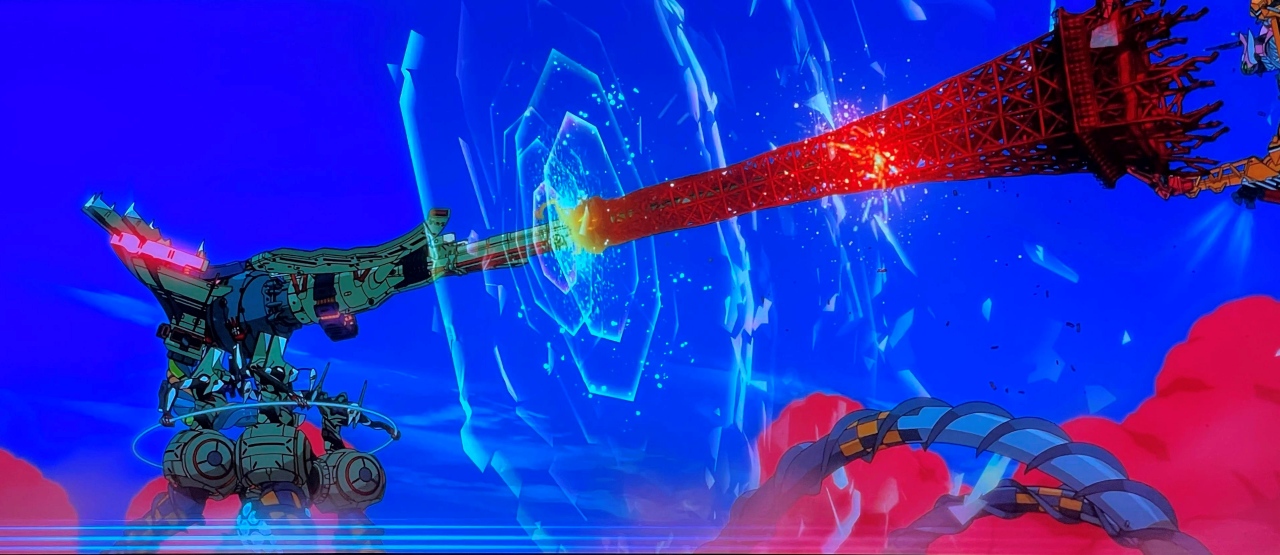
The film opens on a stunning sequence that takes place in Paris where the city is protected by a ring of battleships in a circle in the sky, which later come together to form into a Transformer. There’s a girl in a power suit who appears strung up in the sky between wires as she wields a massive amount of firepower against the invading aliens and then picks up the toppled Eiffel Tower and uses it as a massive battering ram against the alien ship. The scale of the action is expectedly epical, but again I had no real clue why this was happening or how it related to the subsequent events.
Thrice Upon a Time then drops back to a much slower pace in the scenes set in the ruins of Tokyo where the survivors have adopted a more pastoral way of life. We join various of the familiar characters, while Shinji seems traumatised by what has happened to him and keeps to himself. Also there is what Wikipedia tells me is a clone of Rei who is a totally unworldwise innocent – the sort of waif character beloved of anime – whose dialogue is all amazement and discovery of the basic aspects of human life – wearing clothes, taking a bath, eating food. The placidity of life amid the ruins is certainly artistically portrayed and there are surreal touches in the midst of this – phantom train carriages floating in mid-air – before the pullback to reveal that this is a precarious existence protected behind a forcefield.
The film is bookended by the epical action scenes that open the show and then the ones with The Wunder attacking the Antarctic base, filled with the giant corkscrew ship flying across a giant forcefield of what looks like ice as it fights off NERV attack ships and angels fighting. By contrast, these pastoral sections take up the middle of the film and are much slower paced in comparison.
The climax abandons action for a more transcendental one where Shinji’s father takes us beyond the battle and angels and Shinji learns he has the power to reshape reality itself and so chooses an alternate reality where there are no angels. It is a climax that aims for the transcendental apotheosis of a 2001: A Space Odyssey (1968) or an Interstellar (2014). However, rather than take the ending onto another whole level, or even explain anything about why the attacks are happening, it banally has the central character imagine a different world where none of this happened and presto the entire universe we invested four films in is gone and replaced by something resembling a typical Japanese anime school romance. Talk about a letdown.
Trailer here