

Crew
Director – Andrew Stanton, Screenplay – Colby Day, Producer – Jared Ian Goldman, Photography – Ole Birkeland, Music – Thomas Newman, Visual Effects Supervisor – Jake Braver, Visual Effects – Cadence Effects (Supervisor – Craig Crawford), Lola | VFX (Supervisor – Jeremiah Sweeney), Phosphene (Supervisor – John Bair) & Weta FX Limited (Supervisor – Martin Hill), Special Effects Supervisor – Tyler Shymkiw, Makeup Effects Designer – Werner Pretorious, Production Design – Ola Maslik. Production Company – Mighty Engine.
Cast
Kate McKinnon (Coakley), Rashida Jones (Claire Robertson), Daveed Diggs (Greg), Jorge Vargas (Thorn), Tanaya Betty (Hera), Skywalker Hughes (Lark), Rhona Rees (Voice of ROSCO), Tatyana Baptiste (Adult Lark), Nox Watkins (Lucky), Tyson Night (Adult Lucky), Luc Roderique (David), Diana Tsoy (V 12 Years Old), Andrea Bang (V), Karin Konoval (Claire’s Mother), Theodore Starr (Village Elder), Cameron Roberts (Hunter)
Plot
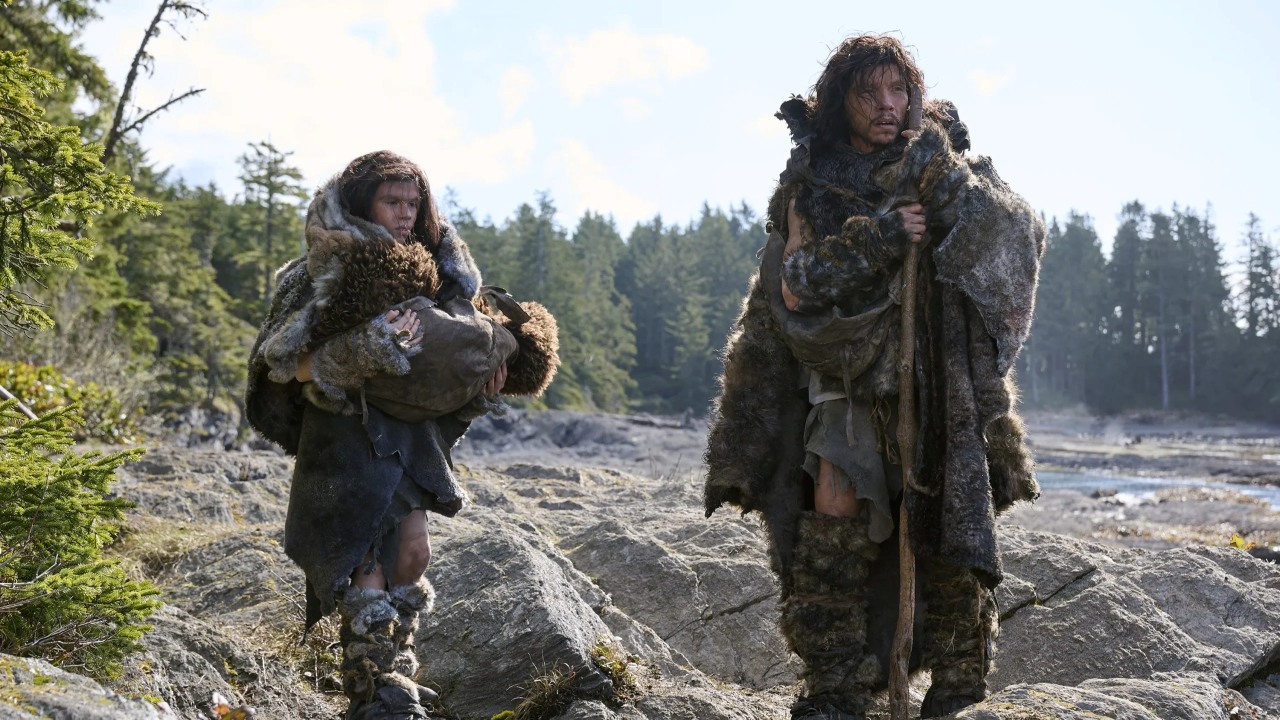
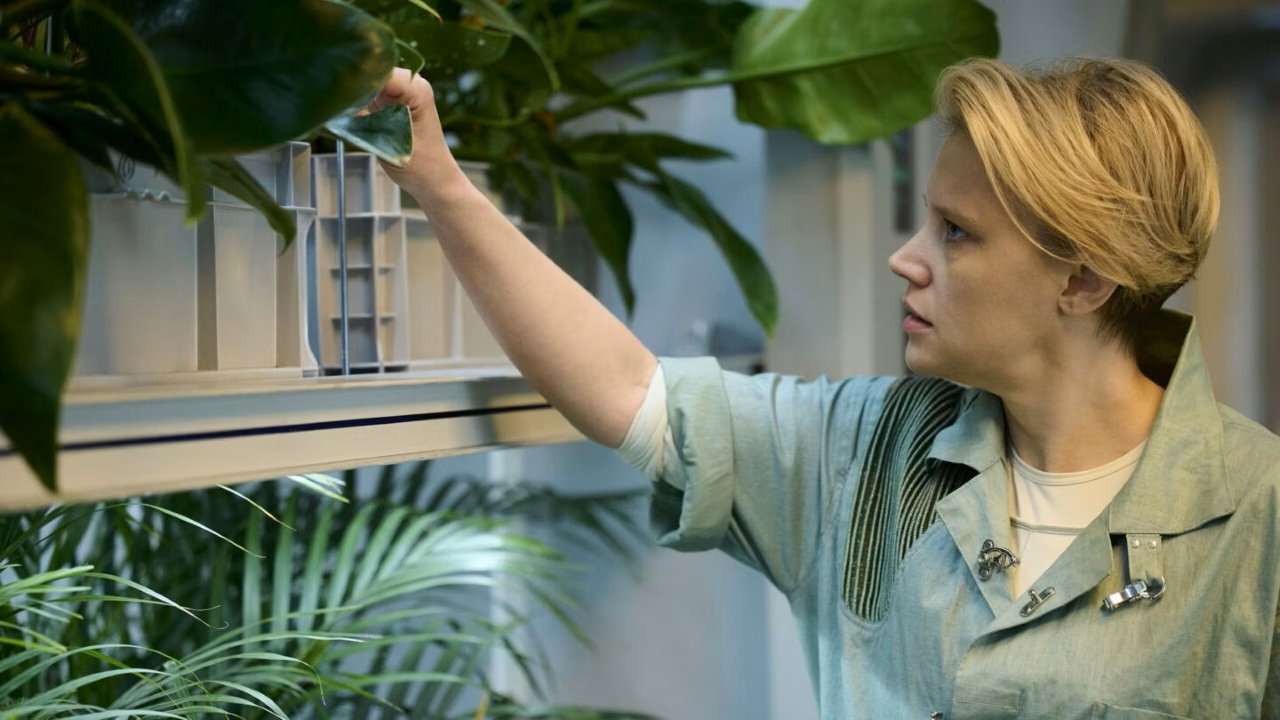
45,000 B.C.E. A neanderthal family deal with life, birth, death and daily survival. In the present-day, Claire Robertson, a doctoral candidate in anthropology who is studying a neanderthal skeleton, hooks up with Greg from Statistics. She is forced to leave her position and fly to Vancouver to deal with her dying mother. Throughout she maintains contact with Greg and the relationship becomes deeper than she expects. In the year 2417, Coakley is a longevity-enhanced human piloting a ship with a cargo of human embryos on its way to colonise the planet Kepler-16B. However, something has infected the plants on board that generate the oxygen. Coakley needs to kill the infected plants and grow new ones, but this severely depletes the available oxygen supply. The only choice is shutting off the two major consumers of oxygen onboard – either killing herself or switching off the A.I. ROSCO.
Andrew Stanton is the Pixar director who made classics such as Finding Nemo (2003) and Wall-E (2008). Stanton has been working as an animator at Pixar for a number of years before that and had contributed to the screenplays for Toy Story (1995), A Bug’s Life (1998), Toy Story 2 (1999) and Monsters, Inc. (2001). Following the acclaim received by these films, Stanton made his live-action debut with John Carter (2012), which alas proved a big box-office flop. Stanton then returned to Pixar for Finding Dory (2015) and subsequent to this with Toy Story 5 (2026).
Stanton has been quiet ever since then and In the Blink of an Eye is his first feature film in eleven years. He has been paying the bills directing episodes of tv series such as Better Call Saul (2015-22), Stranger Things (2016-25), Legion (2017-9), For All Mankind (2019- ), Tales from the Loop (2020) and 3 Body Problem (2021- ), as well as being an executive producer on Obi-wan Kenobi (2022) and a consulting producer for a handful of Pixar films. I hope that that decade hasn’t been spent pre-planning In the Blink of an Eye as, following its premiere at Sundance, the film failed to receive a theatrical release and went directly to streaming on Hulu where it received very middling reviews right across the board.
When it comes to In the Blink of an Eye, the film that you are immediately reminded of is The Wachowskis’ Cloud Atlas (2012) and its Cross-Historical Story taking place in multiple eras with stories and characters who were not connected except by overall theme. In the Blink of an Eye has slightly more connection than Cloud Atlas did with the acorn that appears across all three eras, while we see at the end that Rashida Jones and Daveed Diggs’ son is the one who founds the company Elixir that is behind the systems on the spaceship.
The film also has something of 2001: A Space Odyssey (1968), another Cross-Historical Story that jumps between a prologue set in Prehistory and a spaceflight where an astronaut is dealing with a shipboard Artificial Intelligence. Although the latter scenes are far more upbeat here than the HAL 9000 scenes in 2001 were – I did have a burst of giggles during the scene where Kate McKinnon goes in to switch ROSCO off and kept expecting it to start saying “I’m losing my mind, Dave.”
The thing that Andrew Stanton does not seem to remember about Cloud Atlas is that it was a box-office flop and most audiences didn’t seem to respond to its disconnected story told across eras. I didn’t get the impression that anybody had an issue with the storytelling device here – maybe it is that Cloud Atlas introduced audiences to it, or simply just that Stanton is telling a much more simple and easy to follow story.
The other issue that Cloud Atlas shared is that most of the stories there and all of the stories here are just not substantial enough to stand on their own dramatically. A neanderthal family experience life, birth and death. Rashida Jones can’t decide whether she is involved with Daveed Diggs or not while having to deal with a dying mother. Kate McKinnon finds the plants on the spaceship are dying of some unknown infection and faces a choice about what to do.
Not to say that these stories don’t get developments later on, particularly near the end where we see things expand outwards – the neanderthals encounter early humans and are adopted; Rashida and Daveed have a son who goes on to make great scientific discoveries; Kate hatches the embryos and the ship makes a landing. On the other hand, these are developments that come late in the show. You feel like something more than just the observation of everyday life for said people and something a little more dramatic should have been the basic requirement when making a film.
I was also interested to see that In the Blink of an Eye won the Alfred P. Sloan Prize at Sundance, which is awarded for the film that shows the best depiction of science, technology and engineering. And the film gets the process of anthropology down fairly good, while there is a specific scene later on inserted to counter myths that Homo Sapiens out-competed Neanderthals in favour of likely cooperation and co-mingling.
On the other hand, I do have some quibbles with areas where Andrew Stanton has not done his research or thought things through. One of these is the idea of a preserved acorn found in the hand of the neanderthal skeleton. Buried skeletons can survive for millennia because the bones are protected by sediment where they will gradually mineralise (a process called permineralisation). An acorn, by contrast, is soft organic matter and would usually rot away long before that, unless preserved under rare and highly unusual conditions.
The other big issue is when Kate McKinnon and her shipboard A.I. have a big debate about which one of them to turn off. The correct answer would be that neither of them could complete the mission without the other. Kate would not have the ability to navigate and calculate orbiting trajectories and landing of craft in her head – that’s been handled by computers ever since the Moon Landing because of the complexity of the maths. Also the A.I. would be monitoring the ship’s systems, such as crucial things like life support for the embryos, not to mention running the 3D Printer as we see. Equally, you wonder if Kate suicided then how would the A.I. manage things like tending the plants, birthing the embryos and setting up basecamp on the planet.
Trailer here