

Crew
Director – Timur Bekmambetov, Screenplay – Marco van Belle, Producers – Robert Amidon, Timur Bekmembetov, Majo Nassif & Charles Roven, Photography – Khalid Mohtaseb, Music – Ramin Djawadi, Visual Effects Supervisors – Axel Bonami & Paul Butterworth, Visual Effects – DNeg (Supervisors – Chris Keller & Simon Maddison), Special Effects Supervisor – Eric Frazier, Production Design – Alex McDowell. Production Company – Atlas Entertainment/Bazelevs/Big Indie Pictures.
Cast
Chris Pratt (Chris Raven), Rebecca Ferguson (Judge Maddox), Kali Reis (Jacqueline “Jaq” Diallo), Annabelle Wallis (Nicole Raven), Chris Sullivan (Rob Nelson), Kylie Rogers (Britt Raven), Jeff Pierre (Patrick Burke), Keneth Choi (Ray Vale), Rafi Gavron (Holt Charles)
Plot
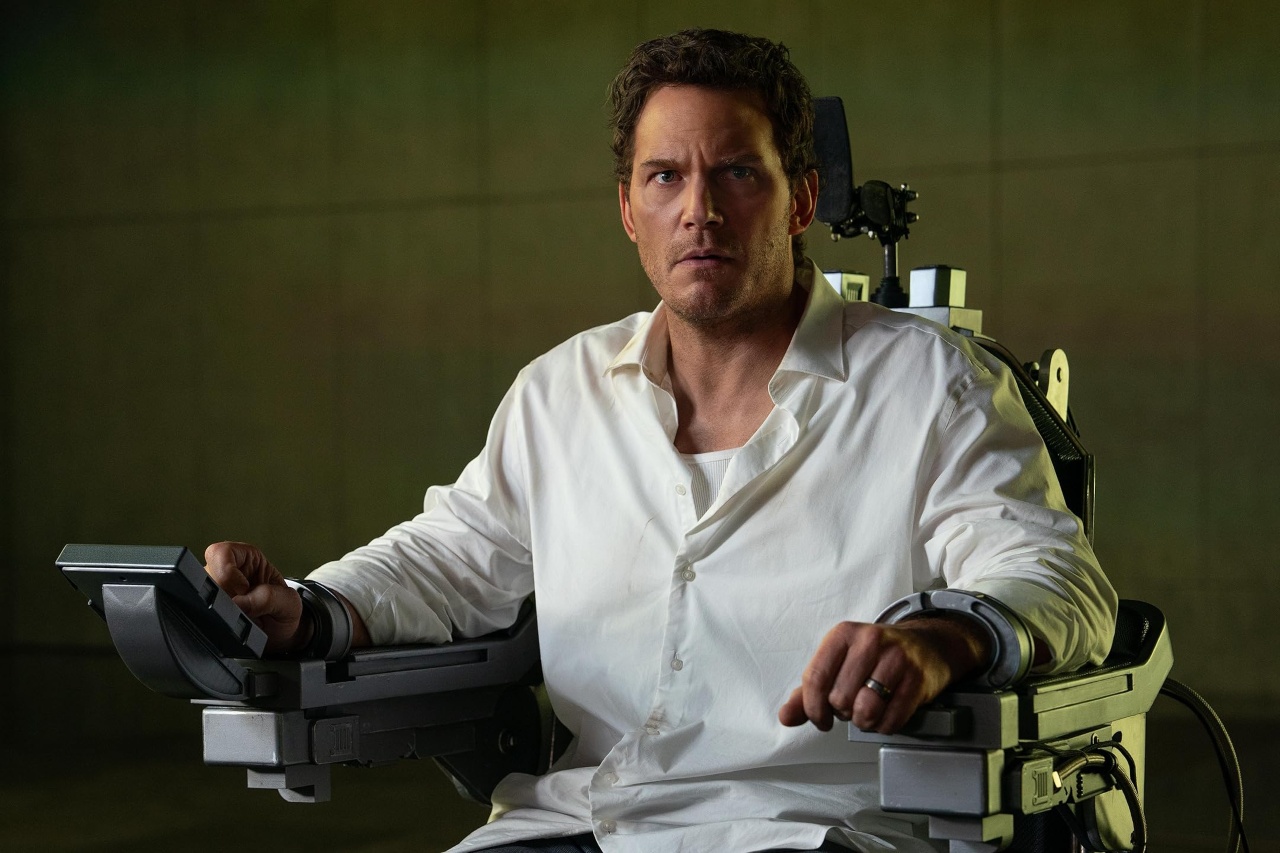
In the near future, rising crime and unemployment rates in Los Angeles have resulted in the creation of the Mercy Court – an artificially intelligent judicial system that assesses the evidence and sentences those deemed guilty to execution. Police detective Chris Raven comes around placed in the Mercy Court before the A.I., Judge Maddox. He has ninety minutes before he is sentenced to execution for the murder of his wife Nicole. He cannot remember what happened, having turned up at the house drunk after she had thrown him out and demanded a divorce over his drinking. With the aid of his partner Jaq Diallo, Chris goes on a virtual tour of the crime scene and interrogates others, but all the evidence seems to conclusively point to him as the killer. As the clock ticks down, Chris tries to explore other avenues as everything seems to point to him.
Timur Bekmambetov is a director from the former Soviet Union – he was born in the area that is now Kazakhstan. He gained substantial international attention with the Russian supernatural film Night Watch (2004) and its sequel Day Watch (2006). These had Bekmambetov brought to the US to directed the likes of Wanted (2008), Abraham Lincoln, Vampire Hunter (2012) and the remake of Ben Hur (2016). Mercy was Bekmambetov’s fifteenth film as director. Bekmambetov has also produced a number of other films (see below).
We have had a huge number of films predicting the arrival of Artificial Intelligence since the mid-2000s. That output has slowed to a trickle after the actual advent of generative Artificial Intelligence in the real world in 2022. As most people are still reeling with the changes wrought on a huge number of levels of society by real world A.I., the actual number of films about it has slowed down. There has been the odd effort to come out during this time with the likes of The Creator (2023), Subservience (2024), Companion (2025), The Electric State (2025) – but most of these seemed constructed on old models where it is hard to know if they were made and conceived before the advent of large-language models or not. The only one that could be said to be influenced by real world A.I. is the inane Afraid (2024). Thus you could say Mercy emerges as one of the very first films about A.I. made after the arrival of real world A.I.
Ever since Unfriended (2014), Timur Bekmambetov has specialised in works that focus on new screen and internet technologies. In Unfriended, he relied on the screenlife process where the film becomes a computer screen that is filled with messenger and video pop-ups windows. Bekmamnbetov directed one film in the screenlife process with Profile (2018), a non-genre thriller about Islamic terrorism recruitment. Other works he has produced include Hardcore Henry (2025) that was shot by a GoPro, while both Resurrected (2023) and the widely derided War of the Worlds (2025) were similarly shot in the screenlife process.
Similarly, Mercy is shot using a variety of non-traditional processes that include doorbell cams, cctv surveillance footage, clips from news broadcasts and police body-cameras, as well as the usual information, messenger and video call pop-ups familiar to screenlife. It should also be pointed out that not all of Mercy is shot in the screenlife process and there are still some regular cinematographic set-ups with Chris Pratt in the Mercy courtroom and others. It can also be noted that the film takes place in a real-time timeframe where the court deadline of 90 minutes is also the runtime of the film.
The surprise about Mercy, given that it is one of the first films made after the advent of real world A.I., is how little it has to say about the subject. In the real world, the advent of A.I. has had massive ripple effects from layoffs in many industries due to replacement by A.I. I can personally relate the annoyance of having to face A.I. agents that have now become ubiquitous in customer service calls and how my income as an editor has taken a tumble with people prefer to use A.I. services instead. Anything to do with A.I. writing and artwork is heavily disparaged wherever you go, which is almost immediately followed by a kneejerk reaction about stolen creativity (not an argument I agree with). I’ve also been asked to proof A.I. devised court documents for a friend so have some ever so tenuous connection to A.I. as it is applied in the court system.
You would surely expect there to be massive reaction to the use of A.I. in courts – which when you think about an A.I. is surely better positioned to analyse evidence than juries, which are frequently swayed by their own biases and appeals to emotion – but all that we ever get is the real killer’s motives at the end, which seem to have more to do with revenge than anti-A.I. protest. At the very least, the process should have some kind of human oversight over the A.I.’s decision, especially when it comes to capital cases that result in the ending of a human life (it should also be noted that Chris Pratt is to be sentenced to execution less than 24 hours after the murder of his wife, which seems nowhere enough time for police to process things like forensic evidence). Mercy has nothing to say about any of this, except perhaps a finale with the defeat of the killer, which opts for a “thank goodness the process works” relief on Chris Pratt’s part ie. a tacit support for such a system.
Beyond its failure to engage with an opinion on its very subject matter, I found Mercy dull. There is a certain fascination to seeing some of the tech advances in action – the quadcopter that Kali Reis blats about on from scene to scene is a cool variant on the Blade Runner (1982)-esque spinner. The latter twenty minutes or descend into a routine action movie chase sequence and showdown. The denouement of the murder mystery and revelation of the real killer also feels routine.
Timur Bekmambetov has also produced a number of other projects including the animated 9 (2009), the NASA Moon landing/alien possession mockumentary Apollo 18 (2011), the alien invasion film The Darkest Hour (2011), The Snow Queen (2012), Unfriended/Cybernatural (2014), Hardcore Henry (2015), Unfriended: Dark Web (2018), The Drone (2019), Syostry (2022), Resurrected (2023) and War of the Worlds (2025).
Trailer here