

Crew
Director/Story – Lester Wm. Berke, Screenplay – Jerome Bixby & John McPartland, Producer – Lee Gordon, Photography (b&w) – Kenneth Peach, Music – Gerald Fried, Special Photographic Effects – Jack R. Glass, Makeup – Alan Snyder, Set Design – William Ferrari. Production Company – William Berke Productions, Inc..
Cast
Robert Loggia (Dr David Loring), Ellen Parker (Joan Wood), Philip Pine (Dr Joe Freed), Larry Kerr (General Barr), Marilee Earle (Ella Freed). Narrator: Lawrence Dobkin
Plot
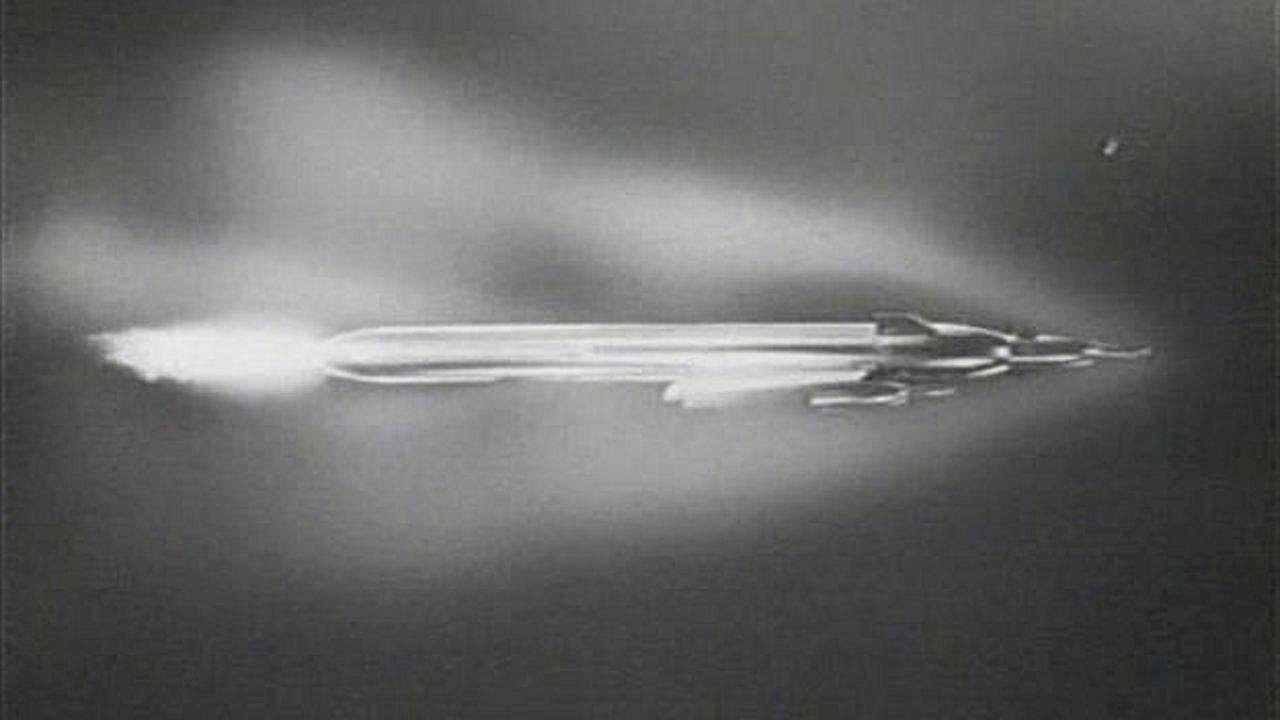
At the Havenbrook Atomic Research institute in New York, project head David Loring is so busy developing their hydrogen warhead nicknamed Joe that he does not even have time to marry his secretary/fiancée Joan Wood. Just then, news of a runaway missile is picked up by the Distant Early Warning system, heading across Canada at 4000 miles per hour and radiating heat of a million degrees and incinerating everything in its path. Nothing they are able to bring against it is able to stop the lost missile. No country on Earth knows where it comes from. David’s associate Joe Freed believes that the missile might be extra-terrestrial in origin. As the missile heads on a path towards New York City, the authorities prepare to evacuate the civilian populace, while David comes up with a last-ditch plan to fire the hydrogen warhead against the lost missile.
The Lost Missile is a fascinating artefact from Cold War science-fiction. It is very much a work that was birthed by Cold War fears – as the narrator says at one point “The world is one minute away from hydrogen war.” 1958 was also the era of the ICBM (Intercontinental Ballistic Missile). The year before The Lost Missile came out, the Soviet Union had launched the world’s first ICBM known as R7 and in 1958 propelled the Space Race into high gear by placing the world’s first satellite into space with Sputnik. At this point, the fears of nuclear war that had dominated much of 1950s science-fiction went from aerially dropped nuclear warheads to bombs that could be propelled from continent to continent on the end of missile warheads. The film also manages to wind in the Distant Early Warning System, a line of radar dishes that the USA had built up in the Arctic Circle to detect approaching Soviet bombers, which had just been gone active in 1957, the year before this.
Many science-fiction films of the 1950s seemed to only be tapping the fears of atomic war indirectly – either by making the Soviet threat a metaphor in terms of alien invasion or having atomic monsters stand in for atomic bombs. In The Lost Missile, the missile and the idea of the alien threat are blended into one. In lieu of alien invaders, we now have an alien ICBM. This is an idea that is not particularly well explored – the film reaches an end where no explanation is ever given of where the missile originated from. Every country in the world denies it is theirs and there is speculation that the technology is too advanced to come from Earth. Robert Loggia’s assistant Philip Pine is certain that the missile is extra-terrestrial but gives no evidence as to how he reached such a conclusion – and given that he was in wide-eyed lunatic mode at the time, you have to regard this theory with a certain dubiousness. That however does leave us with a film where the missile turns up out of nowhere, causes imminent destruction and then nobody offers any explanation of where it comes from.
Like a number of other science-fiction films of the era such as Invasion USA (1952) and Rocket Attack U.S.A. (1958), The Lost Missile has been built around recycled stock footage. Much of the film is spent giving us a documentary-like detailed description of the various procedures employed by the Distant Early Warning system, the Air Force response and the evacuation procedures in the cities. The Air Force footage is well integrated with the live-action. The first credit of the film makes the dedication “To the Department of Defense and to the Department of the United States Army, Navy and Air Force, without whose cooperation this film could not have been made, the producers of The Lost Missile extend their appreciation.”
The latter scenes with the civilian evacuation look forward to the British-made nuclear war classic The War Game (1965), although in terms of their depiction of the social reaction the two films could not be more apart – in The Lost Missile, society is mannered and calm to the point of absurdity, while The War Game saw that the inability of authorities to conceive of the magnitude of the disaster would result in devastation. As such, The Lost Missile is very much a product of the Duck and Cover era and its wild lack of knowledge about nuclear realities.
Outside of the stock footage, The Lost Missile is directed with the same pedestrian dullness that typifies the majority of science-fiction films of the era. The narrator delivers everything in tones of a gravitas that contains a momentous urgency. The film works far better when it comes to the scenes showing the civilians attempting to deal with the oncoming disaster.
The Lost Missile was directed by William Berke (1903-58), a director of some 80 B movies, mostly Westerns, way back to the 1930s. Among Berke’s genre films was the feature-film version of Dick Tracy (1945), Caged Fury (1948) about a psycho lion tamer, the jungle boy film Zamba (1948), and the first six of the quasi-fantastical Johnny Weissmuller Jungle films –Jungle Jim (1948), The Lost Tribe (1949), Mark of the Gorilla (1950), Captive Girl (1950), Jungle Jim in Pygmy Island (1950) and Fury of the Congo (1951), as well as the eleventh entry Valley of the Head Hunters (1953). The Lost Missile was Berke’s last film as he died on the first day of shooting. The production was taken over by his son Lester William who maintained a minor career mostly producing in television.
The Lost Missile was written by Jerome Bixby (1923-98), a well-known genre writer who dabbled in a number of genres and different media during his career. Bixby wrote several novels, although is mostly known for his short stories. He delivered several scripts for genre movies, including Curse of the Faceless Man (1958), It! The Terror from Beyond Space (1958), The Man From Earth (2007) and, most famously, the original story for Fantastic Voyage (1966). He also wrote several episodes of Star Trek (1966-9) and the famous It’s a Good Life episode of The Twilight Zone (1959-63), which was later remade as a segment of Twilight Zone – The Movie (1983).
The most well-known name on the credits today is Robert Loggia in his second ever leading role. Loggia went onto a celebrated career, finding his fame in his fifties in films like Psycho II (1983), Big (1988), the tv mini-series, Wild Palms (1993) and Lost Highway (1997). He was mostly known for playing cops or mob guys on tv and supporting roles in films like Scarface (1983), Prizzi’s Honor (1985) and of course tv’s The Sopranos (1999-2007).
Trailer here
Trailer here