

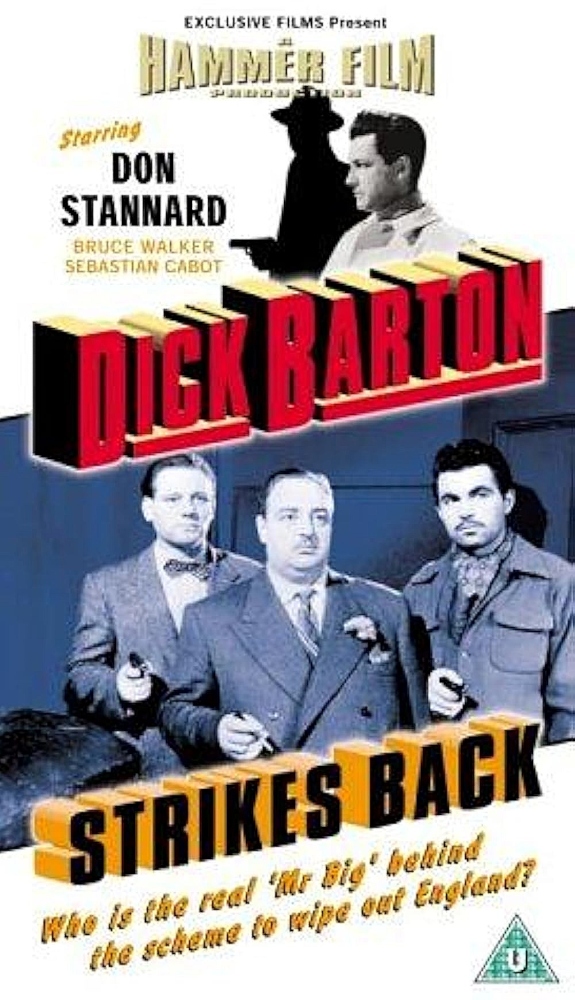
Crew
Director – Godfrey Grayson, Screenplay – Elizabeth Baron & Ambrose Grayson, Story – Ambrose Grayson, Based on the Radio Series
Cast
Don Stannard (Dick Barton), Bruce Walker (Snowey White), Sebastian Cabot (Alphonso Fouracada), James Raglan (Lord Armadale), Jean Lodge (Tina), John Harvey (Major Henderson), Morris Sweden (Robert Creston)
Plot
Government agent Dick Barton and his sidekick Snowey White get wind of a plot by Alphonso Fouracada to bring England down. Immediately after, they discover villages where Fouracada has deployed a deadly sonic ray, killing all life. Barton follows the trail of Fouracada whose activities are disguised behind a travelling circus and uncover his plans to mount the ray on top of the Blackpool Tower and train it on the residents below.
Everybody knows Hammer Films for their Dracula and Frankenstein films starring Christopher Lee and Peter Cushing, along with their prolific output of other horror works. The Hammer story didn’t begin proper until 1957-8 with the breakthrough successes of The Curse of Frankenstein (1957) and Dracula/The Horror of Dracula (1958), which set the studio on the path where it became associated with the Anglo-Horror Cycle.
Less well known are the works that fall outside of Hammer’s horror output – their historical and war films and tv-derived comedies like On the Buses (1971) and Man About the House (1974). Prior to their association with horror, Hammer had been in operation for two decades. They were founded as Exclusive Films in 1935 where they put out a number of films, only really getting into gear after the War. During the late 1940s to the late 1950s, they put out a busy schedule of films that were quota quickies (films made cheaply to fulfil a UK government mandate that a certain percentage of films had to be British made). Not being able to afford name stars, they turned to conducting a series of films based on popular radio series of the day that included the likes of PC 49 films, Dr Morelle: The Case of the Missing Heiress (1949), The Man in Black (1950) and Room to Let (1950).
Dick Barton was the hero of the popular radio series Dick Barton – Special Agent (1946-51). The show was aired every day of the week in fifteen-minute episodes and concerned the activities of the titular government agent as he went into action to save the nation. Hammer made three films based on the radio show beginning with Dick Barton: Special Agent (1948). Dick Barton Strikes Back was the second of these and was followed by Dick Barton at Bay (1950). A fourth film was planned with Dick Barton Goes to Africa, but the series’ lead actor Don Stannard was killed in a car crash after leaving the wrap party for the third film whereupon Hammer respectfully elected not to continue the series.
Dick Barton Strikes Back is a very different film if you come to it with a knowledge of Hammer’s typical film output. The Dracula and Frankenstein films were made in a vivid colour and period surroundings – the Hammer look became something clearly identifiable and was copied by other filmmakers. By contrast, the Dick Barton films look exactly like quota quickies – shot in dreary black-and-white, made contemporary and on low budgets. Aside from one or two familiar Hammer names on the credits – most prominently that of producer Anthony Hinds – there is nothing here that would identify the film as Hammer product if you didn’t know otherwise.
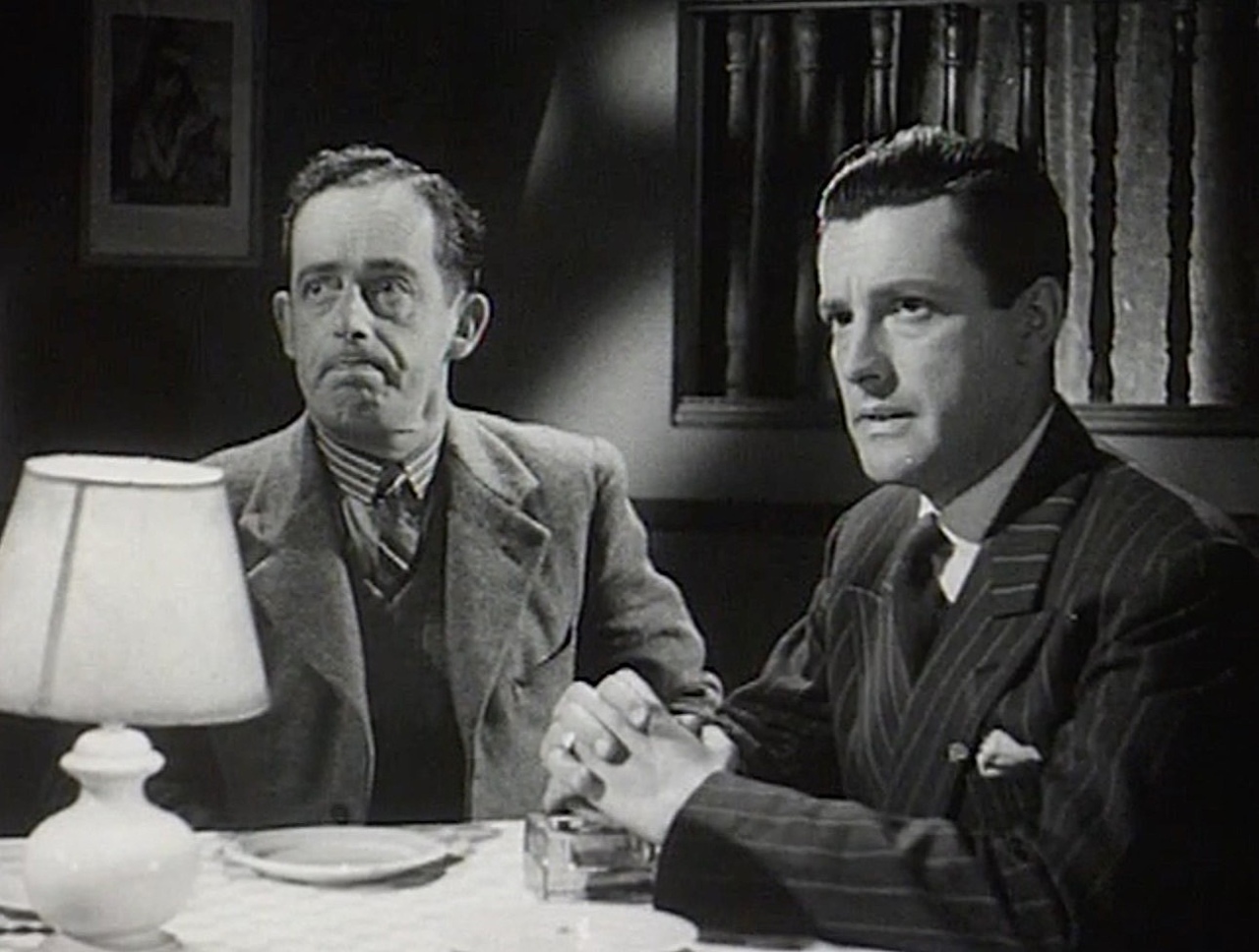
The Dick Barton films were also spy films made before the advent of the Spy Film as a genre over a decade later with the massive success of the James Bond films beginning with Dr No (1962). It makes for interesting contrast. Don Stannard’s Barton is dashing but is a standard square and cleancut detective hero of the day viz Bulldog Drummond, not the ruthless playboy who was licensed to kill we had after Sean Connery stepped into the fray. Here there is none of Bond’s womanising – the sole woman in the cast line-up (Jean Lodge) is on the side of the bad guys. She takes a fancy to Barton and comes to his aid, but he seems to display almost no interest in her – she is killed at the end and Stannard shrugs “poor girl” and in the next line is off to join Snowey for a pint of bitter.
One of the points where this does anticipate the James Bond film is in Sebastian Cabot’s portly larger-than-life than life villain, which looks forward to Bond Super-Villains like Gert Frobe in Goldfinger (1964). The disappointment of the film and its probable quick shooting schedule is that we don’t get enough of Cabot, the liveliest actor present, and he is sidelined in the latter sections as the real villain who is pulling the strings comes to the fore (but is played by a less lively actor). The other familiar aspect is in the use of a death ray device employed by the villain, which became one of the stock tropes of the spy film in Bond efforts such as Diamonds Are Forever (1971) and The Man with the Golden Gun (1974), among others.
The Dick Barton films were made on B-budgets. The action takes place in drab black-and-white with little drama. To be fair, things pick up somewhat towards the end where there is a fine scene where villain Sebastian Cabot locks Barton and Snowey in the circus’s snake house and then shoots out the glass windows of the cages to release the poisonous snakes. There is also a decent dramatic climax with Don Stannard climbing the Blackpool Tower to stop the sonic ray from being activated, while having to duck around the scaffoldings to avoid being shot at.
Dick Barton Strikes Back was the directorial debut of Godfrey Grayson (1913-98), one of the forgotten directors from the early days of Hammer. Godson made eight of Hammer’s quota quickies, all in the thriller field, including The Adventures of P.C. 49: Investigating the Case of the Guardian Angel (1949), Dr Morelle: The Case of the Missing Heiress (1949), Meet Simon Cherry (1949), Dick Barton at Bay, the Jack the Ripper film Room to Let (1950), What the Butler Saw (1950) and To Have and Have Not (1951).
Trailer here