
USA. 2026.
Crew
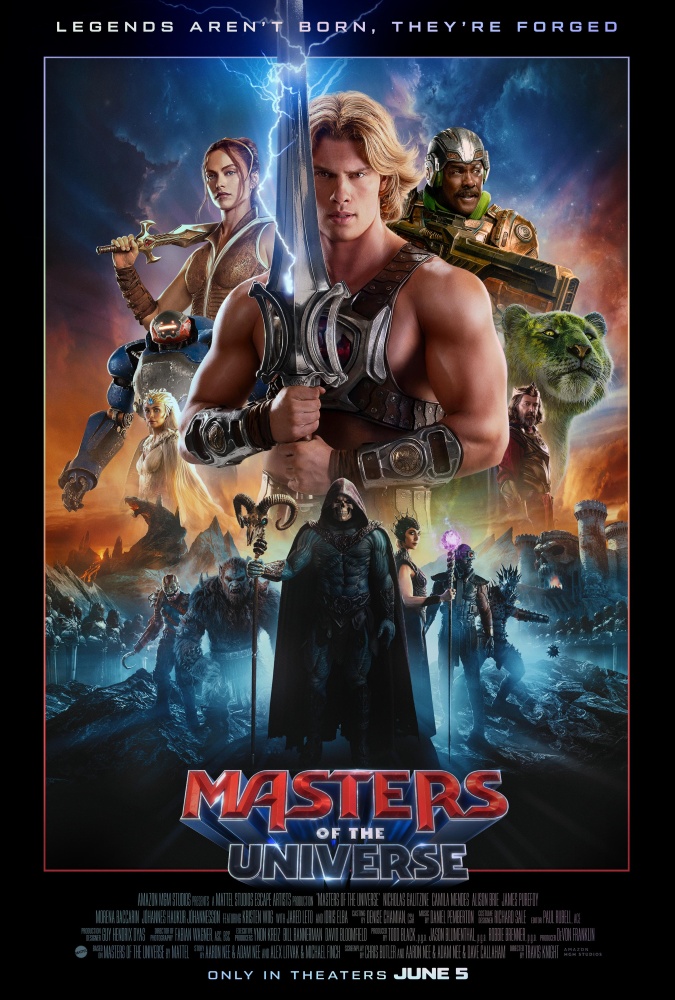
Director – Travis Knight, Screenplay – Chris Butler, Dave Callaham, Aaron Nee & Adam Nee, Story – Alex Litvak, Michael Finch, Aaron Nee & Adam Nee, Producers – Todd Black, Jason Blumenthal, Robbie Brenner & DeVon Franklin, Photography – Fabian Wagner, Music – Daniel Pemberton, Visual Effects Supervisors – Tim Burke & David Vickery, Visual Effects/Animation – Anibrain, Cinesite (Supervisor – Christian Irles), DNeg (Supervisors – Chris McLaughlin & Rhys Salcombe), Host VFX (Supervisor – Joss Flores), Industrial Light and Magic (Supervisor – Pietro Ponti), Rebel Unit (Supervisor – Theodor Flo-Groeneboom), Rodeo FX (Supervisor – Joseph Kasparian) & Untold Studios (Supervisor – James Hattsmith), Special Effects Supervisor – Chris Corbould, Prosthetics Designer – Barrie Gower, Production Design – Guy Hendrix Dyas. Production Company – Mattel Studios/Escape Artists.
Cast
Nicholas Galitzine (Prince Adam/Adam Glenn/He-Man), Camila Mendes (Teela), Jared Leto (Skeletor), Idris Elba (Duncan/Man-at-Arms), Alison Bree (Evil-Lyn), Johannes Haukur Johannesson (Fisto), Jon Xue Zhang (Ram Man), Kristen Wiig (Voice of Roboto), James Purefoy (King Randor), Charlotte Riley (Queen Marlena), Morena Baccarin (The Sorceress), Christaan Bettridge (Dian), Christian Vunipola (Hussein), Sasheer Zamata (Suzie), Artie Wilkinson-Hunt (Young Adam), Eire Farrell (Young Teela), Sam C. Wilson (Trap Jaw), James Wilkinson (Mecka-Neck), Dolph Lundgren (Macho-Man), Elena Rivers (Julie), Olivia Marcus (Comic Store Employee)
Plot
The young Prince Adam trains as a fighter at Castle Greyskull on the planet Eternia. Greyskull is then invaded by the evil skull-faced Skeletor and Adam is quickly ushered away by the sorceress and sent to safety through a portal to Earth. He is given the Sword of Power but loses it in transit. Adam grows up in Oklahoma City and works an office job. He is admonished by his superior for his obsessive search for the sword during work hours. Adam finally finds the sword being used as a prop in a comic store, just as the city is attacked by one of Skeletor’s beast creatures. His childhood friend Teela appears and takes Adam back to Eternia to claim his birthright. As he comes to discover the powers that the sword gives him, he unites the characters from his childhood to defeat Skeletor.
Masters of the Universe was a phenomenon that began as a toy line in 1982. This began with He-Man and his nemesis Skeleton but was soon expanded to a whole bunch of supporting characters, along with accessories, comic-books, colouring-in books and lunchboxes. The most successful incarnation was in the animated series He-Man and the Masters of the Universe (1983-85), which laid down the essence of the mythology. This led to a spinoff series She-Ra: Princess of Power (1985-7) concerning He-Man’s twin sister and two video-released movies The Secret of the Sword (1985) and Skeletor’s Revenge (1986). There was then the live-action film Masters of the Universe (1987) from Cannon Films starring Dolph Lundgren. This was followed by two animated revivals with The New Adventures of He-Man (1990-1) and He-Man and the Masters of the Universe (2002-4). Power of Grayskull: The Definitive History of He-Man and the Masters of the Universe (2017) is a documentary that charts the entire He-Man phenomenon. This is a new live-action film that reboots the franchise on the big screen.
Masters of the Universe was the third film directed by Travis Knight. Knight started out as a stop-motion animator and became a producer with Laika on films like ParaNorman (2012), The BoxTrolls (2014) and Missing Link (2019). Knight stepped up to direct the acclaimed Laika film Kubo and the Two Strings (2016). That gave him enough collateral that he went on to direct the live-action Transformers series spinoff Bumblebee (2018).
Masters of the Universe emerges as a much more successful film than the 1987 film – at least in terms of ambition. The 1987 film was produced on a Cannon Films budget ($22 million), which meant that Eternia was sidestepped for Earth for the better part, while the line-up of supporting characters was greatly reduced. By contrast on a budget in the $170-200 million range, this version becomes a full-fledged Planetary Adventure that winds in as many of the franchise’s supporting characters as possible. It is fully embracing of the mythos from the inclusion of Cringer the Battle Cat to Adam proclaiming “By the power of Greyskull” as he transforms – even right down to the appearance of the character Orko at the end to give the audience the moral of the story just like the animated series. A post-credits scene hints at the introduction of She-Ra. Dolph Lundgren even makes a cameo appearance in the scenes at the gym where Nicholas Galitzine has a line asking “Any advice for the new guy?”
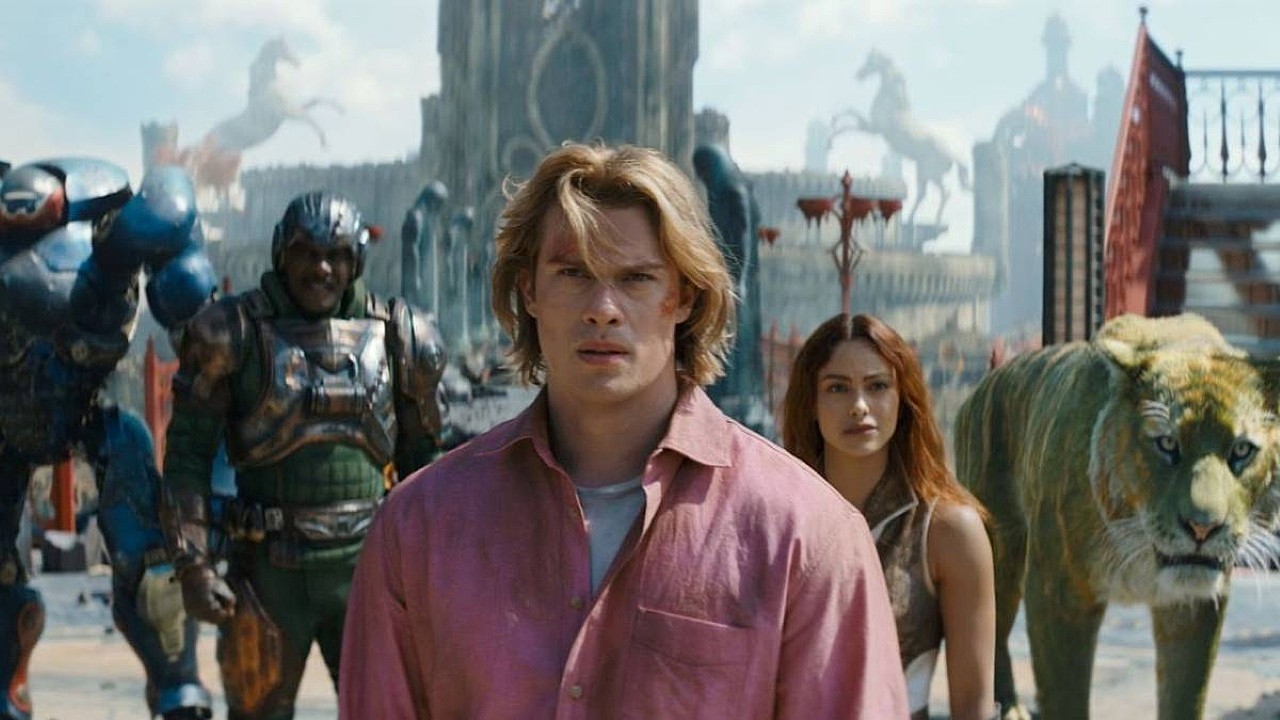
The bigger budget allows a fully furnished depiction of Eternia, the costuming and outfitting of all the characters and a full display of visual effects when it comes to the various fighting and ships buzzing around. That said, for all the film getting the mythos down accurately, Masters of the Universe is still a film of third hand cliches. Its draws direct from Star Wars (1977) mixed up with tropes slung together from the sword-and-sorcery genre – magic swords, good and evil witches, magic portals.
Some of the effects tends to blur into being CGI eye candy after a time – there is an obvious artificiality to Cringer and the scenes buzzing around Eternia. On the plus side, the film throws itself into the fight scenes and these have a good deal of enthusiastic full tilt action to them. This ends up lifting the film up over its very generic feel in other regards.
The biggest issue I have with the new film is that it is constantly undercutting itself with a sense of audience-pleasing humour. You sink from about the point that Prince Adam uses words like “awesome” and “cool” in his introduction. The character of the Roboto is voiced by Kristen Wiig with a gratingly lippy tone that left bad reminders of the robot Claptrap in Borderlands (2024), while Teela admonishes Adam with lines like “Can you please stop making friends with the appliances?” Even Skeletor, a black-and-white villain if there ever was one, gets into the act and Jared Leto, outfitted with fake gravitas and British accent, gives a performance that tips over into campiness.
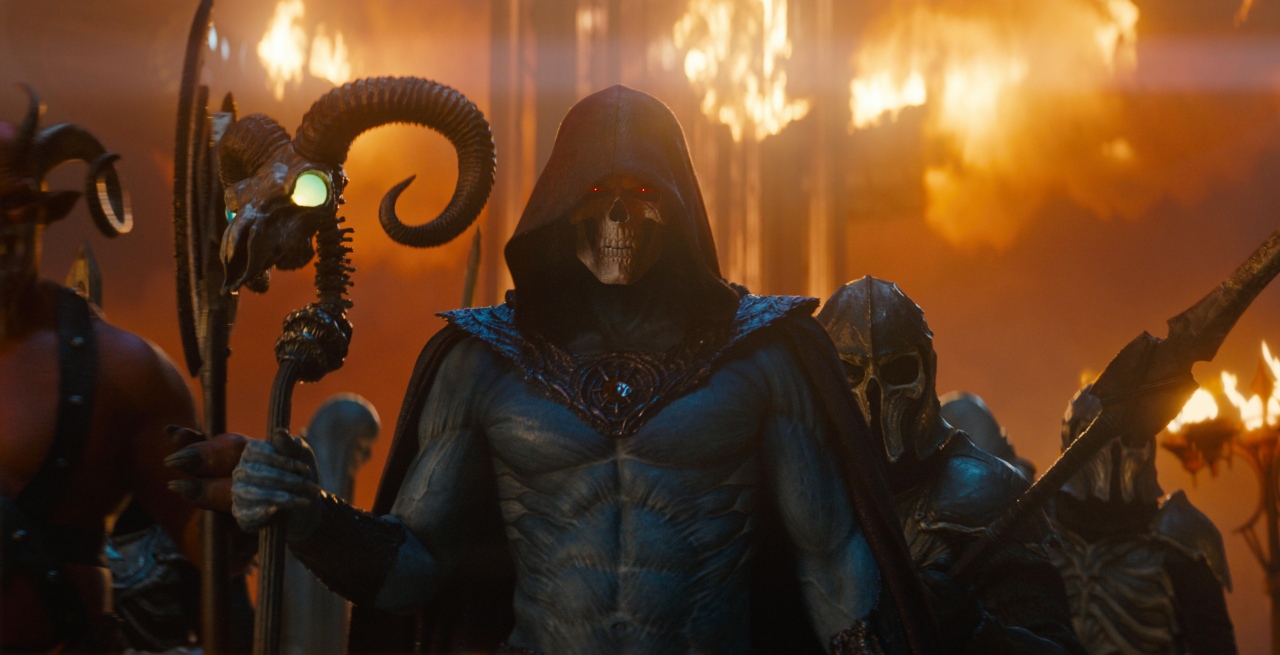
This does lead to a relationship between the filmmakers and the source material that can be defined as constantly deflating it. Adam is made into a comic figure. We see him on a date who walks out on him when he starts recounting his childhood. This is most evident in the scenes at the end where Adam talks about all the names he gave to the characters, which are the original ones for the toys and characters in the animated series, and then embarrassedly mentions his own name for himself as being He-Man. There is a self-conscious cringe factor to the way everyone plays the scene where it seems perfectly evident that the filmmakers are aware of the silliness of the names but are trying to figure out a way to slide them in by making fun of them. And right after this, Adam having a secret identity is made into a joke. It very much spells a film that feels it cannot take its own source material seriously.
About the point of the inclusion of Queen’s Princes of the Universe (1986) – a track taken from the film Highlander (1986) – it suddenly dawned on me that the model for Masters of the Universe 2026 was in fact the campy exploits of the remake of Flash Gordon (1980) – a work that the 1987 film also had some allegiance to. This is never as actively tongue-in-cheek as Flash Gordon but there is the same sense of refusing to take the source material seriously.
There was a lot of the usual kneejerks reactions online about Masters of the Universe being too woke. Which I would dispute. What the critics seem to miss is that the film is actually parodying wokespeak. Adam gets to wield a lot of modern jargonese about truth-talking and tone policing, tries to engage the Eternians in team-building exercises, while the HR head (Sasheer Zamata) threatens to fire him amid the use of terms like ‘harshing his buzz’ and ‘awesome sauce’. There is a pointed scene where we get a closeup of the plaque on Adam’s desk, which identifies him by his pronoun ‘he/him.’ There is even a gag about a corporate meeting where everybody sits about chanting “I have the power.” There is a ridiculous climactic scene where Adam confronts Skeletor and then suggests that they just talk things out. It seems here that we have a film afraid of buying into and celebrating the hyper-masculine ideal that its original model represented and feeling it no longer can do so in today’s world of gender-blurred definitions. But at the same time, it also seems to be a film that finds the whole business of pronouns a bit ridiculous and is spoofing these as well.
Ultimately, Masters of the Universe is a film that fails to believe in its source material. The original He-Man cartoons was never sophisticated. Like the original Flash Gordon serials of the 1930s, they played their outlandish adventures with complete conviction for child audiences without a hint of self-mockery. This version lacks that conviction. Every time the film edges toward the kind of po-faced material of its source material, it feels that it has to reach for an audience-winking joke.
Trailer here