

Crew
Director – Franklin Adreon, Screenplay – Arthur C. Pierce, Producer – Earle Lyon, Photography – Alan Stensvold, Music – Paul Dunlap, Special Effects – Roger George, Art Direction – Paul Sylos, Jr.. Production Company – United Pictures Corporation/Harold Goldman Associates, Inc..
Cast
Michael Rennie (Garth A7), Karen Steele (Dr Sharon Mason), Warren Stevens (Dr. Carl Zellar), Wendell Corey (Sheriff), Eduard Franz (Professor Sigmund Marx), Harry Carey, Jr (Jay C), Chubby Johnson (Uncle Pete), Tyler MacDuff (Sam Gilmore), Adam Roarke (Deputy Dan), Dale Van Sickel (Tracer #1), Troy Melton (Tracer #2), Jimmy Hibbard (Rick), Sherry Alberoni (Laura Zellar), John Beck (Skinny), Betty Jane Royale (Jill)
Plot
Garth A7 is sent back in time from the year 2087 to the small California town of Desert City in 1966. He is immediately hunted by police after stealing a vehicle and clothing. He heads to the Future Industries Inc laboratory in search of Professor Sigmund Marx. However, Marx has departed to deliver a lecture in Los Angeles and the only person there is his assistant Sharon Mason. Garth impresses on her that Marx must not conduct his demonstration of his radio telepathy device tomorrow. This will lead to the future he comes from where the populace exists under mind control and have been turned into cyborgs like he is. At the same time, two cyborg tracer units have been sent back from the future to stop Garth carrying out his mission.
Cyborg 2087 was one of a handful of films produced by Earle Lyon (1918-2012). After making nine Westerns and two Western tv series, Lyon turned to science-fiction with the likes of Castle of Evil (1966), Destination Inner Space (1966), Dimension 6 (1966) and Panic in the City (1968), as well as the horror film The Astral Factor/Invisible Strangler (1976), most of which ended up being directed by his older brother Francis. Cyborg 2087 was originally made for tv but was granted a theatrical release.
The one footnote that Cyborg 2087 has in history is as “the film that inspired The Terminator (1984).” Admittedly, there are other contenders for that claim – Harlan Ellison won a copyright claim against James Cameron for his taking from the The Outer Limits episode Soldier (1964). There are however an uncanny number of developments between The Terminator and Cyborg 2087– a man sent back from the future to prevent a machine-dominated future coming about and the two killer androids(?) sent back to stop him. There are also elements here that the sequel Terminator 2: Judgment Day (1991) takes up – the good cyborg/android being sent back and revealing his inhuman nature; the plot about preventing a scientist from releasing a discovery that will bring about a nightmare future.
Of course, the one thing that James Cameron gave The Terminator that is sorely lacking here is a fight to the death against the machines. Here we get one or two scenes where the tracers pursue Michael Rennie across a rooftop, shooting at him, and a climax fighting with him inside a power plant. But these take place at a snail’s pace compared to modern action sensibilities. This was an era before the Action Movie even existed as a label – an indication of how sedate this is that we even get scenes with rock‘n’rolling teenagers (fairly much obligatory for any 1960s films) and where their dune buggy proves integral to the chase.
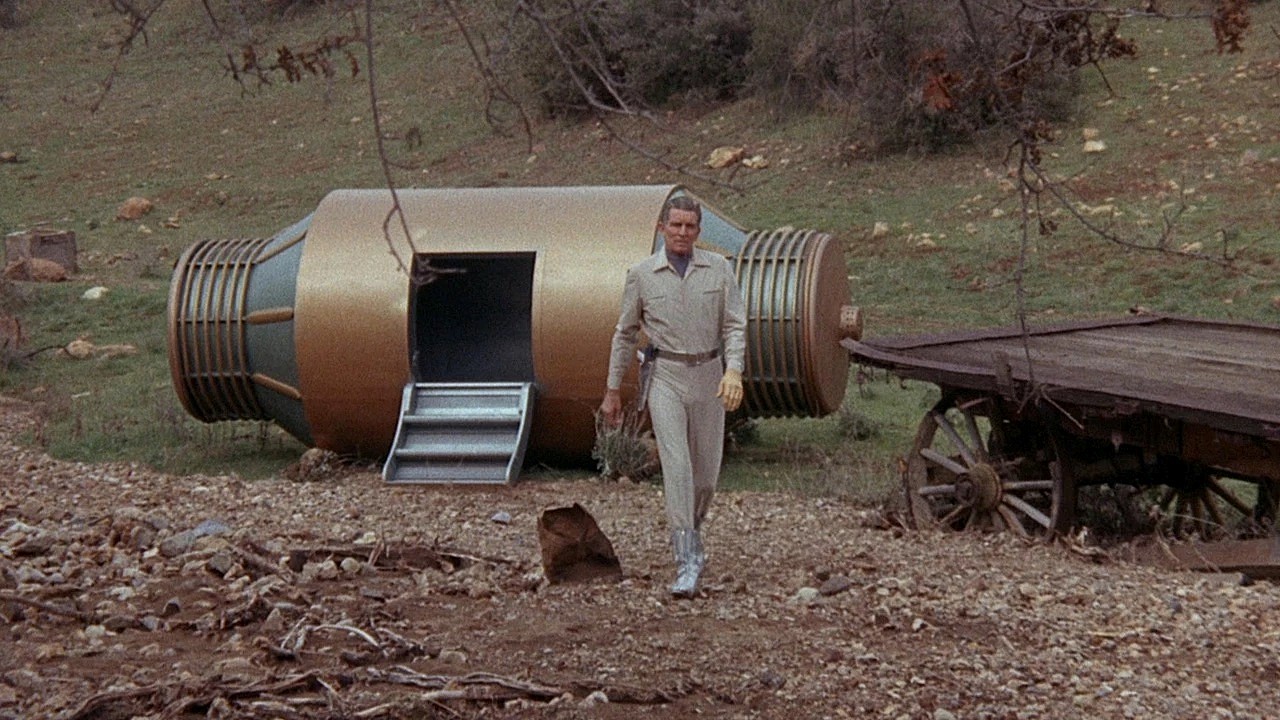
In a way, Cyborg 2087 suffered from its timing. Genres like the Time Travel film were still in their infancy, while this would probably have only been among first half-dozen or so depiction of a Cyborg on screen. Later developments that came in the 1980s began to treat these themes with far greater sophistication and had Cyborg 2087 been made then it could well have been a much better film. Some of the quaintness of the technology is amusing today – the tracers come with tracking compasses strapped to their wrists!
The film’s star was British-born actor Michael Rennie, who was most famous as Klaatu in The Day the Earth Stood Still (1951). This came towards the dog end of Rennie’s career when he was appearing in episodic tv guest spots with his last films including the cheap Spanish monster bash Dracula vs. Frankenstein (1970), before his death in 1971.
Screenwriter Arthur C. Pierce had a long resume of B and Z science-fiction during this era, having written the scripts for The Cosmic Man (1959), Terror in the Midnight Sun/Invasion of the Animal People (1959), Beyond the Time Barrier (1960), The Human Duplicators (1965), Mutiny in Outer Space (1965), Destination Inner Space (1966), Dimension 5 (1966), The Destructors (1968) and The Astral Factor/Invisible Strangler (1978). He only ever directed one film with Women of the Prehistoric Planet (1966).
Franklin Adreon (1902-79) started out as a screenwriter in the serial era, turning out the scripts for serials such as S.O.S. Coast Guard (1937), Dick Tracy Returns (1938), Dick Tracy’s G-Men (1939), Drums of Fu Manchu (1940), The Mysterious Dr Satan (1940) and The Black Widow (1947), along with several Zorro and Lone Ranger scripts. He turned director with the serials Canadian Mounties vs Atomic Invaders (1953), Commando Cody, Sky Marshal of the Universe (1953), Panther Girl of the Kongo (1955) and acted as producer on several others. As serials died off, he then pivoted to film and tv, mostly directing Westerns. He made one other SF film with the Earle Lyon produced Dimension 6 (1966).
Trailer here
Full film available here