

Crew
Director – Renny Harlin, Screenplay – Shayne Armstrong, Pete Bridges, S.P. Krause & Damien Power, Story – Shayne Armstrong & S.P. Krause, Additional Writing – John Kim, Producers – Volodymyr Artemenko, Dale G. Bradley, Grant Bradley, Adrian Guerra, Gary Hamilton, Ryan Hamilton, Neal Kingston, Gene Simmons, Robert Van Norden, Bob Yari & Ying Ye, Photography – D.J. Stipsen, Music – Fernando Velazquez, Visual Effects Supervisor – Emma Clifton Perry, Visual Effects – Fin (Supervisors – Denis Baudin, William Gammon & Derek Wentworth), Orca Studios (Supervisors – Lionel Estivill Calleja & Javier Garrido Tomas), El Ranchito (Supervisor – Isaac de la Pompa) & Spin VFX (Supervisor – Jeff Campbell), Special Effects Supervisors – Dean Clarke & Pau Coster Moeller, Production Design – Helen Strevens. Production Company – Arclight Films/Simmons-Hamilton/Nostromo Pictures s.l./Nostromo Pictures Canarias s.l./Aristos Films/DW Film Holdings Pty, LLC/Magenta Light Studios/Rabbits Black/Blue Rider Media.
Cast
Aaron Eckhart (Ben), Ben Kingsley (Richard Peters), Angus Simpson (Dan), Richard Crouchley (Matt), Molly Belle Wright (Cora), Lucy Barrett (Penny), Li Wenhan (Sam), Zhao Simei (Lisa), Kate Fitzpatrick (Becky), Lakota Johnson (Hutch), Nashi (Zoe), Elijah Tamati (Finn), Mark Hadlow (Coach Dade), Rarmian Newton (Jesse), Madeline West (Martine), Bob Kipa-Williams (Jim), Ryan Bown (Declan)
Plot
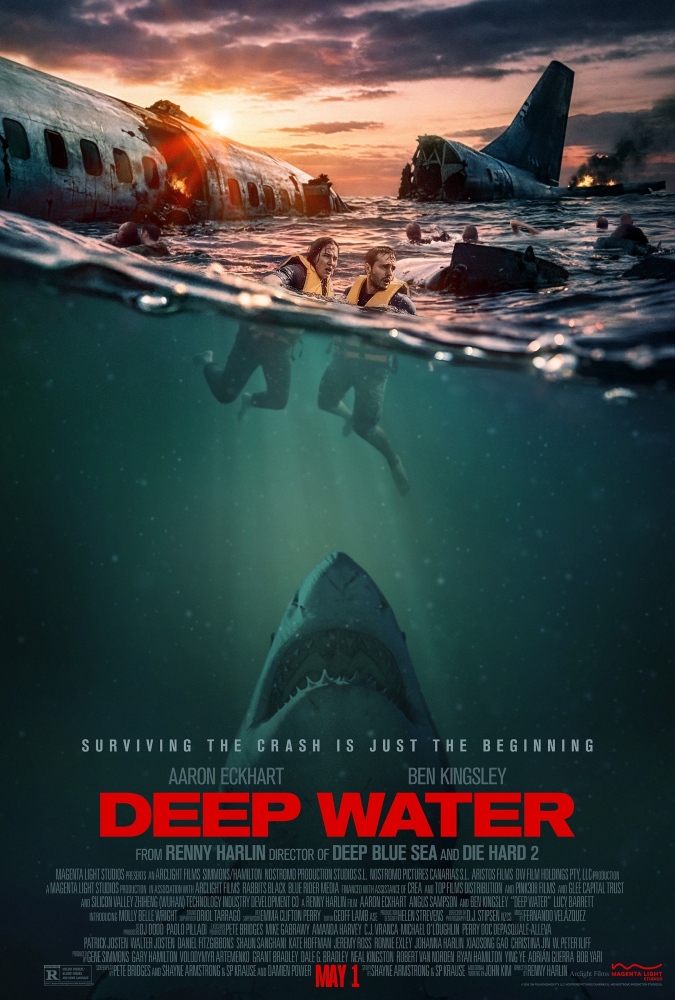
Northeastern Airline Flight N-140 takes off under Captain Richard Peters, heading on a course to Shanghai. Soon into the flight, turbulence causes cargo to shift and an improperly stored battery in the cargo deck explodes and causes a fire. This ends up blowing out the engine and causing an explosive depressurisation. The plane crashes into the sea and pancakes, splitting into three pieces. The first officer Ben is forced to abandon the wounded Rich in the cockpit. He attempts to herd those in the nose section to safety but realises that they are surrounded by sharks. Other survivors floating in the mid-section or trapped in an air bubble in the sinking tail section try to survive as the sharks circle to pick them off.
Jaws (1975) created the Killer Shark Film. It spawned several sequels and a good many imitators. By the late 2000s, these had graduated to the deliberately ridiculous with the likes of Mega Shark vs Giant Octopus (2009) and the cult bad movie hit of Sharknado (2013), followed by a whole host of imitators. This same period also brought a growing body of killer shark films that take a more survival horror focus and feature people stranded in shark-infested waters with the likes of Open Water (2003) and sequels, The Reef (2010) and sequel, The Shallows (2016) and 47 Meters Down (2017) and sequel. In recent years, the survival in shark-infested waters film has become its own niche with the lesser budgeted likes of Adrift (2017), Great White (2021), Swim (2021), Maneater (2022), The Requin (2022), Shark Bait (2022), Shark Waters (2022), The Black Demon (2023), Blind Waters (2023), The Last Breath (2024), Shark Warning (2024), Something in the Water (2024), Beast of War (2025), Fear Below (2025), Great White Waters (2025), Into the Deep (2025), The Bay (2026) and Chum (2026).
Deep Water was originally intended as a sequel to Bait (2012), the ridiculous Australian film about shark loose in a supermarket. However, this was sidelined after the disappearance of Malaysian Airline Flight 370 in 2014, where real-life came too close to the film’s plot about a plane crashing at sea. Later revived as a standalone script, Deep Water comes as a Frankensteinian coalition of international companies in Spain, USA, New Zealand, Australia and China. It ends up with what must be a record number of 58 names listed as producers (including executive, associate, co and line producers). This includes some interestingly odd names such as Gene Simmons, the lead singer/bassist for 70s rock group Kiss, as a producer.
The cast is a mix of Hollywood names – like Aaron Echkart and Ben Kingsley (who at age 82 when the film comes out, looks well past retirement age – the International Civil Aviation Organization mandates a ceiling of age 65 for commercial airline pilots), along with assorted Australian, New Zealand and Chinese names among the passenger complement. The most amusing of these Angus Sampson, James Wan’s co-writer and co-star on Saw (2004) and the Insidious films, as the cantankerous hardhead among the group.
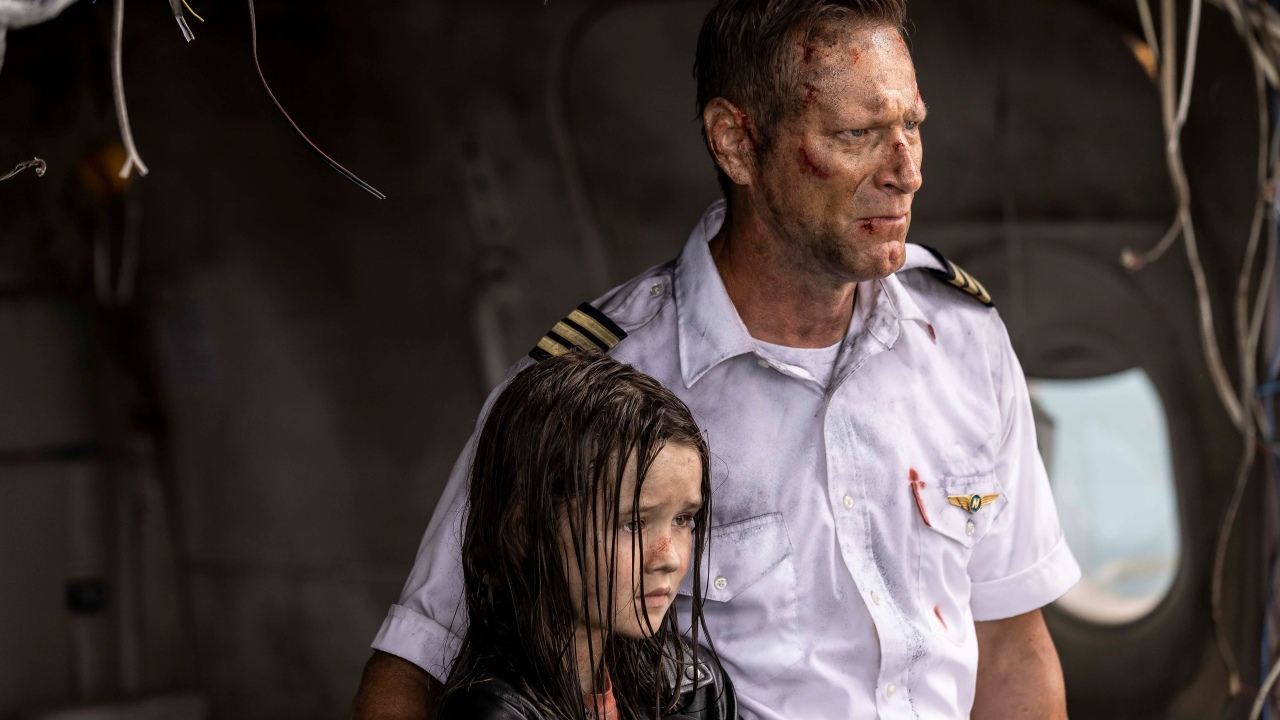
Deep Water comes out as a conceptual gimmick that makes it feel as though it has been conceived as a mix of a Disaster Movie and a Killer Shark film. Your immediate comparison is to Airport ’77 (1977) with its passenger plane downed at sea having been crossbred with one of the survival in shark-infested waters films. Unlike the standard shark-infested waters film that has maybe half-a-dozen people in a raft or swimming, this offers a full disaster movie complement of characters including stranded hostesses, a cute kid, members of a sports team and their coach, young lovers, two different hotheads, the co-pilot left in charge who has unresolved family separation issues, and an elderly woman who makes snide remarks comparing herself to Shelley Winters in The Poseidon Adventure (1972).
Renny Harlin is someone who has long been on my list of bad directors. The Finnish born Harlin first appeared in the US with his third and fourth films, Prison (1987) and A Nightmare on Elm Street IV: The Dream Master (1988), and then gained a modest degree of respectability with Die Hard 2 (1990), followed by a series of mindlessly spectacular action films like Cliffhanger (1993), CutThroat Island (1995), The Long Kiss Goodnight (1996) and Driven (2001). Into the millennium, Harlin seemed to demonstrate a predilection for genre material with the likes of the previous killer shark movie Deep Blue Sea (1999), the universally derided Exorcist: The Beginning (2004), the serial killer thriller Mindhunters (2004), the supernatural horror The Covenant (2006), the unsolved mystery The Dyatlov Pass Incident (2013), The Legend of Hercules (2014), the Wu Xia Legend of the Ancient Sword (2018), and the trilogy The Strangers: Chapter 1 (2024), The Strangers: Chapter 2 (2025) and The Strangers: Chapter 3 (2026).
I had fairly much written Renny Harlin off as a complete hack. None of his films are very good at all. Which is why Deep Water ends up being a surprise. Certainly, it is a film with an eminently predictable script where most of the characters run to expected arcs. Nevertheless, Harlin makes good drama out of it. The scene where the plane goes down is a seat-edge piece with the engines exploding, flaming debris ripping through the cabin, the plane depressurising and coming apart, passengers thrown around and dragged out, the reef tearing open the floor and water rushing in.
You are drawn to compare Deep Water to Renny Harlin’s earlier ridiculous shark film Deep Blue Sea. By contrast, the sharks here are malevolent and incredibly aggressive. When most shark-infested waters films have them merely appearing as circling fins, this has them as full-size beasts leaping into liferafts. Harlin generates quite reasonable tension out of these scenes such that you are almost prepared to forgive four decades of bad filmmaking. The only point that this enters the absurd realm of Deep Blue Sea is a scene where a shark manages to drag down a helicopter by attacking a diver being winched down into the water.
Trailer here