

Crew
Director/Screenplay – Lawrie Brewster, Based on Short Stories A Watcher By the Dead (1889) by Ambrose Bierce & Cool Air (1928) by H.P. Lovecraft, Producers – Lawrie Brewster & Sarah Daly, Photography – Michael Brewster. Production Company – British Horror Studios/Hex Studios/Amicus.
Cast
A Late Appointment:- Laurence R. Harvey (Dr Graves), Megan Tremethick (Charlotte Gibbon), Dorian Ashbourne (Mancher), Laurie Brewster (Dr Mayley), Nick Ford (Dr Alfred Hawver). A Watcher By the Dead:- Dorian Ashbourne (Dr Mancher/Jarette), Sam Barclay (Harper), Michael Daviol (Dr. Helberson). The One Way Ward:- Megan Tremethick (Charlotte Gibbon), Jonathan Hansler (Dr. Walker), Chris Capaldi (Dr. Maitland), Jane Merrow (Margaret). A Diagnosis of Death:- Nick Ford (Dr Alfred Hawver), Lawrie Brewster (Dr Mayley), Alex Zorn (Dr Johnson), Novarro Ramon (Thomas), Peter Mahoney (The Mortician)
Plot
A Late Appointment:- A group of people arrive at a seemingly abandoned hospital. They are guided to a meeting in the basement with Dr Graves. A Watcher By the Dead:- Two junior doctors, Mancher and Harper, are approached about an experiment by Dr Helberson, who wants someone to spend the night in the basement with a corpse. Harper agrees to use himself as a subject. The One Way Ward:- Charlotte Gibbon signs on as a nurse at the hospital. She becomes intrigued by patients who are taken away to what is referred to as the One Way Ward. She sneaks in and discovers that Dr Walker is conducting experiments in trying to prolong life indefinitely by reducing the temperature and injecting subjects with a formula. Charlotte eagerly signs on to assist because she has a terminal condition. A Diagnosis of Death:- The American Dr Hawver is taken on at the hospital to replace Dr Mannering who has gone missing. Hawver tries to find Mannering’s secrets that have resulted in a ward of other doctors reduced to an incurable state. As he uncovers, Mannering was able to predict the exact time of people’s deaths and sought a method to prevent these.
Formed in 1962, Amicus Films was the most successful of the companies that jumped on the Anglo-Horror Cycle of the 1950-70s that had been created by Hammer Films. Amicus’s signature film was the Horror Anthology, beginning with Dr Terror’s House of Horrors (1965) and including the likes of Torture Garden (1967), The House That Dripped Blood (1970), Asylum (1972), Tales from the Crypt (1972), The Vault of Horror (1973) and From Beyond the Grave (1974). They did make various other films, including several other horror films, psycho-thrillers, rock‘n’roll movies, several SF films, a duo of lost world films beginning with The Land That Time Forgot (1974), and two films adapted from the tv series Doctor Who (1963-89, 2005– ) starring Peter Cushing with Dr Who and the Daleks (1965) and Daleks Invasion Earth 2150 A.D. (1966), even a Harold Pinter adaptation The Birthday Party (1968).
Lawrie Brewster is a Scottish director who has making B-budget films since first appearing with White Out (2011). He has mostly worked in horror with the likes of Lord of Tears (2013), The Unkindness of Ravens (2016), The Black Gloves (2017), Automata/The Devil’s Machine (2019), Dragon Knight (2022), Ghost Crew (2022), The Vance Institute (2023), The Slave and the Sorcerer (2024) and The Reign of Queen Ginnarra (2025), as well as a previous anthology For We Are Many (2019). He has also produced a number of other films. Brewster can be seen on screen here in the role of the bespectacled Dr Marley in the third episode.
The Amicus anthology horror occupies a cherished place in British genre cinema meaning that In the Grip of Terror and revival of the Amicus name arrives with a considerable burden of expectation heaped on their shoulders. Lawrie Brewster speaks with great passion about a love of the Amicus films and of a desire to bring back a return of the British horror studio tradition. To this extent, he contacted the estate of Milton Subotsky, the co-founder of Amicus who passed away in 1991, and negotiated the use of the Amicus title with his family. The opening credits dedicate the film to Subotsky, while his widow Fiona suggested the two short stories that are adapted in the film and his two sons Sergei and Dmitri act as Executive Producers.
Brewster has also made all effort to preserve the look and feel of the original films – something he describes as an alternate history in which Amicus never ceased production in 1977. This is even taken to the extent of maintaining a soft 1970s setting – the hospital uses rotary dial phones, while Jonathan Hansler’s doctor types his notes on a typewriter. Brewster also treats the material with seriousness rather than any kind of audience-winking irony – about all I picked up was a patient named Grimsdyke, the name of Peter Cushing’s character in Tales from the Crypt.
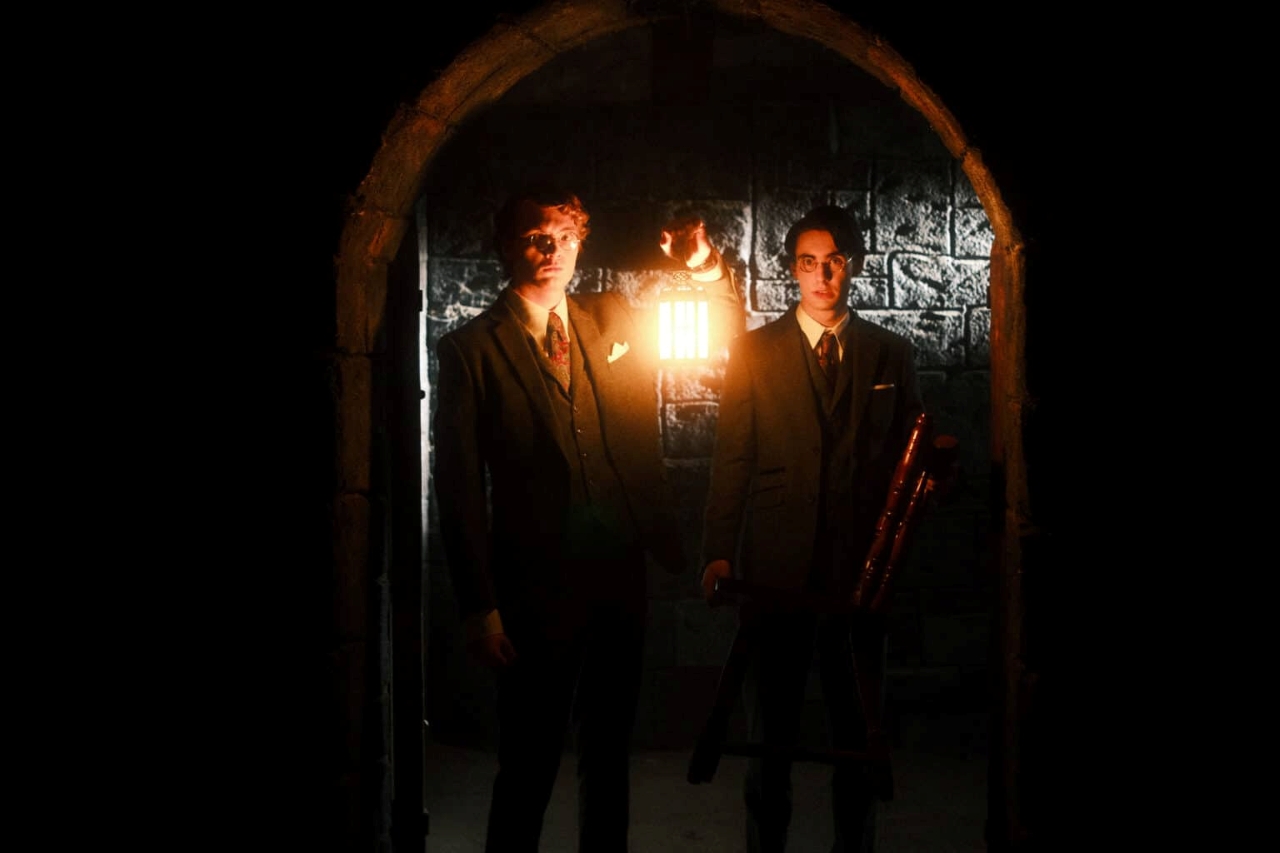
There are many of the familiar aspects of the Amicus film. The hospital setting recalls something of Asylum; the wraparound with the trio of figures gathered recalls the characters gathered in the basement in The Vault of Horror; while Laurence Harvey is not dissimilar to narrators like Cushing’s Dr Terror in Dr Terror’s House of Horrors or Ralph Richardson’s Crypt Keeper in Tales from the Crypt who gather to tell stories before spelling out ill fates for the characters. You could only contrast this to the revival of Hammer Films brand in the late 2000s, where the films produced, while not unworthy in themselves, had none of the style or feel of the classic Hammer films. (There was a company called Amicus Entertainment operating briefly in the US in the late 2000s, producing Stuck (2007) and It’s Alive (2008), but they appear to have merely appropriated the Amicus name).
The clearest difference from the classic Amicus formula is one of length. All of the Amicus anthologies tell either four or five stories plus a wraparound within a runtime of around 90-100 minutes – the shortest is Asylum at 88 minutes and the longest The House That Dripped Blood at 102 minutes, running to an average of just over fifteen minutes apiece give or take. By contrast, In the Grip of Terror gives us three stories and a wraparound within a one hour and 45-minute runtime. This mean that each of the stories is getting a longer runtime – an average of 26 minutes each.
This is something that both has its advantages and disadvantages. The Amicus stories were models of economy – tightly structured and to the point and with no fat on the bone. The stories here are looser and allowed to divert, even occasionally feel padded – you feel that they would have been trimmed in places in the Amicus heyday. The advantage however is that allows Brewster to build more sustained atmosphere than the old films usually had time to do. The film’s atmosphere building is superb.
The first episode A Watcher By the Dead, adapted from the 1889 story of the same name by Ambrose Bierce, has something of films like The Vigil (2019) or Simon Barrett’s The Empty Wake episode of V/H/S/94 (2021) wherein a person must spend the night with a corpse. The episode gets some superlative candle and match lit atmosphere as Sam Barclay maintains his vigil and the body starts to stir. The one minus point is that In the Grip of Terror is often marked by some abrupt veers of tone – here the end of the segment goes off into broad grotesquerie with Sam Barclay’s reappearance as a Beetlejuice (1988)-like figure, which jars with the exemplary build of atmosphere prior to that.
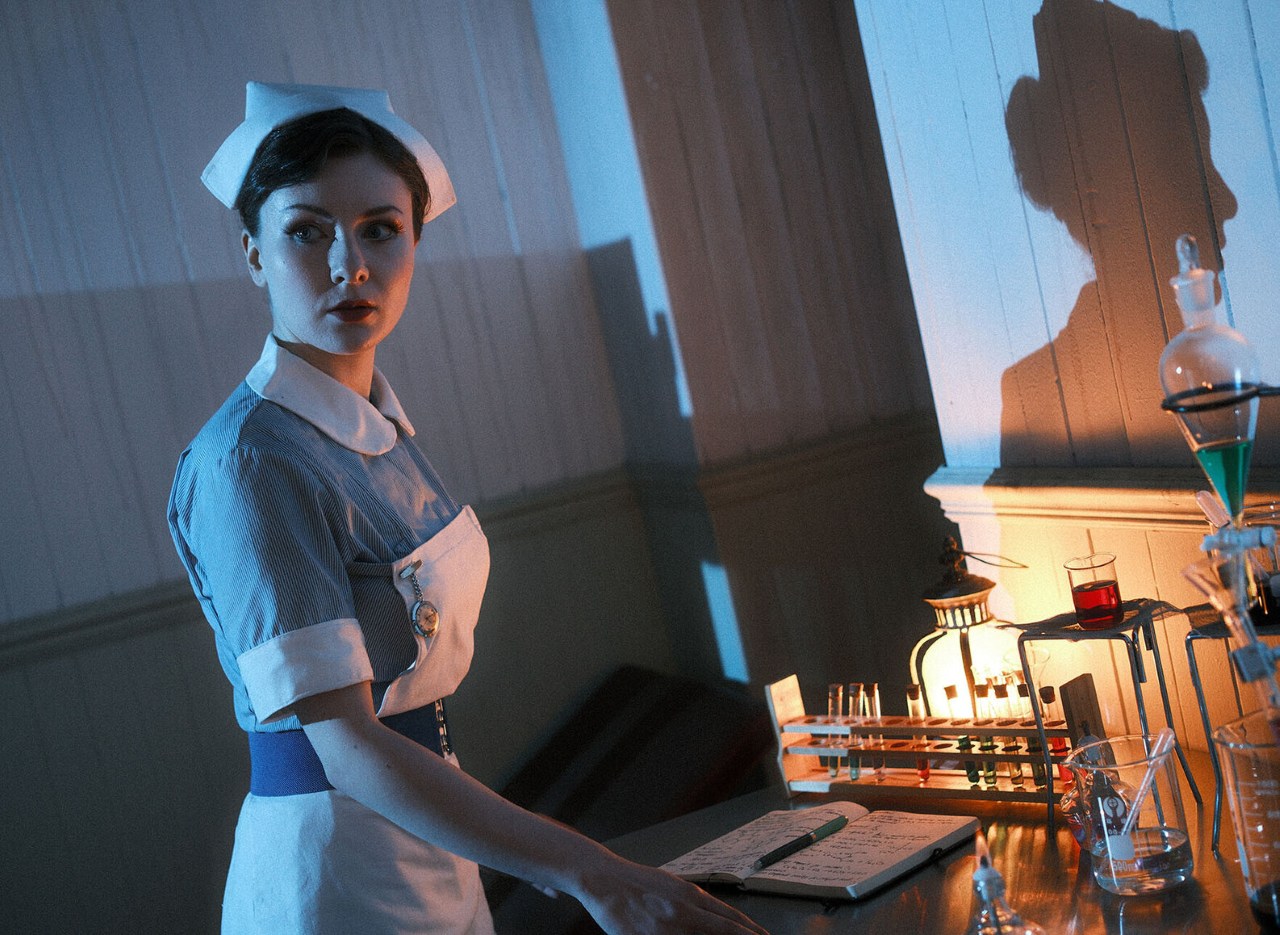
The One Way Ward is the standout episode of In the Grip of Terror. It is a very loose adaptation of H.P. Lovecraft’s Cool Air (1928), which has been twice filmed before – as an episode of the Lovecraft anthology Necronomicon (1994) and as Albert Pyun’s H.P. Lovecraft’s Cool Air (2006). Brewster goes for broke in terms of atmosphere with Dutch angles and amazing lighting schemes that gradually reduce everything to a near-monochrome. Brewster regular Megan Tremethick stands out with a wide-eyed performance that almost takes on a near-silent-screen physicality. The episode also gets in an appearance from Jane Merrow, a classic actress from the 1960s and 70s – she never appeared in an Amicus film but was in Hammer’s Hands of the Ripper (1971).
A Diagnosis of Death is an original episode with a doctor investigating arcane experiments on the patients at the hospital. More beautiful moody lighting during the scenes with Nick Ford in his predecessor’s apartment. This is one episode that could have done with some trimming – some of the scenes feel padded and the central story never tightens enough. In another of the odd veers of tone, the episode shifts to the basement where an experiment abruptly bursts into patients performing and dancing to a rockabilly number. No doubt Brewster was also contriving to wind in homage to Amicus’s brief ventures into 1960s rock‘n’roll cinema with the likes of It’s Trad, Dad! (1962) and Just for Fun (1963) but it is a tonally jarring scene that feels bizarrely out of place.
Occasional inconsistences aside, In the Grip of Terror takes an ambitious bite into a revered legacy and succeeds. It is a promising start. I’d certainly welcome back Amicus to the marketplace and look forward to seeing more in this vein. As it is, Lawrie Brewster and his team are off to a great start.