

Crew
Director – Albert Pyun, Screenplay – Cynthia Curnan, Based on the Short Story Cool Air (1928) by H.P. Lovecraft, Producers – Cynthia Curnan, Robert Ladeisch & Norbert Weisser, Photography – James Carl Hagopian, Music – Tony Riparetti, Visual Effects/Makeup Effects – Lars Simkin. Production Company – Curnan Pictures Wrekin Hill Entertainment/ Curnan Pictures/Sound Logic Studios/Robert Ladesich Films. Inc./CMPS, LLC.
Cast
Morgan Weisser (Charles Baxter), Virginia Dare (Estella Hayward), Crystal Green (Dr Shockner), Wendy Phillips (Mrs Hayward), Norbert Weisser (Aaron Deltoid)
Plot
Down-on-his-luck screenwriter Charles Baxter rents a room at the Malibu home of Mrs Hayward. Not long after, Mrs Hayward orders Charles out for becoming too friendly with her autistic daughter Estella only for Charles to abruptly have a heart-attack. Dr Shockner, the mysterious guest who lives in the room on the top floor and never leaves, comes to Charles’s aid. Through this, Charles learns Dr Shockner’s secret – that she keeps her life preserved by a means that require the air conditioning in her room be kept at 55 degrees.
Cool Air (1928) was a short story from H.P. Lovecraft (1890-1937), whose works have gained a considerable cult following and resulted in numerous films adaptations (see below and a more detailed listing in Lovecraftian Films). Lovecraft’s Cool Air story concerns an unnamed narrator who rents an apartment in New York City. Suffering a heart-attack, he seeks the aid of upstairs neighbour Dr. Muñoz who keeps his room chilled to 55 degrees (Fahrenheit, which is about 12 degrees Celsius). The narrator then learns that Muñoz died several years earlier and has been keeping his body preserved through maintaining chill temperatures. Cool Air had previously been filmed as The Cold episode of the Lovecraft anthology Necronomicon (1993).
As with most of Albert Pyun’s films made this side of the 2000s, Cool Air appears to be shot on a low-budget. It is contained within the locale of a single Malibu big house (I won’t say mansion) that Pyun and Curnan have either rented, borrowed or is maybe even their own home. This is a fairly modern house and nowhere near suggests the dread that Lovecraft’s story does – we don’t even, for instance, enter into Shockner’s room and see her cooling equipment.
Dr Munoz from the original is now rewritten as a woman (played by Crystal Green). The script adds a few other characters around the house, including Virginia Dare as the autistic daughter. Now I am all in favour of a higher representation of those on the ASD spectrum in the media but the performance that Dare gives, stuttering and repeating things, does no service to this.
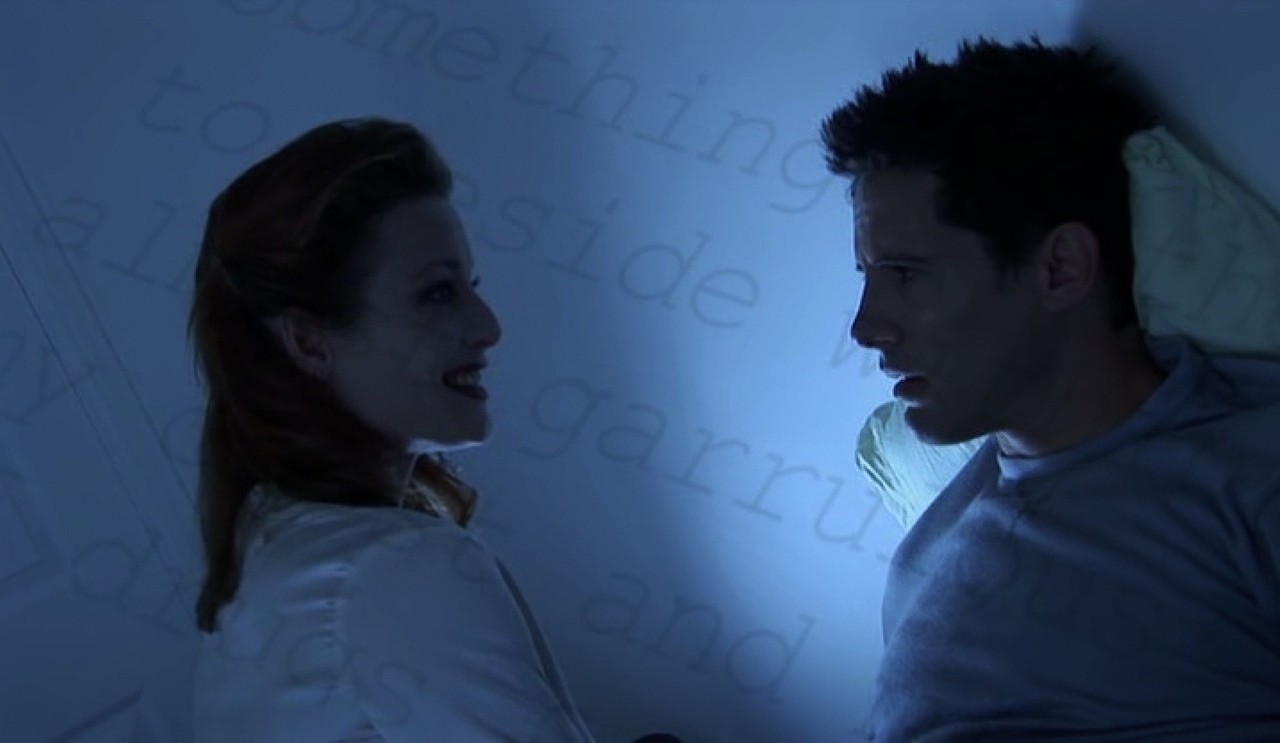
As Cool Air started, I quite liked the voiceover narration. This comes with the flavour of classic Film Noir almost, even though the style and surroundings are very modern. However, after an intriguing start, the film goes way downhill. It becomes nothing more than a series of scenes – mostly set in Morgan Weisser’s bedroom as various people come in and talk to him. We don’t even hear what these others say as most of these scenes are narrated in voiceover by him too. That and the odd effect of the words said being projected in typeface on the wall behind him. Almost the whole film is these narrated stories while Morgan Weisser is a patient in bed, before he just gets well, Shockner dies and he leaves. Talk about a major letdown.
Albert Pyun’s other films are:– The Sword and the Sorceror (1982), Radioactive Dreams (1984), Vicious Lips/Pleasure Planet (1987), Alien from L.A. (1988), the uncredited Journey to the Center of the Earth (1988), Cyborg (1989), Deceit (1989), Captain America (1990), Dollman (1990), Brain Smasher… A Love Story (1993), Knights (1993), Nemesis (1993), Arcade (1994), Hong Kong 1997 (1994), Heatseeker (1995), Nemesis 2: Nebula (1995), Nemesis 3: Timelapse (1995), Adrenalin: Fear the Rush (1996), Nemesis 4: Death Angel (1996), Omega Doom (1996), Postmortem (1998), Ticker (2001), Infection (2005), Bulletface (2007), Left for Dead (2007), Tales of an Ancient Empire (2010), The Interrogation of Cheryl Cooper (2014) and Interstellar Civil War (2017).
Other films based on the works of H.P. Lovecraft include:- The Haunted Palace (1963), Die, Monster, Die/Monster of Terror (1965), The Shuttered Room (1967) and The Dunwich Horror (1969). The big success in the modern era was Stuart Gordon’s splattery black comedy version of Re-Animator (1985), which popularised Lovecraft on film. This led to a host of B-budget Lovecraft adaptations, including Stuart Gordon’s subsequent From Beyond (1986), The Curse (1987), The Unnameable (1988), The Resurrected (1992), Necronomicon (1993), The Unnamable II: The Statement of Randolph Carter (1993), Lurking Fear (1994), Stuart Gordon’s Dagon (2001), The Dream-Quest of Unknown Kadath (2003), Beyond the Wall of Sleep (2006), Chill (2007), Cthulhu (2007), The Tomb (2007), Colour from the Dark (2008), The Dunwich Horror (2009), The Color (2010), Pickman’s Muse (2010), The Whisperer in Darkness (2011), The Dark Sleep (2013), The Haunter of the Dark (2015), Herbert West: Re-Animator (2017), Color Out of Space (2019), H.P. Lovecraft’s The Deep Ones (2020), the tv series Lovecraft Country (2020), Markham (2020), H.P. Lovecraft’s Witch House (2021), The Lurking Fear (2023), Suitable Flesh (2023), H.P. Lovecraft’s The Old Ones (2024), The Innsmouth School for Girls (2024) and Unspeakable: Beyond the Wall of Sleep (2024). Lovecraft: Fear of the Unknown (2008) is a documentary about Lovecraft.
Also of interest is The Manitou (1978), which features an appearance of the Great Old One; Cast a Deadly Spell (1991) and its sequel Witch Hunt (1994), a tv movie set in an alternate world where magic works and where the central character is a detective named H.P. Lovecraft; Juan Piquer Simon’s cheap and loosely inspired Cthulhu Mansion (1992); John Carpenter’s Lovecraft homage In the Mouth of Madness (1995); the fan parody The Last Lovecraft: Relic of Cthulhu (2009) and the parody Call Girl of Cthulhu (2014); even a trilogy of animated children’s film Howard Lovecraft and the Frozen Kingdom (2016), Howard Lovecraft and the Undersea Kingdom (2017) and Howard Lovecraft and the Kingdom of Madness (2018) in which a young Lovecraft encounters his own creations; while Batman faces Lovecraftian horrors in the animated Batman: The Doom That Came to Gotham (2023); and Lovecraft homages such as H.P. Lovecraft’s Monster Portal (2022), The Breach (2022) and Gods of the Deep (2023). The Elder Gods turn up at the end of The Cabin in the Woods (2012), Lovecraft (Paul Titley) appears as an imaginary companion in Ghostland/Incident in a Ghostland (2018) and In Search of Lovecraft (2008) features a tv news crew discovering that Lovecraft’s works are true. Lovecraft’s key work of demonic lore The Necronomicon also makes appearances in films such as Equinox (1970), The Evil Dead II (1987) and Army of Darkness (1992), and was also borrowed as an alternate retitling for Jesus Franco’s surreal and otherwise unrelated Succubus/Necronomicon (1969) about a BDSM dancer.
Trailer here