
Crew
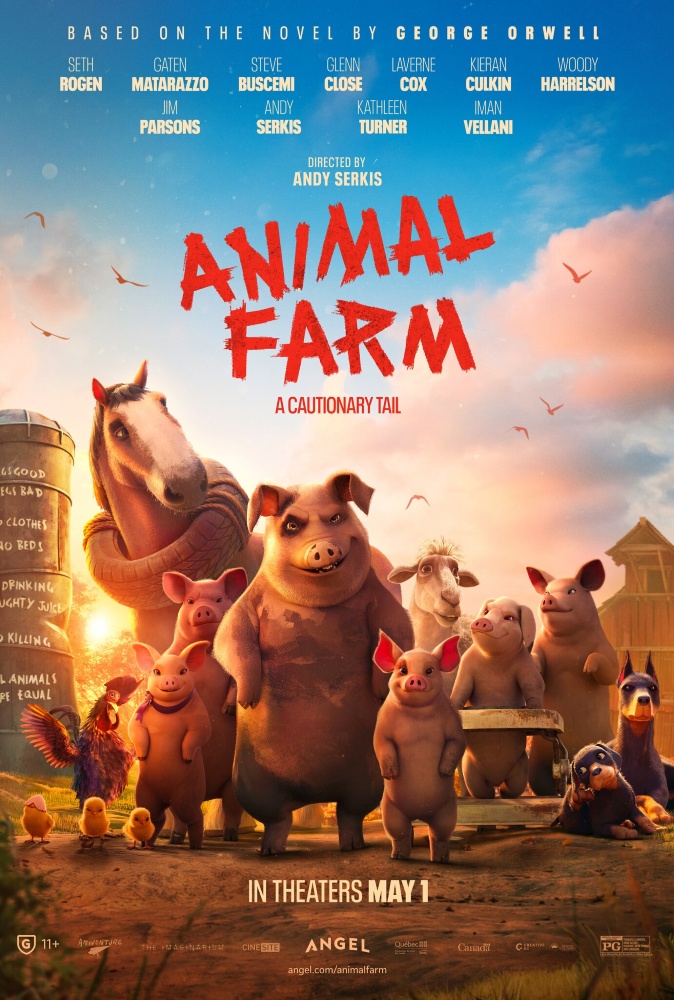
Director – Andy Serkis, Screenplay – Nicholas Stoller, Based on the Novel Animal Farm (1945) by George Orwell, Producers – Jonathan Cavendish, Adam Nagle, Peter Nagle, Peter Rosenbaum & Andy Serkis, Music – Heitor Pereira, Animation – Cinesite, Visual Effects Supervisor – Mark Theriault, Animation Supervisor – Ryan Schaller, Production Design – Amos Sussigan. Production Company – Angel/Aniventure/The Imaginarium.
Voices
Seth Rogen (Napoleon), Gaetan Matarazzo (Lucky), Glenn Close (Frieda Pilkington), Woody Harrelson (Boxer), Laverne Cox (Snowball), Kieran Culkin (Squealer), Iman Vellani (Puff/Tammy), Steve Buscemi (Jeffrey Whymper), Jim Parsons (Carl/The Sheep), Kathleen Turner (Benjamin)
Plot
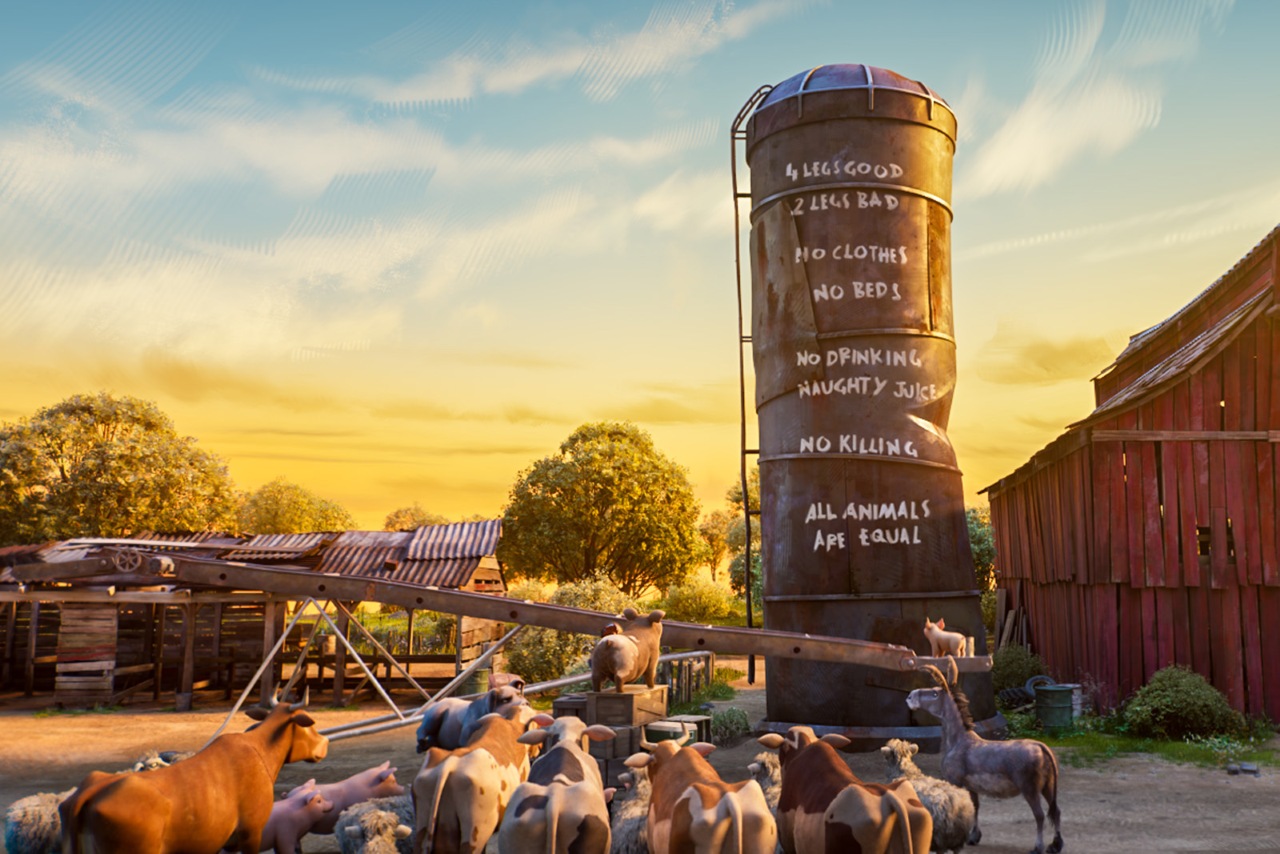
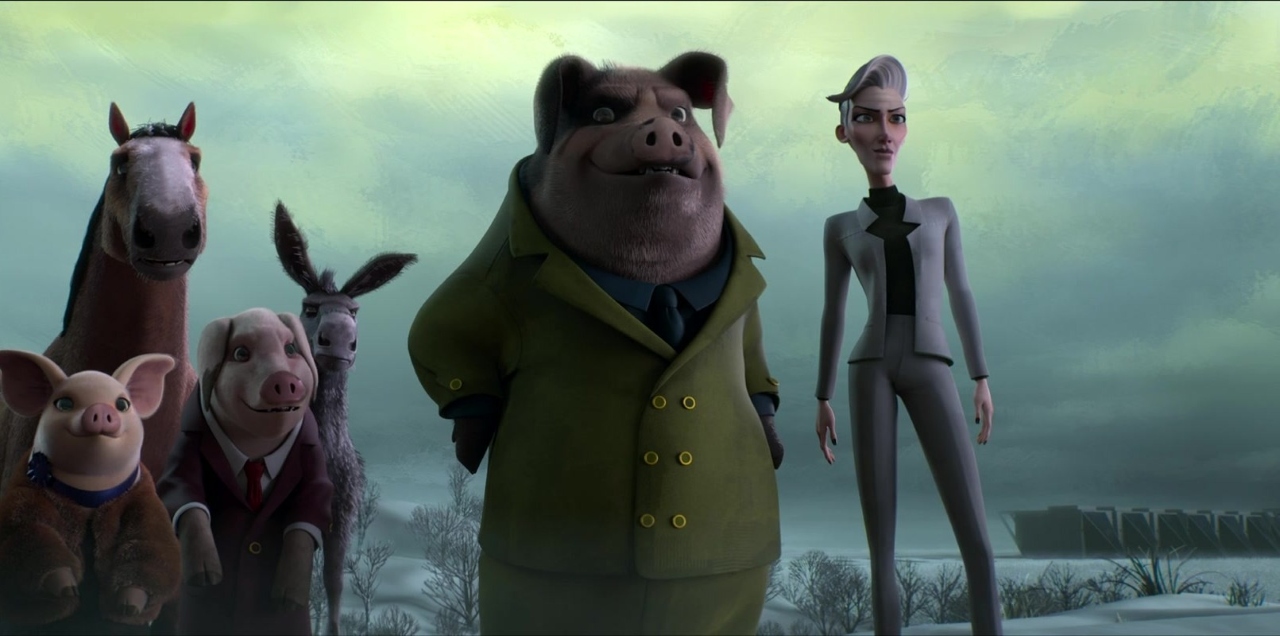
The animals at Manor Farm are herded into a truck and realise that the property is being foreclosed and they are being taken to the slaughterhouse. Instead, they stage a rebellion against Farmer Jones and take over the farm. Vowing to never repeat the mistakes of Farmer Jones, the pig Snowball establishes a series of rules banning living in the farmhouse, wearing clothes, drinking alcohol, and swearing to treat all equally. However, the more aggressive pig Napoleon pushes his way in to take over and twists the rules to banish Snowball. They then learn that the farm still owes money to the bank. They devise a scheme to deal with this by setting up a market to sell the produce. When this runs to a profit, Napoleon spends the money on clothes and a sports car for himself. Napoleon is wooed by Frieda Pilkington, CEO of the corporation opposite Manor Farm, who suggests they build a massive dam on the property. The young pig Lucky is swept up in this but comes to soon see that Napoleon has become all that the animals vowed to never be.
Animal Farm (1945) is a novel by George Orwell, the British writer who is best known for Nineteen Eighty-Four (1949). Orwell was a dedicated socialist and had fought in the Spanish Civil War but became disillusioned with the way he saw the ideals he was fighting for put into practice by Communism and the Soviet Regime. Animal Farm was written as an allegory using talking animals to enact the Russian Revolution and how an authoritarian figure (Josef Stalin the form of the pig Napoleon) corrupts a system intended to treat all equally to his own advantage. The book was previously filmed as Animal Farm (1954). the first animated film to be made in England, and as the live-action Animal Farm (1999).
This version comes from actor Andy Serkis and his The Imaginarium production company. Serkis was an actor who was propelled to fame after appearing as the motion captured animated Gollum in The Lord of the Rings: The Two Towers (2002). This has made Serkis into the world’s top performance capture actor and he has played other parts such as the title role in King Kong (2005) and Caesar in the Planet of the Apes reboot trilogy, along with assorted live-action roles. Serkis made his directorial debut with the non-genre Breathe (2017), the true-life story of a young man paralysed with polio. He subsequently went on to make a motion-capture animated version of Rudyard Kipling’s The Jungle Book stories with Mowgli (2018) and then Venom: Let There Be Carnage (2021). He has next been announced as director of The Lord of the Rings: The Hunt for Gollum (2027).
The script has been handed over to Nicholas Stoller, a British born writer who has directed a number of light comedies with the likes of Forgetting Sarah Marshall (2008), Get Him to the Greek (2010), Neighbors (2014), Bros (2022) and You’re Cordially Invited (2025), as well as the animated Storks (2016). Stoller has also written a number of other films, including Fun with Dick and Jane (2005), Yes Man (2008), Gulliver’s Travels (2010), The Muppets (2011), Muppets Most Wanted (2014), Sex Tape (2014), Zoolander 2 (2016), Captain Underpants: The Epic First Movie (2017) and Dora and the Lost City of Gold (2019).
Andy Serkis’s directorial outings swing between Mowgli, which was quite good, and Venom: Let There Be Carnage, which is possibly the single worst superhero film made this side of the 2000s. One was hopeful for Animal Farm at the outset but it plunges into the awful within minutes. (You really hope like anything that Serkis can turn this around in time for The Hunt for Gollum but his batting average is not looking positive).
It is not a good sign for a film adaptation when it opens on a progression of scenes that do not even exist in the book – the animals about be taken away to the slaughterhouse; the farm about the be foreclosed by a banker; and everything being observed by drones from a sinister corporate figure in a corporate tower (which also doubles as a mall later on) that just happens to be located right across the road from Manor Farm. Oh and the revolution occurring with rap songs playing on the soundtrack. And the film’s central character of Lucky doesn’t even exist in the book. By this point, you easily get the impression that George Orwell might be spinning in his grave.
Things proceed to get worse from there. I get where Serkis and Stoller were coming from – Orwell wrote Animal Farm in 1945 so there was the desire to modernise it and make it relevant for today’s audiences and bring in contemporary themes about the evils of big corporate influence. But oh boy. Stoller has just written everything in terms of what he is used to – mainstream US comedy and modern animation where Orwell is supplanted by cutsie one-liners and gags. At one point, we get Napoleon letting loose a rip-roaring fart and proclaiming “This is the sound of freedom.” Although the film’s singularly most cringe-inducingly awful moment is where Napoleon stands up in the corporate boardroom and announces “Call me Na-po-po” – and then asks where his action figure marketing accessory is.
Orwell never gave the humans in the story beyond Farmer Jones any life. This helped preserve the delicate fantasy of talking animals. The film has no compunction about this and has the animals and humans readily mixing. In one of the most ridiculous twists, the animals learn that they owe money to the bank and so respond by creating a farmer’s market at the farm, selling produce and with the animals even repurposed to give human rides. There are scenes with the animals walking through and shopping at the mall. Animals buy cellphones and use them to film the comic mishaps of the initial attempts to walk on two legs. They are even given credit cards and Na-po-po gets to drive a high-end sports car.
It should be pointed out that the film reaches the ending of the book – where the animals observe that the pigs in the farmhouse have now become indistinguishable from the humans – is reached about halfway through the film (and even then it has to hammer the audience over the head with the point). About the point of the climactic scenes where there is the building of a massive dam on the property and Napoleon has become a dictatorial figure addressing a vast rally to proclaim “Some animals are more equal than others”, followed by the other animals sabotaging his media feed with videos of cute chicks and blowing the dam up, you can only shake your head at what an utterly sad and pathetic trashing of Animal Farm that we have ended up with.
George Orwell’s most famous book Nineteen Eighty-Four (1949) has been filmed variously as the BBC tv play Nineteen Eighty-Four (1954) and the films 1984 (1956), Nineteen Eighty-Four (1984) and 1984 (2023). Orwell: 2+2=5 (2025) was a documentary about Orwell.
(Winner Worst Film in this site’s Worst Films of 2025 list).
Trailer here