


Crew
Director – King Hu, Screenplay – Chong A. Cheng & King Hu, Based on Stories from the Strange Tales from a Chinese Studio (1766) by Pu Songling, Producer – Ng Ming Choi, Photography – Stephen Yip, Music – Ng Tai Kong, Art Direction – James Leung & Wang Ji Xian. Production Company – New Treasurer Films Co.
Cast
Cheng Ching Sai [Adam Cheng] (Wang Hsi-Tzu), Joey Wong (You Feng), Samo Hung (High Monk), Wu Ma (Senior Monk), Lau Shun (Zheng Daoling), Lam Ching-Ying (Purple Taoist)
Plot
Wang Hsi-Tzu is studying for the imperial exams. On his way home, he comes across a woman You Feng who says she has fled from her home. He offers her a place to stay with him and then sets about trying to persuade his wife to let him take You Feng on as his concubine. The wife looks in at You Feng bathing to see that she has removed her painted face mask to reveal something hideous beneath and realizes that she is a ghost. Wang goes to seek the help of two Taoist monks. As the monks come into the fray, You Feng reveals that she intends no harm and has made an escape from the Lord of Yin and Yang. However, the lord has now arrived seeking vengeance.
Hong Kong cinema between the early 1980s and late 1990s contained an unparalleled outpouring of fantastic cinema. Tsui Hark didn’t create Wu Xia Cinema but popularised it with the completely nutty Zu: Warriors from the Magic Mountain (1983). This was followed not long after by the hits of Mr Vampire (1985) and A Chinese Ghost Story (1987), which built on this to create a unique blend of martial arts and Chinese supernatural. This was followed by a huge outpouring of films that blended martial arts, flying swordplay, Eastern beliefs and the supernatural, along with liberal doses of broad comedy. (See Hong Kong Cinema).
However, the person who can be said to have created the Wu Xia films is director King Hu (1932-97) going way back to the 1960s, including Come Drink With Me (1966), the first flying swordsman film, and others such as the hit Dragon Gate Inn (1966), the acclaimed A Touch of Zen (1969), The Fate of Lee Khan (1973), The Valiant Ones (1974), Legend of the Mountain (1979), The Invincible Ones (1982) and Swordsman (1990), which spawned a popular series of sequels. Painted Skin would be Hu’s last film. The King of Wuxia (2022) is a documentary about Hu.
It is clear that Painted Skin has been intended as a copy of A Chinese Ghost Story – the two films are even adapted from stories found in the same volume Strange Tales from a Chinese Studio (1766). There is the same basic plot in each – an innocent scholar who is drawn in by and has feelings for a ghost girl who is in thrall to a demonic lord of hell and the need to call on monk(s) adept in Eastern beliefs to fight to save her and banish the evil. Both films even have the same actress Joey Wong playing the ghost girl and feature Wu Ma as a monk. The film also imports Lam Ching-Ying, the mainstay of the Mr Vampire film series.
On the other hand, Painted Skin is also a copy of A Chinese Ghost Story that, for the most part, lacks the crazed energy that director Ching Siu-Tung gave that film – at least up until the climactic scenes. The film does start to perk up and gain some colour when it comes to the pageantry of the Lord of Yin and Yang in black demon mask and his entourage of masked figures and dancers. Or of phantom figures flitting over the tops of walls. But mostly the early sections take place without much verve. Part of the problem may have been King Hu. As the documentary The King of Wuxia (2022) reveals, Hu was used to taking a year to make a film was not at home in the Hong Kong cinema of the 1980s-90s where producers enforced much quicker shooting schedules on him.
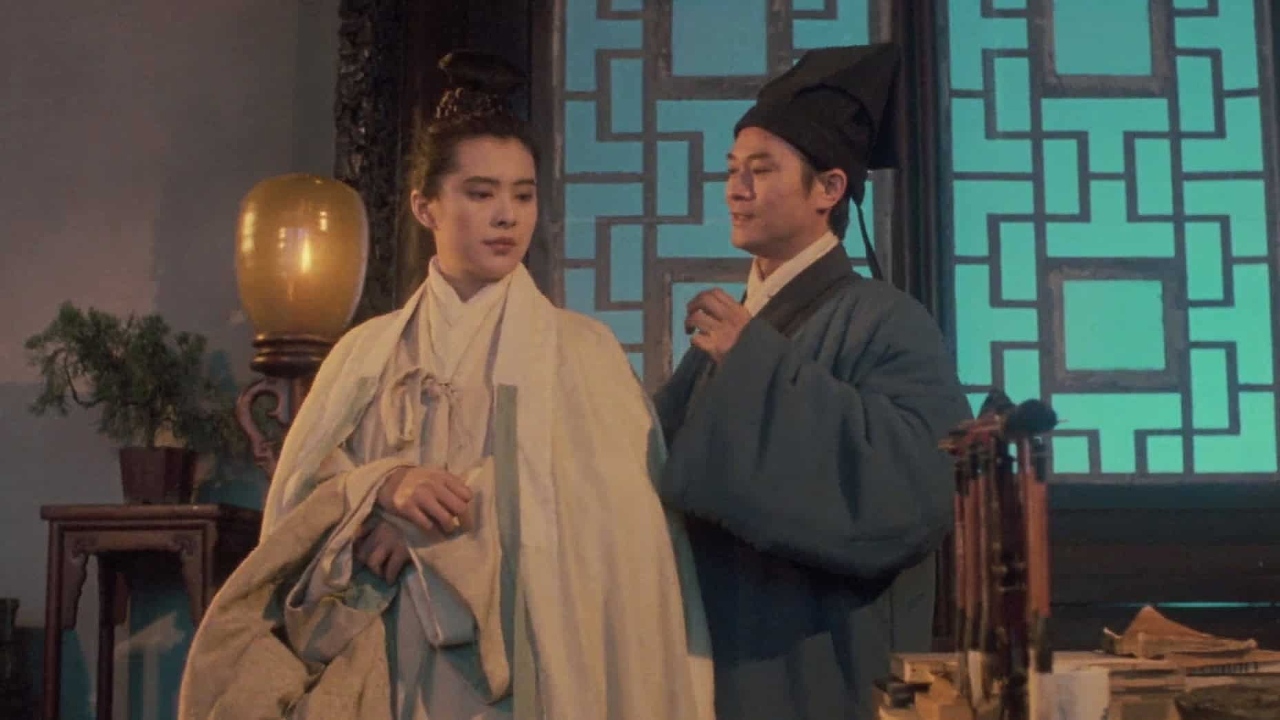
The film starts off as one story – a scholar (Adam Cheng) encounters a girl (Joey Wong) and tries to persuade his wife to let him move her in as a concubine before finding she is a ghost on the run from a demon overlord. In the latter half of the story, the ghost girl gets sidelined and the film becomes about the monks fighting against the demon overlord, who then possesses the human body of Adam Cheng. It feels like two different films mashed together.
Certainly, of these two sections, the first half is the better, concentrated on building up the ghostly triangle. That said the ‘painted skin’ aspect is not that relevant – we get one scene peeping in through the wall slats as Joey Wong takes her face mask off to reveal a single shot of something hideous beneath and that is it. It is also a storyline where the comic conflict between the scholar and the two women gets dropped and forgotten without any dramatic resolution.
The latter half with the monks is less interesting for some time but does pick up considerably at the climax. This involves the monks battling the Lord of Yin and Yang amid assorted acrobatic, wall and tree bouncing moves with gusts of blown leaves, supernatural winds, with they blasting one another with fireballs, flying through the air and firing off nets of cobweb. It is entertainingly lively, although I have seen other offerings in the genre that do all of this much better.
The film was late remade as Painted Skin (2008), which spawned a sequel Painted Skin: The Resurrection (2013) and was spun off into a tv series Painted Skin (2011).
Full film available here