


Crew
Director – Kunio Miyoshi, Screenplay – Masumi Suetani, Producer – Hiroaki Kitayama, Photography – Yoshinori Sekiguchi, Music – Toshiyuki Watanabe. Production Company – Toho.
Cast
Sayaka Yamaguchi (Lora), Megumi Kobayashi (Moll), Aki Hano (Belvera), Hikari Mitsushima (Shiori), Masaki Otake (Kohei), Shimada Maganao (Yoji), Atsushi Okuno (Mikio Kotani), Hajime Okayama (Junichi Nagase), Maho Nomani (Princess Yuna)
Plot
On Okinawa Island, young Shiori discovers a small furry gorgo creature and shows it to her classmates Kohei and Yoji. The witch Belvera appears and persuades two corrupt fishermen Kotani and Nagase to try and steal the gorgo back. Mothra’s handmaidens, the tiny Elias sisters, appear to the children, explaining that they need the gorgo to show the way to the legendary land of Ninai Kanai. Both they and Belvera are seeking Ninai Kanai’s treasure to fight back against Dagahra, a monster made from all the pollution in the ocean’s waters. The children set sail in a small boat under the gorgo’s direction and the pyramid city of Ninai Kanai rises from the waters. Both the awakened Mothra and the risen Dagahra arrive and enter into combat with one another.
Mothra is the most famous of Toho’s Japanese movie monsters next to Godzilla. Mothra first appeared in her own film Mothra (1962) and was shortly after pitted up against Godzilla in Godzilla vs the Thing (1964). Thereafter she became a regular fixture of Toho’s classic monster bashes in the likes of Ghidrah the Three-Headed Monster (1964), Godzilla Vs the Sea Monster (1966) and Destroy All Monsters (1968).
In the 1990s, Toho began the process of reviving Godzilla and pitting it up against many of the classic monsters from the 1960s and 70s, albeit worked over with modern animatronic and later CGI effects. Amidst this, the Godzilla and Mothra match was reimagined in Godzilla and Mothra: The Battle for Earth (1992). This proved sufficiently successful for Toho to then revive Mothra in three standalone films beginning with Rebirth of Mothra (1996), followed by Rebirth of Mothra II here and the subsequent Rebirth of Mothra III (1998). Mothra has also appeared in several of the other modern Godzilla films with Godzilla vs Space Godzilla (1994), Godzilla, Mothra and King Ghidorah: Giant Monsters All-Out Attack (2001), Godzilla: Tokyo SOS (2003), Godzilla: Final Wars (2004) and Godzilla: The Planet Eater (2018), as well as the US-made Godzilla, King of the Monsters (2019) and Godzilla x Kong: The New Empire (2024).
These Rebirth of Mothra films are made for children. They come down around the level of the late 1960s Godzilla films – Son of Godzilla (1968), Godzilla’s Revenge (1969), or some of Daiei’s Gamera films – in terms of their focus. This becomes particularly evident here with the focus of the story around the adventures of three children and the inclusion of a small furry creature that looks like a miniature version of a Tellytubby with one eye and an antenna poking up from its head. There is a return of the witch from the first film (a madly overacting Aki Kano), who is accompanied by two idiot fishermen who become her henchmen and undergo assorted comic pratfalls.
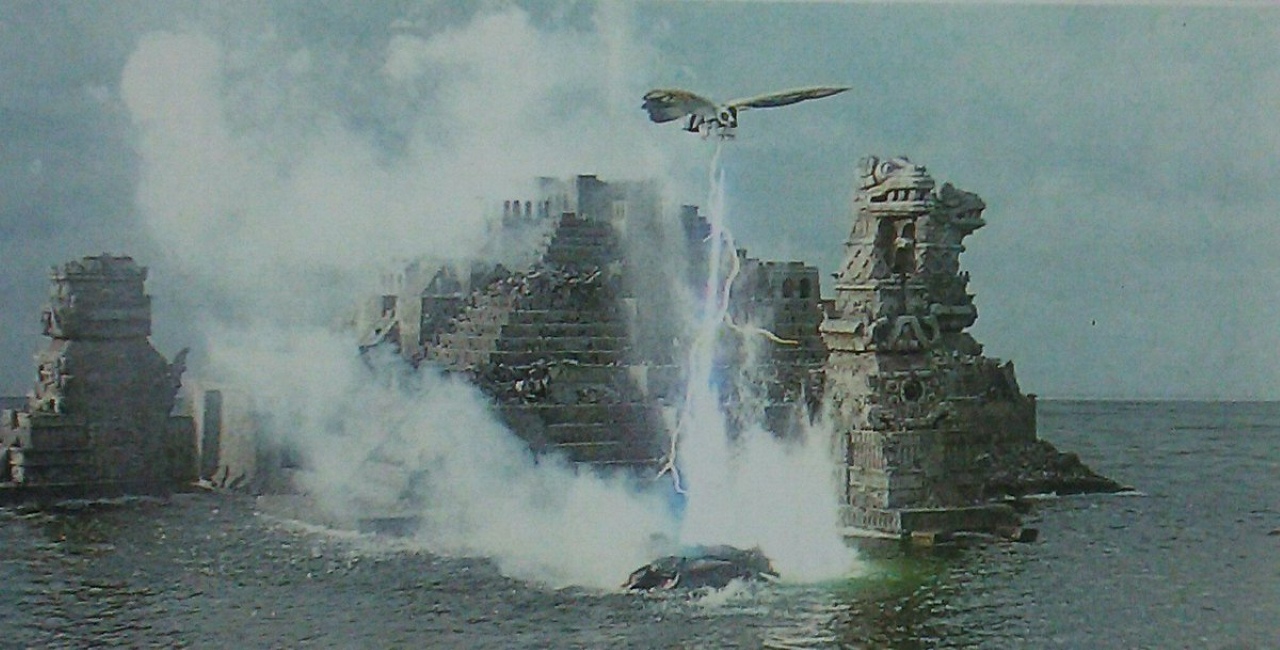
While most of the Godzilla films are rooted in nominal science-fiction elements – atomic monsters, alien invaders and the like, Rebirth of Mothra II plays far more to fantasy elements – witches, princesses revived from eternal slumber, creatures that emit lots of magical rainbow beams. There is a Lost City that rises from the deep – we are told this is Mu, which leaves you wondering if it is the same one referenced in Godzilla vs Megalon (1973). It looks like a South American pyramid and the latter half of the film involves much chasing around the halls of the pyramid city looking for the treasure.
The effects are about average for the 1990s monster movie and vary between quite good for the most part and the occasionally dodgy – the Dagahra monster looks rubbery – and with some decent models for the pyramid city. As always, Japanese Monster Movies are worth watching for the enjoyably ridiculous battles between the monsters. There are entertaining scenes with Mothra racing about firing rainbow-coloured ray blasts at Dagahra, it responding with crimson energy blasts up from beneath the lake and then trying to bodyslam Mothra into a hillside. The two Elias sisters fly alongside on a miniature version of Mothra, sending up blasts of green energy in an effort to heal Mothra.
The main problem is that two-thirds of Rebirth of Mothra II gets taken up by Mothra and Dagahra perched atop the pyramid firing energy blasts at one another, while the other parties run around inside the pyramid. After a time, this does start to drag. This does arrive at an appealing climax where Dagahra goes into the attack firing off a horde of red energy spiders at Mothra, which it responds to by firing out a flotilla of miniature Mothras that fly down Dagahra’s gullet and engage in a Star Wars (1977)-styled series of dogfights as they eliminate the miniature spiders.
Trailer here