
Crew
Director – Cate Shortland, Screenplay – Shaun Grant, Based on the Novel Berlin Syndrome (2011) by Melanie Joosten, Producer – Polly Staniford, Photography – Germain McMicking, Music – Bryony Marks, Visual Effects Supervisor – Murray Curtis, Production Design – Melinda Doring. Production Company – Aquarius Films.
Cast
Teresa Palmer (Claire Havel), Max Riemelt (Andi Werner), Matthias Habich (Erich Werner), Emma Bading (Franka Hummels), Elmira Bahrami (Jana), Chritoph Franken (Peter)
Plot
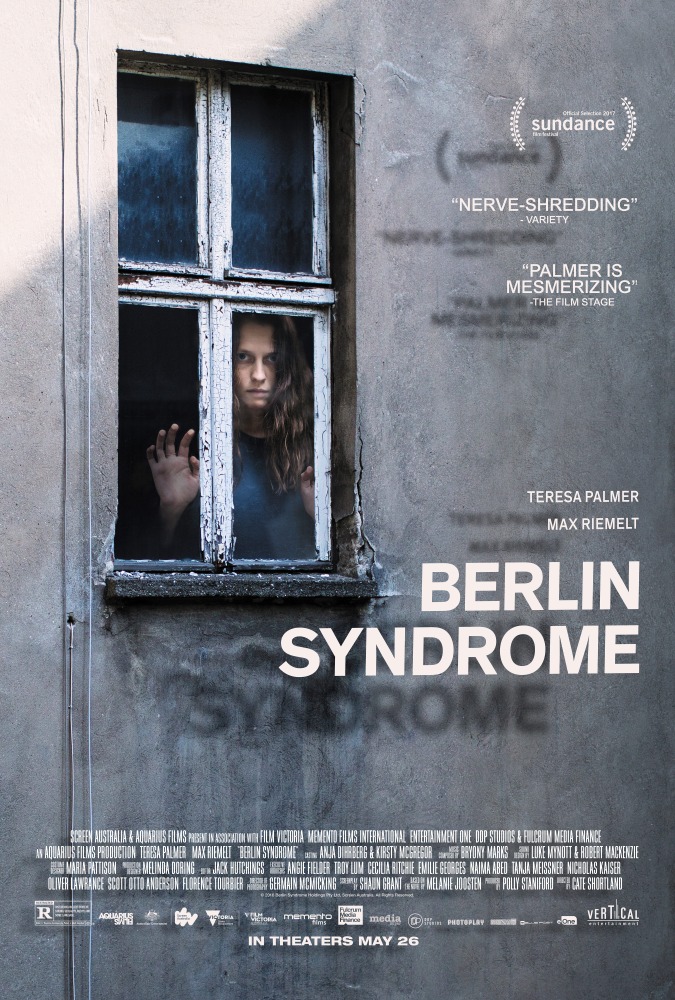
Australian Claire Havel arrives in Berlin on a backpacking holiday. After a chance encounter with local English teacher Andi Werner in the street, she allows him to show her the sights. Instead of going on to Dresden, she returns to be with him. He takes her back to where he lives in an abandoned block of apartments and they spend the night together. However, when she wakes in the morning, Claire finds that she is locked into the apartment and is unable to find the key. She then makes the realisation that Andi has made her his prisoner in the apartment.
Berlin Syndrome was the third feature film from Australian director Cate Shortland. She had first appeared with Somersault (2004). I had been majorly impressed with her second film Lore (2012) about an orphaned German family in the immediate aftermath of World War II. On the basis of Berlin Syndrome, Shortland was selected to helm the big-budget MCU film Black Widow (2021). The film is based on a 2011 debut novel from Melbourne social worker Melanie Joosten, which accrued her an award for Australian Best Novelist Under the Age of 30.
Berlin Syndrome is a variant on the Imprisonment Thriller. The story we have here was first conducted by The Collector (1965) in which shy nervous Terence Stamp makes object of his affections Samantha Eggar a prisoner in his cellar. The basics of the story have undergone numerous variations since from the likes of Scissors (1991), Boxing Helena (1993), Paranoid (2000), Bad Guy (2001), Captivity (2007), P2 (2007), Rogue River (2012), Estranged (2015), Road Games (2015) and Perfect Skin (2018), to other works such as Misery (1990).
The kind of story that Berlin Syndrome tells is a familiar one from The Collector onwards. The film’s storyline rides all the usual dramatic rollercoasters of hope and dashed disappointments as Teresa Palmer attempts to free herself – of trying to improvise escape attempts with items to hand, of trying to get help from other people nearby and then seeing these dashed.

In fact, you could that on a purely plotting level there is nothing in Berlin Syndrome that does not play out true to the plotting conventions (and clichés) of the genre. All of that said, it is also a film that works well. A large part of this is that Cate Shortland doesn’t set out to make a thriller so much as she does a relationship drama. As much time is spent on Teresa Palmer’s confinement and attempts to escape as it is on Max Riemelt’s life outside the apartment with his teaching job and aging father.
This is a film about a toxic relationship but in the early sections, something too many of these other films skip over, Cate Shortland takes the time to show us the romantic attraction between Teresa Palmer and Max Riemelt and invests this with a soft sincerity that communicates itself out through the screen. All before things turn nasty.
The two lead actors, Teresa Palmer and Max Riemelt, who are the only two present on screen for almost the entire film, both give good performances. She initially is all awkward nervousness but comes to find her strengths, while he plays with charms even when he is displaying darker things beneath. Berlin Syndrome is a slow burn film rather than a full thriller but the journey there is not unwelcome.
Trailer here