


Crew
Director – Renny Harlin, Screenplay – Allan R. Cohen & Alan Freedland, Producers – Alistair Burlingham, Mark Canton, Charlie Dombek, Christopher Milburn, Madelaine Petsch, Gary Raskin & Courtney Solomon, Photography – Jose David Montero, Music – Justin Burnett & Oscar Senen, Visual Effects – Reactor VFX (Supervisor – Ben Burrell), Special Effects Supervisor – Max McDonald, Prosthetics Supervisor – Ionel Popa, Production Design – Adrian Curelea. Production Company – Fifth Element/Stream Media/Sherborne Media.
Cast
Madelaine Petsch (Maya), Gabriel Basso (Gregory/Scarecrow), Richard Brake (Sheriff Rotter), Krystal Ellsworth (Dollface Photo Double), Ema Horvath (Shelly Barnes/Pinup), Rachel Stenton (Debbie), Hannah Galway (Claire), George Young (Howard), Jake Cogman (Young Scarecrow), Nola Wallace (Young Pinup), Kyle Breitkopf (Teenage Scarecrow), Finn Cofell (Teenage Pin Up), Pedro Leandro (Deputy Walters), Stephanie Aubertin (Teenage Dollface)
Plot
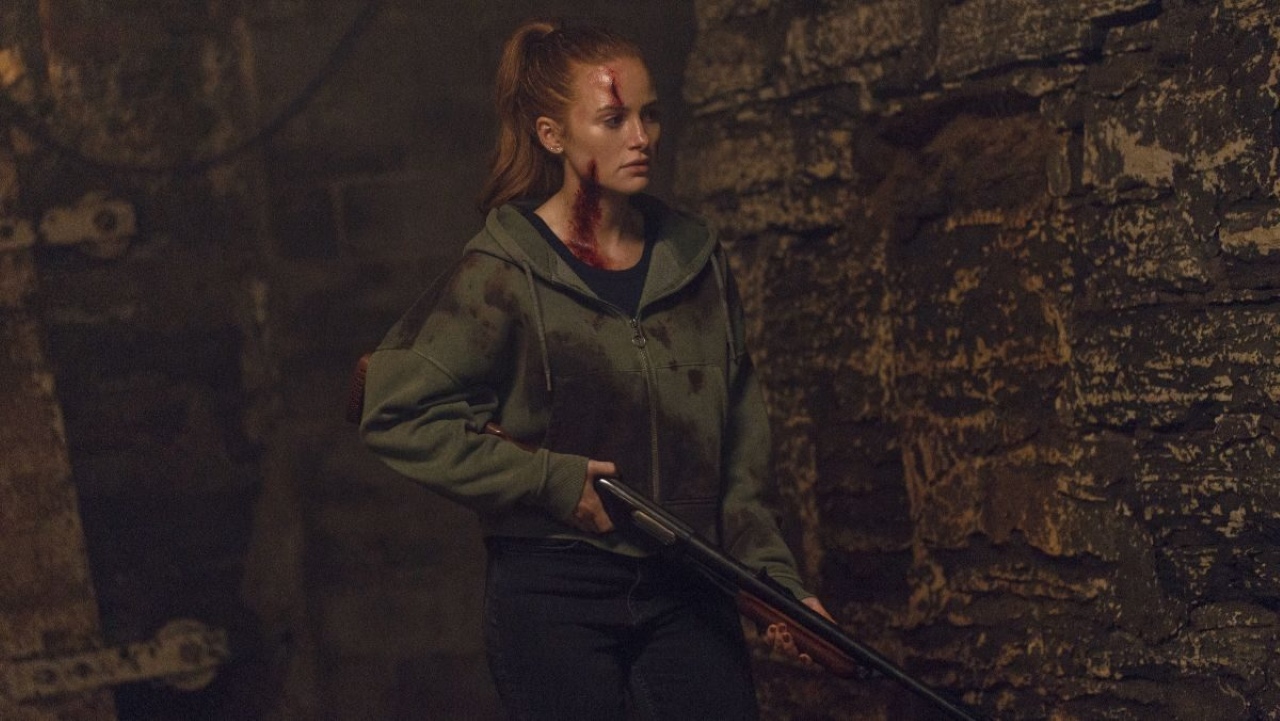
Maya attempts to make an escape from the town of Venus. She steals the sheriff’s car but crashes. She is recaptured and taken to the sawmill out of which The Strangers operate. There Scarecrow attempts to make Maya wear Pinup’s mask and become her replacement.
Bryan Bertino’s The Strangers (2008) was a superbly tense home invasion film and is considered a modern classic. There was one sequel with the strictly average The Strangers: Prey At Night (2018). In the 2020s, it was then announced that the series was going to be rebooted as a trilogy of films – the bad news is that this was to be placed in the hands of the perpetually terrible Renny Harlin (see below for Harlin’s other films). This emerged with The Strangers: Chapter 1 (2024), followed by The Strangers: Chapter 2 (2025) and The Strangers: Chapter 3 here concludes the trilogy.
I had a complete lack of enthusiasm for The Strangers: Chapter 3 and only sat down to watch out of professional obligation to cover major releases. Even though it had just over five months since I had watched the previous chapter, I found I was having to check online resources to remember who among the anonymous twenty-year-olds was who and their relationship to one another, whereas I could still vividly remember details about The Strangers from eighteen years earlier.
By now, Chapter 3 is so far divorced from the mood and tone of the original that it is not even the same type of film. The Strangers was an eerie home invasion story featuring blankly alien assailants, whereas Chapter 3 is more like a standard Backwoods Brutality film. There is one scene early on where the Strangers turn up at the motel room of Hannah Galway but this is over fairly soon and not sustained throughout the rest of the film. By the time of the assault on a caravan in a clearing, there is no atmosphere or tension at all, just raw brutalism.
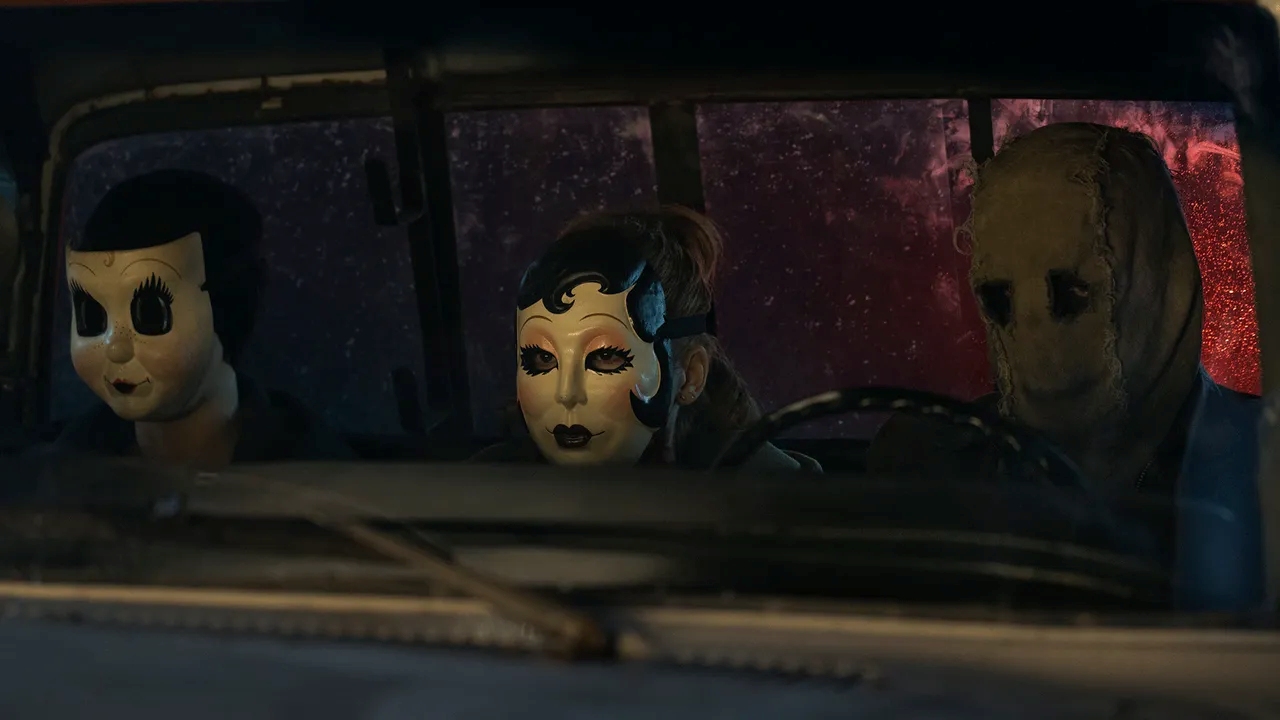
But then comes the point where Chapter 3 ends up surprising you. In the midst of this it diverts off to telling its origin story. We saw the origin story of Pinup Girl in Chapter 2 but this delves into the background of Scarecrow and shows how the two of them became The Strangers. And surprisingly enough this works better than all of the running around the backwoods that makes up the rest of the film. Not enough to make Chapter 3 a particularly great film but at least the most interesting out of all three of the Strangers: Chapters trilogy.
The film also concludes Maya’s story. Here we see Scarecrow forcing her to put on the Pin-Up’s mask and in effect become her and participate in a killing. [PLOT SPOILERS] This provides Maya with an arc that can be traced over the course of the three films, before the end where she turns killer and walks off with the mask in hand. What the script seems to forget is that in terms of the film’s chronology it has only been a day since the initial attack so we would have someone still severely traumatised. The unmasked Scarecrow scenes do however give us the rising and underrated Gabriel Basso who is fine in the role.
One of the big killers of the film for me was the choice of songs on the soundtrack. For some reason, the film opens with a cover version of Simon and Garfunkel’s The Sounds of Silence (1964). Why? Not the slightest idea what relevance it has to the scene. I was happy to dismiss this but then comes the ridiculous scene right at the end, which starts as a romantic conciliation between Madelaine Petsch and Gabriel Basso and turns into her stabbing him the moment he is in her arms. Any effect the scene might have had is rendered ridiculous by running it over with The Moody Blues’ Nights in White Satin (1967).
The Finnish born Renny Harlin first appeared in the US with his third and fourth films, Prison (1987) and A Nightmare on Elm Street IV: The Dream Master (1988), and then gained a modest degree of respectability with Die Hard 2 (1990), followed by a series of mindlessly spectacular action films like Cliffhanger (1993), CutThroat Island (1995), The Long Kiss Goodnight (1996) and Driven (2001). Into the millennium, Harlin seemed to demonstrate a predilection for genre material with the likes of the ridiculously entertaining killer shark movie Deep Blue Sea (1999), the universally derided Exorcist: The Beginning (2004), the serial killer thriller Mindhunters (2004), the supernatural horror The Covenant (2006), the unsolved mystery The Dyatlov Pass Incident (2013), The Legend of Hercules (2014), the Wu Xia Legend of the Ancient Sword (2018) and the killer shark film Deep Water (2026).
Trailer here