

Crew
Director/Producer – Pete Walker, Screenplay – Murray Smith, Photography – Norman Langley, Music – Cyril Ornadel. Production Company – Pete Walker Film Prods Ltd.
Cast
Susan George (Marianne Evans), Barry Evans (Eli Frome), Christopher Sandford (Sebastian Smith), Leo Genn (The Judge), Judy Huxtable (Hildegard), Kenneth Hendel (Rodriguez), Anthony Sharp (Registrar), John Laurimore & Martin Wyldeck (British Police Detectives)
Plot
Marianne Evans is a British girl working as a stripper in Portugal. She flees as people come in pursuit of her and accepts a ride with British traveller Sebastian Smith. Back in London, Sebastian persuades her to marry him after only two weeks together. However, after leaving the registry office, they find that the name of the best man, musician Eli Frome, has been accidentally listed as the husband on the marriage certificate. They must wait several weeks to get an annulment. However, Sebastian has been working for Marianne’s stepfather The Judge all along. The Judge wants to get back the documents that contain proof of his corruption that Marianne’s late mother placed in safekeeping until Marianne turns twenty-one in a few weeks’ time. Sebastian is given orders to bring Marianne to The Judge’s home in Portugal using any methods he can.
Britain’s Pete Walker is one of the more underrated and overlooked directors of the Anglo-Horror cycle of the 1970s. During this period, Walker made a string of psycho films beginning with Die Screaming Marianne, His other films include The Flesh and Blood Show (1972), Frightmare (1974), House of Whipcord (1974), House of Mortal Sin/The Confessional (1976), Schizo (1976), The Comeback (1978) and the old dark house film House of the Long Shadows (1983).
Pete Walker’s films regularly centre around psychos and crazed authority figures. The disappointment of Die Screaming Marianne, especially if you come to it after familiarity with Walker’s other films, is that it is a stretch to even call it a horror film at all. It is a thriller but not always a Psycho-Thrillers a la the fad created by Psycho (1960) – there are no psychos, for one. The plot centres around a scheme to obtain the secrets that are due to Susan George upon her 21st birthday, while the early sections centre around a somewhat far-fetched plot device where she gets married but the aging registrar (Anthony Sharpe who was also the psychopathic Catholic priest in Walker’s House of Mortal Sin/The Confessional) puts the name of the best friend on the wedding certificate by accident.
At a stretch – one that goes to almost complete snapping point – there is a scheme not dissimilar to the ones that appeared in various Old Dark House thrillers about defrauding a heroine of her inheritance. Susan George is sort of hunted around an abandoned building and there is a murder right at the end, but beyond that there is nothing that lists Die Screaming Marianne as horror. One of the finest sequences in the film is where Barry Evans is taken away by two police detectives (John Laurimore and Martin Wyldeck) to a rundown flat and, as we watch his reactions, it gradually dawns on him that he is there to be killed.
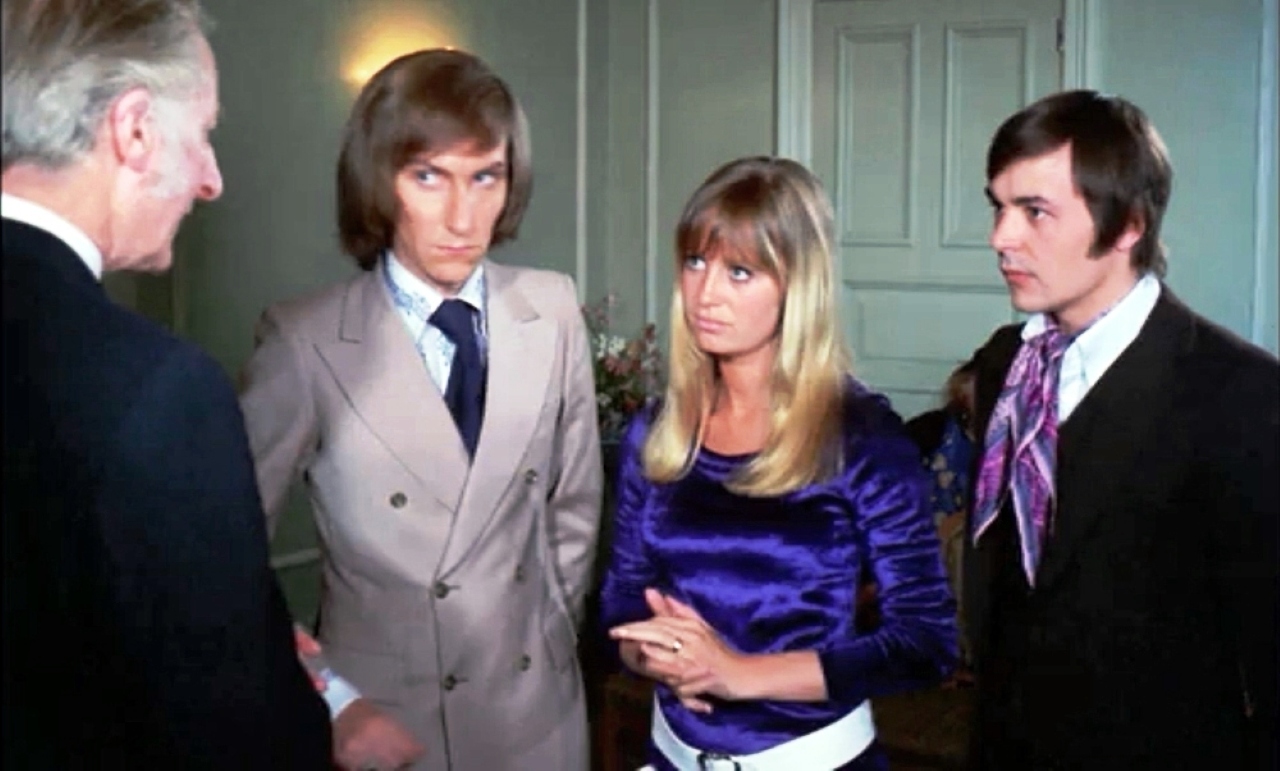
Leo Genn’s Judge is set up to be another of Walker’s psychopathic authority figures – “We shall have an orgy of repentance,” he says at one point, and there is a perverse scene when stepdaughter Judy Huxtable comes onto him and the film toys with an incest theme. Crucially though, all of these scenes could easily play out in a mundane thriller. And it is only being slapped with a title that makes it sound like a 1960s psycho-thriller that Die Screaming Marianne ended up being viewed as a horror film.
The film does have the benefit of Susan George, one of the loveliest actresses of the period – see her appearances in the likes of Fright (1971), Straw Dogs (1971), Dirty Mary, Crazy Larry (1974) and Tintorera (1977). Here she has a wonderful freshness and naturalness and is at her most radiantly lovely. On the other hand, the tall and bony, hawk-faced Christopher Sandford sends out creeper vibes from the moment he is introduced. How someone would not want immediately to run the other way when he pressures Susan George into marrying is one of the film’s big plausibility holes.
Trailer here