

Spain/Italy. 1970.
Crew
Director/Photography – Mario Bava, Screenplay – Santiago Moncada, Producer – Manuel Caño, Music – Sante Romitelli, Makeup – Elisa Anspach & Piero Mecacci, Set Design – Jesus Ma Herrero. Production Company – Pan Latina Films/Mercury Films/Peliculas Ibara & Cia S.A..
Cast
Stephen Forsyth (John Harrington), Laura Betti (Mildred Harrington), Dagmar Lassander (Helen Wood), Jesus Puente (Inspector Russell), Femi Benussi (Alice Norton)
Plot
John Harrington is the head of the House of Harrington fashion house in Paris that specialises in bridal wear. John is bitter and unhappy in his marriage to Mildred who controls all the finances and refuses to give him a divorce. John is also responsible for a series of bride murders where he woos models that are about to be married and then kills them. Police Inspector Russell suspects John but cannot prove it. John then kills Mildred and buries her body in the hothouse. Thereafter Mildred continues to reappear, haunting John and taunting him by letting others see that she is alive.
Hatchet for the Honeymoon was one of the films from the great Italian horror director Mario Bava (1914-80). Bava made extraordinary genre waves with his directorial debut Black Sunday (1960). This created the Continental Gothic horror film of the 1960s, which Bava dabbled in for a number of years. Around the same time, Bava also essentially created the Giallo psycho-thriller first with embryonic The Evil Eye (1962) and in particular with Blood and Black Lace (1964).
Giallo films derived from the psycho-thrillers, in particular the numerous copycats of Psycho (1960) that were being made in English-speaking countries around this time. In contrast to their English-language counterparts, giallo films placed their focus on psycho-sexual pathology and often cruel sexual misogyny and elaborately stylised killings. Bava’s preference was for the Continental Gothic, but he returned to the giallo film a number of other times with Hatchet for the Honeymoon, Five Dolls for an August Moon (1970) and Twitch of the Death Nerve/Bloodbath (1971).
Hatchet for the Honeymoon is one of Mario Bava’s finest films. The film comes shot amid exquisitely beautiful surroundings – conservatories, hothouses, a haute couturie fashion house, exquisitely laid-out gardens beside rivers. The contrast of such lavish surroundings and the stylised murders give the film an amazing sense of decadence.
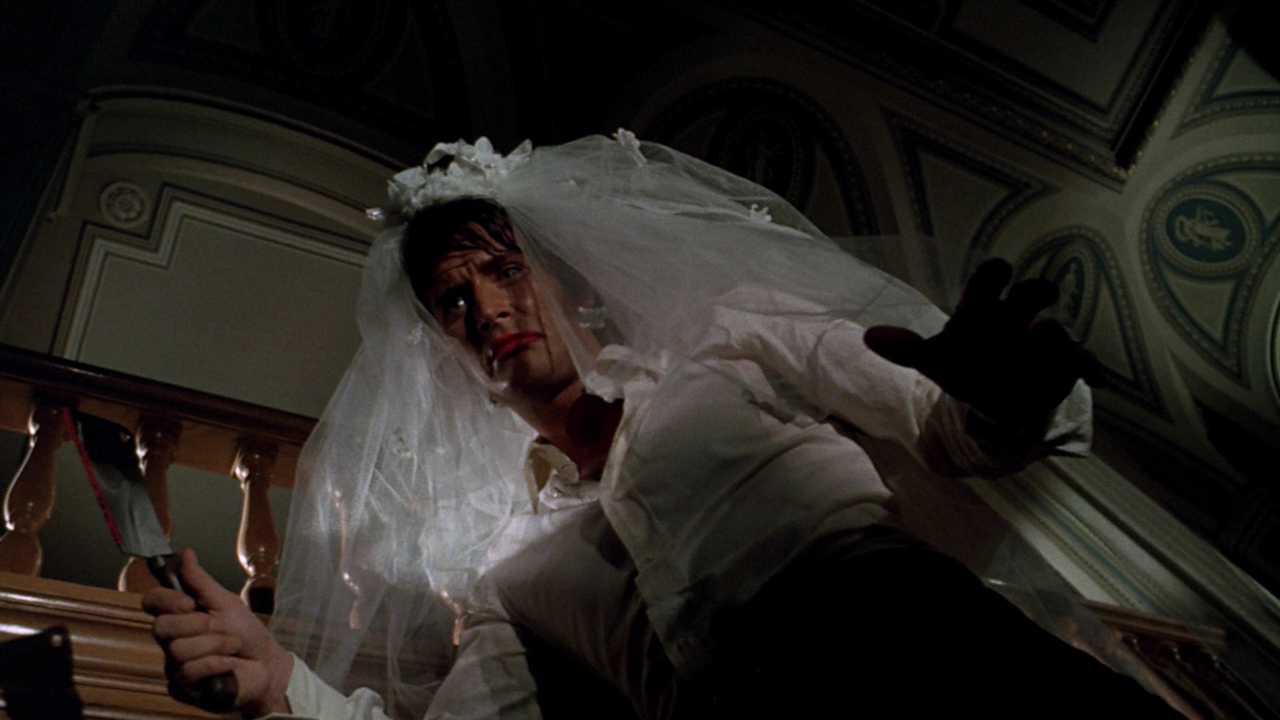
Rather fascinating is Bava’s choice of his lead actor in the impossibly handsome Stephen Forsyth. One of the most immaculately stylish aspects of the film is seeing the handsomely chiselled and perfectly groomed Forsyth and the trappings of his moneyed lifestyle, amid which his voiceover delivers a series of icy contemplations/confessions about murder. At one point he opines: “A woman should live only to her wedding night, love once and then die.” Here Bava has the misogynistic pathology of the giallo film at his most savagely refined.
Bava goes overboard on directorial style. There’s an amazing shot during the opening moments where Stephen Forsyth enters a cabin on a train to kill two newlyweds and raises his hatchet before the bodies and we see the reflection on the gleaming mirrored blade. There are extraordinary images throughout – Stephen Forsyth dancing with one of his victims with her in a bridal gown amid a room filled with mannequins in bridal gowns; his carrying the body into the conservatory filled with orchids and fluttering butterflies to bury it, all accompanied by a beautifully dreamy score.
The latter third of Hatchet for the Honeymoon ventures away from the giallo that takes up the rest of the film. Here Bava ventures into a Psychological Ambiguity – of seeing Stephen Forsyth haunted by the ghost of murdered wife Laura Betti. This whole section gets quite weird in the scenes where other people keep seeing her there and he can see nothing or vice versa. Bava ventured into this kind of territory in several of his other films – various of the episodes of Black Sabbath (1963) and the later Schock/Beyond the Door II (1977), which play an interesting game teasing the audience as to whether there is a genuine element of supernatural or it is all in the mind of the guilty party. The effect is taken from producer Val Lewton who in the 1940s created an amazing series of films that sat in such a sense of ambiguity, beginning with Cat People (1942). Here in Bava’s not always subtle hands, the effect comes out more as one of Edgar Allan Poe’s short stories about guiltily haunted parties in works like The Black Cat (1843) or The Tell-Tale Heart (1843).
Mario Bava’s other genre films are:- uncredited co-direction of Riccardo Freda’s I Vampiri (1957) and Caltiki the Immortal Monster (1959); the Gothic classic Black Sunday/The Mask of the Demon/The Revenge of the Vampire Woman (1960); the Greek muscleman fantasy Hercules in the Center of the Earth/Hercules vs the Vampires (1961); the giallo The Evil Eye (1962); the Gothic horror anthology Black Sabbath (1963); the Gothic horror Night is the Phantom/The Whip and the Body/What? (1963); the giallo Blood and Black Lace (1964); the Gothic Kill Baby … Kill/Curse of the Dead/Curse of the Living Dead/Operation Fear (1965); the sf/horror film Planet of the Vampires (1965); the spy comedy Dr Goldfoot and the Girls Bombs (1966), Bava’s worst film; the masked super-thief film Danger Diabolik (1967); the giallo Five Dolls for an August Moon (1970); the giallo Twitch of the Death Nerve/Bloodbath/A Bay of Blood/Carnage/Ecology for a Crime (1971); the Gothic Baron Blood (1972); the giallo/haunted house film Lisa and the Devil/House of Exorcism (1972); and the possession film Schock/Beyond the Door II (1977).
Trailer here
Full film available here