


Crew
Director/Screenplay – Amando de Ossorio, Photography – Francisco Sanchez, Photography – Modesto Perez Redondo, Music – Anton Garcia Abril, Special Effects – Soria-Molina, Makeup – Cristobal Criado, Set Design – Gumersindo Andres. Production Company – Profilmessa/Ancla Century Films.
Cast
Victor Petit (Dr Henry Stein), Maria Kosti (Joan Stein), Sandra Mozarosky (Lucy), Antonio Castro (Teddy), Julia James (Tilda Flanagan), Pilar Vela (Shopkeeper), Javier de Rivera (Old Doctor), Fernando Villena (Mr Flanagan), Mria Vidal (Mrs Flanagan)
Plot
Henry Stein and his wife Joan travel to a remote seaside village so that he can take up a position as the local doctor. However, they find the locals to be hostile, either ignoring them when they are talking to them or saying they need no doctor. The intellectually handicapped Teddy takes refuge with them, saying he is scared of the dark and Joan lets him sleep in the attic. Joan is kept awake at night by the ringing of a bell and the cries of seagulls. They see the locals conducting a ritual on the beach. What they do not realise is that the ritual is to spare the village from the undead zombies of Knights Templar that live in an abandoned monastery. The locals have created a bargain where each night for seven nights every seven years they must offer up a woman who is taken as part of the Templars’ occult sacrifices.
Night of the Seagulls was the fourth and last of the Blind Dead films from Spanish director Amando de Ossorio (1918-2001). de Ossorio had begun directing in the 1950s and from the late 1960s onwards began to specialise in horror. By far, de Ossorio’s most popular works were the Blind Dead series, featuring blind Knights Templar zombies. de Ossorio made four Blind Dead films, consisting of Tombs of the Blind Dead (1971), Attack of the Blind Dead/Return of the Blind Dead/Return of the Evil Dead (1973), The Ghost Galleon (1974) and finally Night of the Seagulls here. Curse of the Blind Dead (2020) was a modern revival.
As with the rest of the Blind Dead films, de Ossorio gets great moody atmosphere out of the crepuscular hooded corpses of the Templars rising from the tomb and then riding along the beach on their horses in slow-motion. These scenes hold great ominous threat. However, the problem with the Blind Dead films is that you see one of them and you have essentially seen them all – they are just variations on the same effect of the Templars returning to life and advancing in slow motion. Of the four films, the one worth seeing is the first – Tombs of the Blind Dead.
About all that de Ossorio did throughout each of the films was to vary the locations – aboard a ship in The Ghost Galleon and village settings here and in Return of the Blind Dead. Night of the Seagulls certainly gets a wonderfully desolate and abandoned-looking town as location. It has the sort of look that no production designer could ever authentically come up with out of the blue. It does leave you wondering exactly how many people live in the town – there seems less than a hundred involved in the procession along the beach – and how many grown daughters they keep having to produce to meet the demands of the sacrifice.
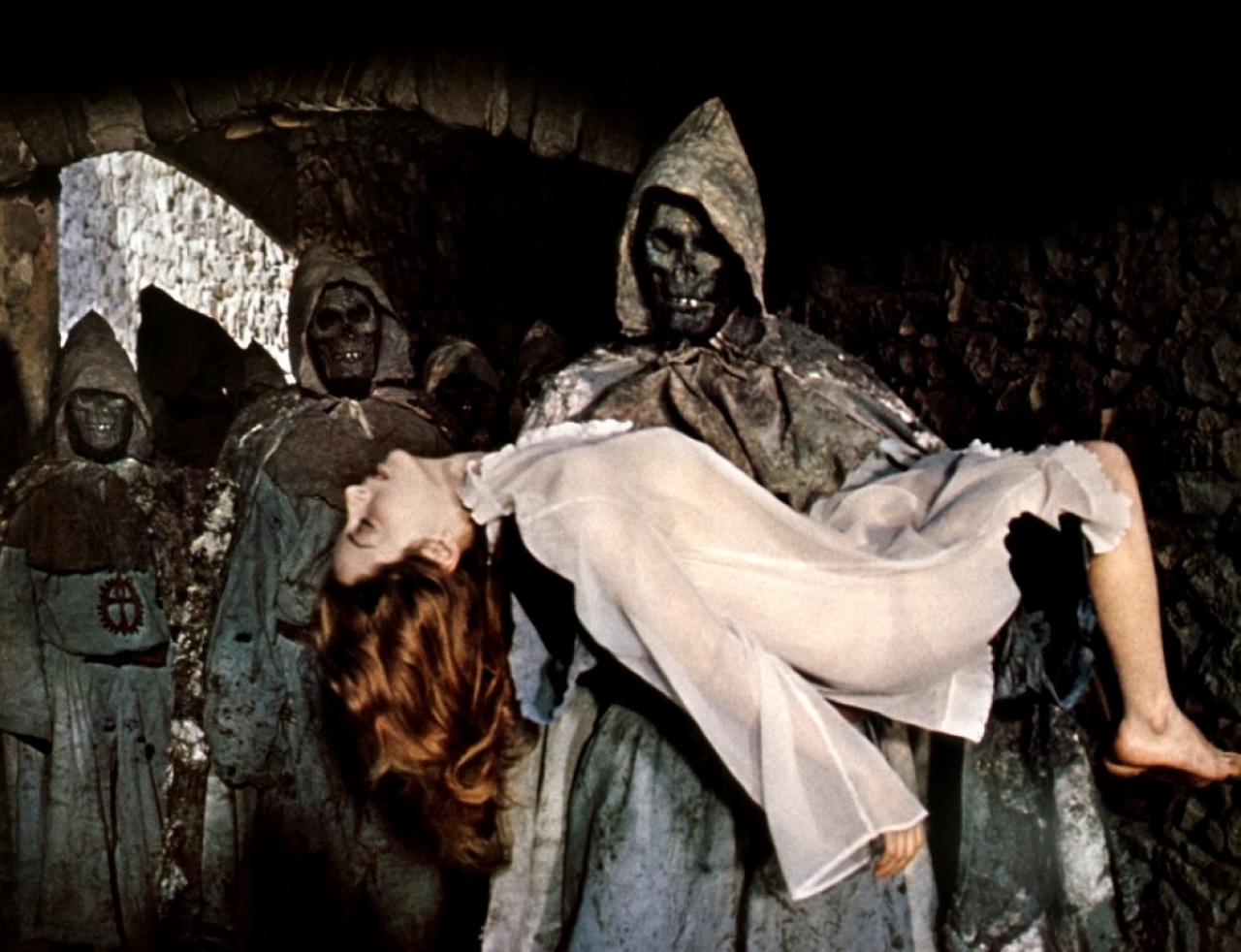
In the latter scenes with the group barricaded in the farmhouse at siege, Night of the Seagulls does capture something of George Romero’s Night of the Living Dead (1968), de Ossorio’s source of inspiration for the Blind Dead films. There is moderate tension created out of the scenes of the Templars bursting into the house, of skeletal hands creeping around doorframes and the likes – but the sequence needed to be longer. There should have been something to it that drew things out with the same tension that de Ossorio gave to the climactic scenes in Tombs of the Blind Dead. But alas I have been watching the rest of the films in vain, waiting for him to find his way back to what he created there again.
Outside of the Blind Dead films, Amando de Ossorio also made the genre likes of Malenka/Fangs of the Living Dead (1969), The Loreley’s Grasp/When the Screaming Stops (1973), Night of the Sorcerers (1974), Demon Witch Child (1975) and The Sea Serpent (1984).
Trailer here