


Crew
Director – AJ Annila, Screenplay – Iiro Kuttner, Producers – Jesse Fryckman & Tero Kaukomaa, Photography – Henri Blomberg, Music – Panu Aaltio, Production Design – Vladimir Bedrich Dvorak, Antti Nikkinen & Ville Vauras. Production Company – Bronson Club.
Cast
Ville Virtanen (Eerik Spore), Tommi Eronen (Knut Spore), Viktor Klimenko (Semenski), Rain Tolk (Vasily Rogosin), Kari Ketonen (Captain Musko), Sonja Petäjäjärvi (Polka), Vilhelmiina Virkkunen (Tytar), Ismo Kallio (Kylanvanhin), Taisto Reimaluoto (Isanta)
Plot
The year 1598 at the end of a long and brutal war between Finland and Russia. Cartographer Eerik Spore heads a joint Finnish-Russian team that has been despatched to the north to determine the border between the two countries. Eerik travels with his brother Knut. Eleven days ago, while they were staying at a farm, Knut was horrified to find Eerik killing a farmer for having Russian sympathies. He locked the man’s daughter in the barn to protect her. He is now haunted by visions of the girl as they travel and urges Eerik to return and free her. The party then come across a village of mysteriously aloof locals and an ominous sauna that sits in the midst of the swamp.
Sauna was the second film for Antti-Jussia (or AJ) Annila. Annila had previously made the martial arts film Jade Warrior (2006) and went on to the historical The Eternal Road (2017), along with assorted tv work.
Sauna slots into being an Historical Fantasy in the vein of films such as The Navigator: A Mediaeval Odyssey (1988), Black Death (2010) and November (2017). The landscape is all desaturated colours and looks dreary and covered in muck everywhere you look, the trees are bare and empty. The characters look unshaven and haggard.
The film broods with allegory. Tommi Eronen maybe sees the ghost of the girl they left locked in the barn appearing in the midst of the landscape as they travel. The village they arrive at is one where the villagers are welcoming but appear to purposefully avoid any of their questions as to whether they are Russian or Finnish. There is a locked storehouse with painted religious icons in it, while something horrible happens to one of the villagers who is confined there. There is the mysterious stone sauna that sits in the middle of the swampy waters and seems to obliquely evade any kind of meaning.
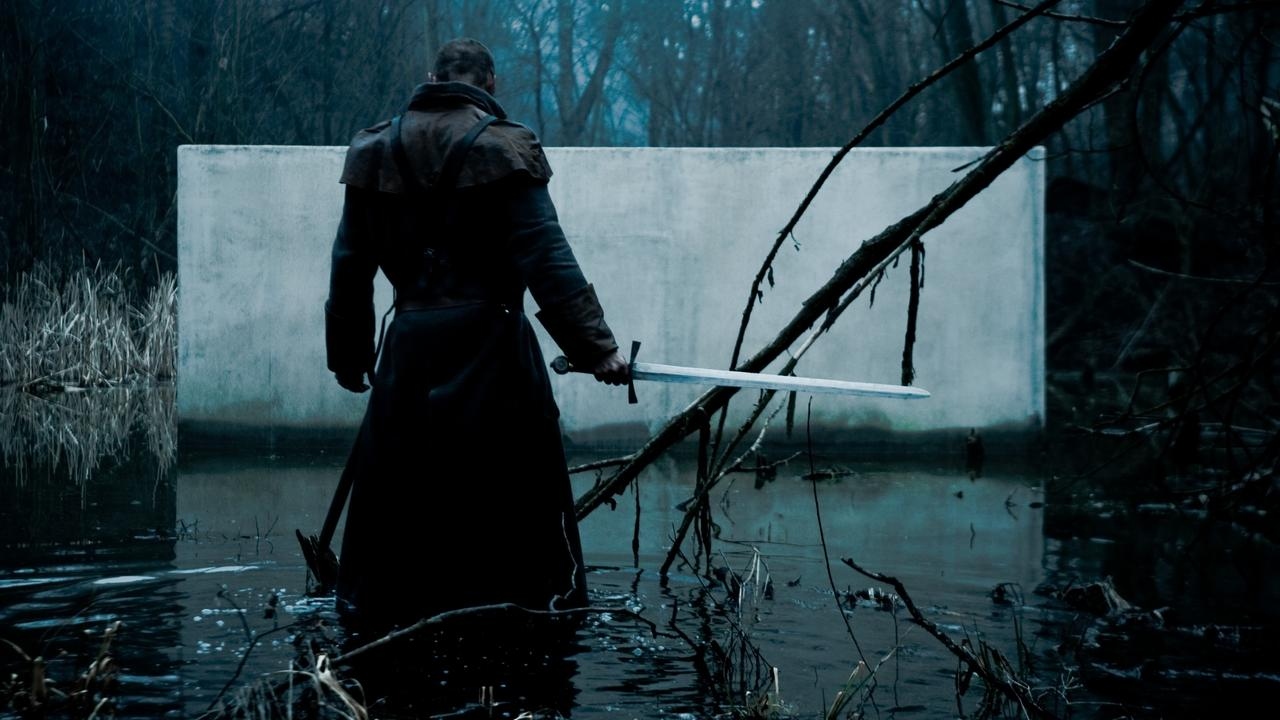
What comes through in the end is a bleak film about characters looking for some kind of internal redemption. But Sauna is also a film where the levels of allegory and deeper meaning are question marks. Not being familiar with the region, some of the historical differences over the border conflicts between Russia and Finland were lost on me. The mysteries that surround the characters are fascinatingly opaque ones. The film hints at deeper meanings going on within but ultimately arrives at no answers.
There are some excellent performances. In particular, one is drawn to Ville Virtanen who is both a brutal murderer (as we see in the opening scenes) and sympathetic in his flinty harshness – indeed, the very end of the film is one that seems to allow him to find a redemption (although being the sort of bleak film it is, the upshot of this is not hopeful). All of which comes in contrast to the more humane and concerned Tommi Eronen, whose humanist concerns never seem to amount to much in the film’s bleak outlook.
Trailer here