

USA. 1982.
Crew
Director – Michael Miller, Screenplay – Joseph Fraley, Producer – Anthony B. Unger, Photography – Robert Jessup & Neil Roach, Music – Peter Bernstein & Mark Goldenberg, Special Effects Supervisor – Jack Bennett, Makeup Effects – Make-Up Effects Lab, Art Direction – Jack Marty. Production Company – Anthony B. Unger/Topkick Productions.
Cast
Chuck Norris (Sheriff Dan Stevens), Toni Kalem (Alison Halman), Ron Silver (Dr. Tom Halman), Steven Keats (Dr. Philip Spires), William Finley (Dr. Paul Vaughn), Brian Libby (John Kirby), Stephen Furst (Charlie), Jay DePland (Biker Leader), Lillette Zoe Raley (Tattooed Biker Mama), Stephanie Dunnam (Nancy Halman)
Plot
In the small Texas town of Hipointe, Sheriff Dan Stevens attempts to stop John Kirby, a psychiatric patient who goes on a rampage at the boarding house where he lives. Kirby seems unaffected by regular damage and is only downed after being multiply shot by deputies. Kirby is taken to the nearby research hospital where he is deemed dead. Doctors Philip Spires and Paul Vaughn decide to try an untested experimental serum on Kirby’s corpse and succeed in bringing Kirby back from the dead. As Dan reunites with his ex Alison Halman, the sister of one of the doctors, the resurrected Kirby goes on a killing rampage around the town.
Carlos Norris, better known to the world as Chuck Norris (1940-2026), was a martial artist and an Action Movie star. Indeed, Norris’s fame grew such that he became an internet meme that makes fun of his invincibility. After serving in the US Air Force in the 1950s and 60s, Chuck opened a karate school and entered into competitions where he became friends with Bruce Lee, who gave Chuck his first major acting job as a bad guy in Lee’s The Way of the Dragon (1973). Chuck’s first lead role was in Breaker! Breaker! (1977) and his breakout success came with A Force of One (1979). A host of other hits soon followed with The Octagon (1980), An Eye for an Eye (1981), Silent Rage and Lone Wolf McQuade (1983), before Chuck became the mainstay of Cannon Films for nine films with Missing in Action (1984) and The Delta Force (1986) and sequels to either, Firewalker (1986), Invasion U.S.A. (1985) and Hero and the Terror (1988).
Silent Rage came fairly early on when Chuck was just starting to emerge as a name. It is a weird mix of Chuck’s staple and 1980s slasher horror. You could even argue that the opening with Brian Libby rampaging through the boarding house with an axe is homaging similar scenes in the then relatively recent The Shining (1980). The boarding house scenes open the film with a reasonable vigour – there is the mad science element and then Chuck moving in with implacable invincibility to wrestle with the killer, who is shot down and then gets back up unaffected.
One of the surprises of the film is that Chuck Norris seems to actually be doing some acting – more than he usually did in his films, which is play someone with stony mien who stared down his opponents and then knocked them out cold with a dropkick. This is especially noticeable in the romantic scenes with Toni Kalem where he seems to be demonstrating an awkward softness and warmth he never displayed elsewhere.
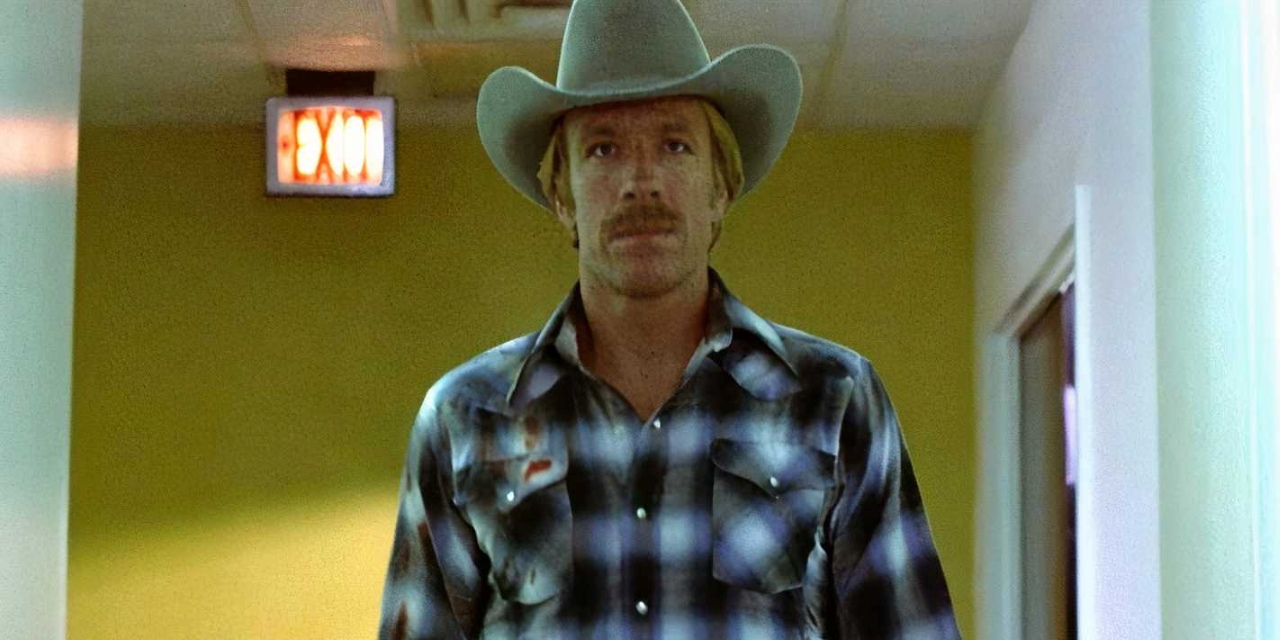
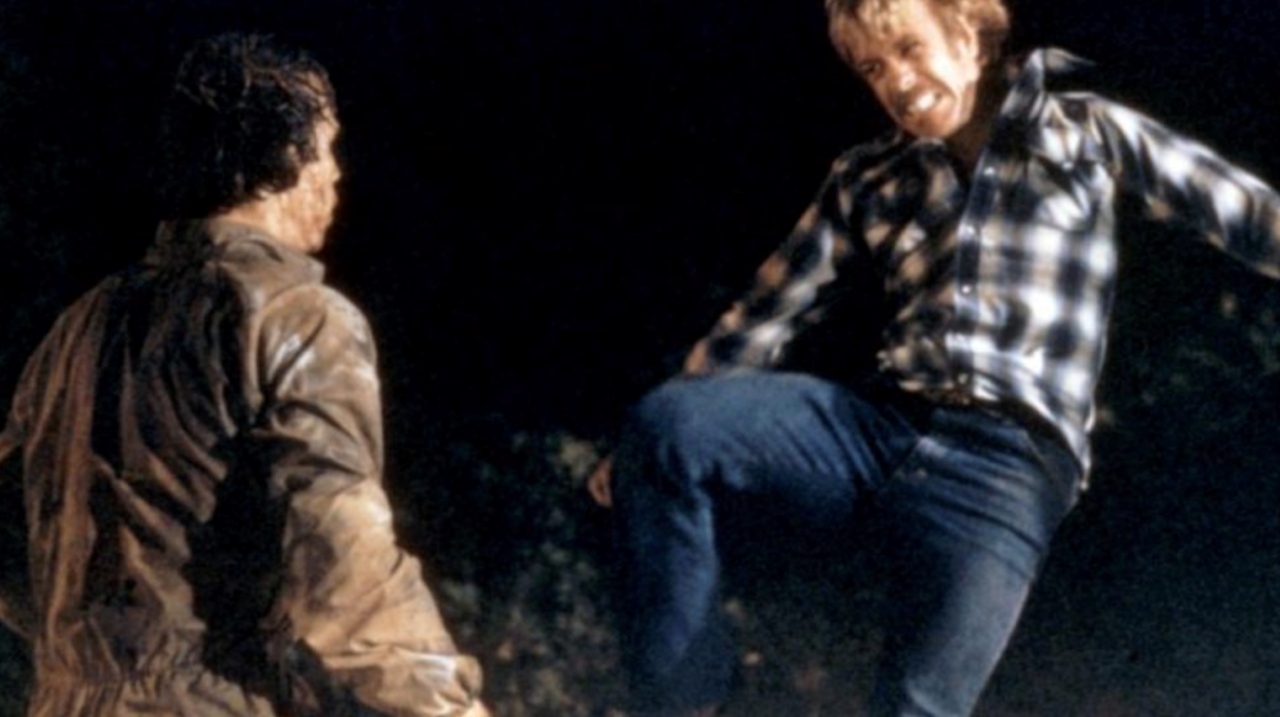
Chuck’s epic moment in Silent Rage is a scene where he singlehandedly goes in to confront a bar full of bikers – one where they are going wild with the barman tied to a post and the lead biker has even brought his bike into the bar with him and starts riding it indoors, before ending up crashing through the window. Watching Chuck defeat the entire biker gang with nothing except his fists and feet is the epic type of action scene that gained him the invincible reputation he did. There is a sneaking part as one watches that suspects that such a scene is the sort of fantasy that goes through the minds of Middle America – it feels like Chuck here and the rednecks who turn up to blow Peter Fonda away in the final scene of Easy Rider (1969) are really only two sides of the same coin.
The problem is that the biker bar scene comes in the middle of the film and is its highlight. The action scenes taper off after that point. Brian Libby’s resurrected psycho fails to be much of a threat – only a couple of years later The Terminator (1984) proved how the relentless unkillable man/machine could be made to work and Silent Rage needed more of that. What you kind of wanted was a series of ongoing action sequences that come fairly much wall-to-wall. The film does pick up slightly with the fight between Chuck and Brian Libby at the climax, but it is not as epic a showdown as you expect it to be and the end peters out as a lame nothingburger.
Director Michael Miller came to Silent Rage from the modest drive-in hit of his second film Jackson County Jail (1975). He went on to direct the slasher parody National Lampoon’s Class Reunion (1982) but since then up until the early 2000s has only directed tv movies.
Trailer here