


Crew
Director/Screenplay – Rainer Erler, Photography – Wolfgang Grasshoff, Music – Eugen Thomass, Production Design – Arturo Mester & Michael Pilz. Production Company – Pentagramma Filmproduktion GmbH & Co. Rainer Erler/ZDF.
Cast
Horst Frank (Mac), Dieter Laser (Don), Uwe Friedrichsen (Steve), Jürgen Prochnow (Oss), Claus Theo Gärtner (Dug)
Plot
Three spaceships made up of German, American and Russian crews have been sent to land on Jupiter’s moon Ganymede, but Earth has lost contact with them. Out of the three ships sent, only one survives and makes a return. As they near Earth, the crew are puzzled to pick up no radio communication. They make an emergency landing just off the coast of Mexico. However, as they come ashore, the crew are baffled to find the towns deserted and no trace of any people.
The 1960s was an era of space films. Big screens were filled with the likes of 2001: A Space Odyssey (1968) and the less well-known likes of Countdown (1967), Marooned (1969) and Moon Zero Two (1969), while tv screens brought classic shows like Lost in Space (1965-8) and Star Trek (1966-9). These were clearly inspired by the real-life Space Race. However, as the Apollo program came to an end in the 1970s, so too did the space film. (See Films Depicting NASA and the Space Program for a more detailed listing). Indeed, by 1977, when Operation Ganymede was made, it was a straggler, still a semi-realistic space film when everyone was turning their sights to copying Star Wars (1977).
Operation Ganymede is making an effort at being a space film. It spends the first thirty minutes inside the returning spaceship. Most of this is focused between the five-man crew, who are all international faces (one of the frustrations of the dvd release is that their dialogue is predominantly English but also consists of non-subtitled German and some Russian). On the minus side, the tight focus on faces spouting Mission Control doubletalk makes for a dull and slow film – in this regard, Operation Ganymede sits alongside other space films of the period such as Voyage to the End of the Universe (1963) and Earth II (1971).
An effort is made to depict a micro-gravity environment with astronauts walking on the ceiling. The stab at scientific credibility of such scenes is somewhat undone by an announcer talking in the opening scene about the mission landing on Jupiter, although from the title you can conclude that what is being referred to is not Jupiter, which would be impossible to land on, but Jupiter’ moon Ganymede. One of the other drawbacks of Operation Ganymede is that this is a film made on an economy budget such that there are no exterior special effects shots when it comes to the space scenes – all we have is video footage recycled from NASA missions. There is even footage of the ticker tape parades in the streets for the returning astronauts (where what we are seeing is disguised by being solarized). There are some minor effects shots of astronauts falling later in the show but that is it.
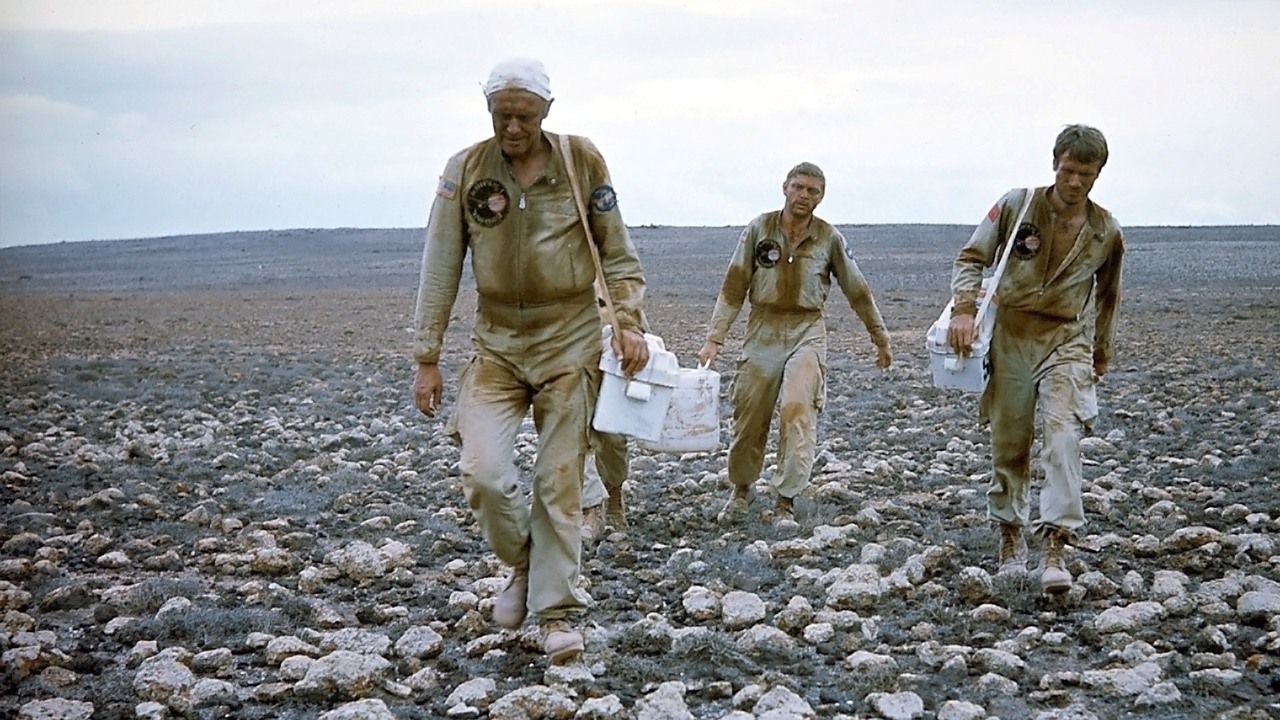
The scenes wandering through the desert and abandoned towns in Mexico are more interesting than the space-set one in that they take us out of the capsule, but these scenes also drag. You cannot help but compare them to the not dissimilar ones with the astronauts crashing and trekking through the desert at the starts of Planet of the Apes (1968) and think how much dramatic and interesting that that film made them into. Certainly, the location shooting in Lanzarote in the Canary Islands makes the world look eerily deserted.
The criminal failing with Operation Ganymede is that we have a film the drags its feet and is well over two-thirds of the way in before we know what is going on. The astronauts returning to find a deserted world reminds of the tv movie Where Have All the People Gone? (1974). Indeed, you can’t help but think that if Operation Ganymede had been given the treatment as a US tv movie, it would have been condensed to a series of tight dramatic progressions rather than allowed to meander through interminable scenes with astronauts on the ship and then bickering as they travel through the desert. The film also reaches a confusing ending where the surviving astronaut makes it to civilisation [PLOT SPOILERS] and is greeted by people where you are left not clear if all of this happened and that this was not some part of his survival training and how exactly Mission Control managed to fake the absence of life on Earth.
There are some interesting later-to-be-famous names among the astronauts. The most well-known of these is Jürgen Prochnow, later famous for works such as Das Boot (1982), The Keep (1983), Dune (1984) and In the Mouth of Madness (1995), among many others. Dieter Laser later gained a notoriety as the mad surgeon in The Human Centipede (First Sequence) (2009) and sequels.
Operation Ganymede was originally made for the West German public broadcasting tv network ZDF. Rainer Erler (1933-2023) was a director who worked in German television. His other genre works are the Edgar Wallace adaptation The Witch (1971), the nuclear thriller Plutonium (1978) and the organ harvesting film Spare Parts (1979).
Trailer here (in German no English subs
Full film available here