

Crew
Director/Producer – Alain Jessua, Screenplay – Paul Gegauff & Alain Jessua, Photography – William Lubtchansky, Music – Armando Trovajoli, Special Effects – Georges Demetrau, Makeup Effects – Dominique Colladant & Reiko Kruk, Production Design – Thierry Flamand & Christian Grosrichard. Production Company – A.J. Films/TF 1 Films Production.
Cast
Jean Rochefort (Victor Lafaurie), Eddy Mitchell (Frank), Fiona Gelin (Elizabeth), Herma Vos (Adelaide), Ged Marlon (Inspector), Anna Gaylor (Corona)
Plot
The scientist Victor Lafaurie, a descendant of Baron Frankenstein, has been breaking into the laboratory where he works to steal limbs. With these, he finally succeeds in piecing a body together and bringing it to life using a computer chip planted in its brain. He names the creature Frank. Frank proves innocent in all ways, including accidentally killing some people, but Victor tries to educate it.
The Frankenstein Film grew out of the huge success of the Boris Karloff starring Frankenstein (1931), which is quoted here at one point. The Karloff film saw a great many sequels, parodies and remakes. Amid these, there have been a host of works that have sought to modernise the Frankenstein film that have included the likes of I Was a Teenage Frankenstein (1957), Dr Franken (tv movie, 1981), Mr. Stitch (1995), Frankenstein Reborn (2005), The Frankenstein Syndrome/The Prometheus Project (2010), Closer to God (2014), Frankenstein (2015) and Depraved (2019), among others. Amid these were several entries, all unrelated, that tried to append a future date to the title beginning with Frankenstein 1970 (1958), Frankenstein ’80 (1972), Frankenstein 90 here and the subsequent Frankenstein 2000 (1992).
At the time Frankenstein 90 was made, the predominating take on Frankenstein films and the classic monsters was overshadowed by the huge success of Mel Brooks’ Young Frankenstein (1974). This saw a number of light-hearted and spoof takes on the Frankenstein and vampire film over the next few years with the likes of Vampira/Old Dracula (1974), Love at First Bite (1979), Mama Dracula (1980), Frankenstein’s Great Aunt Tillie (1985), Transylvania 6-5000 (1985), Frankenstein General Hospital (1988) and Frankenstein: The College Years (1991). France dabbled in several of these with Tender Dracula (1974) and Dracula, Father and Son (1976).
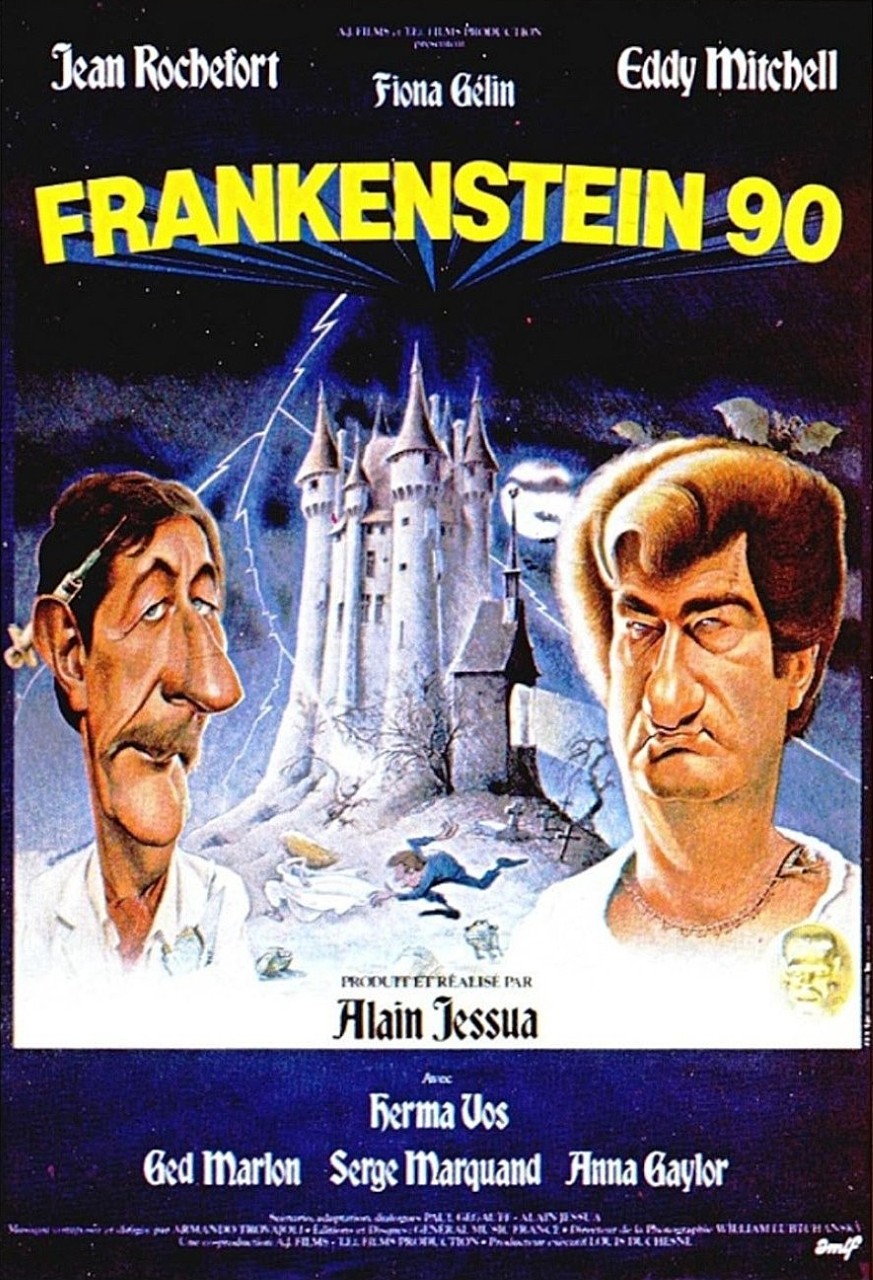
Frankenstein 90 was pitched as another of these parodies – the poster for the film (see above) renders Jean Rochefort and Eddy Mitchell as though they were cartoon caricatures. You sit down to watch the film in the expectation that it will be a horror comedy or parody of the genre – only that is what it never ends up being. It is an amiable and light-hearted effort. There is a certain awkwardness that sits on the edge of being comedy in the scenes with Eddy Mitchell bumbling around trying to drive a car or accidentally killing people. But it is never a film that contains any laughs. It is just a fairly shapeless film based around a certain idea – a modern retelling of the Frankenstein story – that progresses through a series of scenes without a whole lot of drama to any of the story.
Among the cast, Jean Rochefort plays a very laidback and decidedly not mad scientisty Frankenstein descendent. Rochefort had a long career in French drama and comedy since the 1960s. His greatest fame today is probably for his appearance in the documentary Lost in La Mancha (2002), charting Terry Gilliam’s failed production of The Man Who Killed Don Quixote, although he has made appearances in assorted other genre films including L’Atlantide (1992), playing the old blind man in a tv mini-series version of Frankenstein (2004) and Asterix and Obelix: God Save Britannia (2012). Frank the monster is played by French rock singer turned actor Eddy Mitchell. Mitchell’s is one of the more harmless, good natured portayals of the monster.
Alain Jessua (1932-2017) was a French director who only made ten films, although a number of these fall within genre guidelines. These include the mad scientist film Shock Treatment/Doctor in the Nude (1973), Paradise for All (1982) about a depression cure and the subsequent The Colors of the Devil (1997), a retelling of the Faust legend.
Clip from the film here