
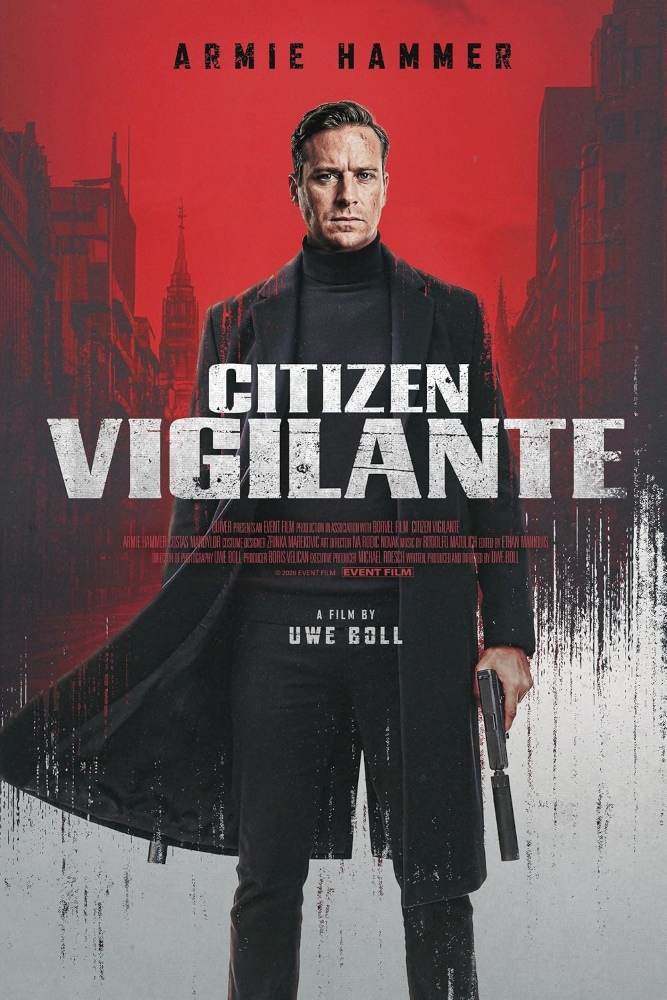
Crew
Director/Screenplay/Photography – Uwe Boll, Producers – Uwe Boll & Boris Velican, Music – Rodolfo Matulich, Visual Effects – Tunnel Post, Special Effects Supervisor – Petar Novakovic, Prosthetic Makeup Effects – Olaf Ittenbach, Art Direction – Iva Rodic Novak. Production Company – Event Films/Borvel Film.
Cast
Armie Hammer (Sanders), Costas Mandylor (Interpol Regional Chief Henry), Desiree Georgette (Elsa), Helen Al-Janabi (Sarna), Steffen Mennekes (Manager Owen), Mukit Abdul Hamid (Yusuf al-Sharaa), Fares Mongi (Ibrahim al-Sharaa), Roni Lepej (Judge Reinhold), Dora Dmic Rakar (Raped Girl), Tvrtko Juric (Raped Girl’s Father), Vini Jurcic (Woman in Supermarket), Valentin Olanrewaju Okoli (Teenage Boy), Lidija Penic Grgas (Teenage Girl), Elizabeth Zacaro (News Anchor), Banjamin Schnau (Jack), Lennart Betzgen (Rick), Danijela Evdjenic & Ema Masala (Girls at Bar), Dino Keric (Bus Driver)
Plot
Sanders is an American living in Europe where he maintains business interests, including a number of properties he has inherited from his late father. Beneath his well-groomed exterior, Sanders also acts as a vigilante, sending out a series of anonymous video broadcasts as Citizen Vigilante, urging people to stand up against the failure of the system to adequately respond to crime. He goes out, often armed, and takes action against those who abuse and take advantage of others, targeting in particular immigrants that come into the country and commit crimes.
Uwe Boll is the German director who began making films in the 1990s. After relocating to Canada in the 2000s, Boll embarked at first on a series of videogame adaptations with House of the Dead (2003), Alone in the Dark (2005), BloodRayne (2005) and sequels, In the Name of the King: A Dungeon Siege Tale (2007), Postal (2007) and Far Cry (2008). These had Boll labelled as the ‘world’s worst director’ due to a combination of things including his quick shooting style, often slapdash scripts, bizarre casting choices and frequent abandonment of videogame canon. (A full list of Boll’s genre films is at the bottom of the page).
In 2016, Boll announced his retirement as director and went into business, setting up the Bauhaus Restaurant in Vancouver’s Gastown area. This enjoyed reasonable success and won several awards. However, Boll was forced to close in 2020 with the Covid lockdowns. He subsequently made a return to filmmaking in 2022 with the German-language Hanau: Germany in Winter (2022), followed by the crime film First Shift (2024), Bandidos: A Life Between Freedom and Law (2024), a documentary about a biker gang, and Run (2025), which also deals with Europe’s migrant problems.
Citizen Vigilante stars Armie Hammer in the title role. Hammer had a solid acting career throughout the 2010s in films like The Social Network (2010), J. Edgar (2011), The Lone Ranger (2013), The Man from U.N.C.L.E. (2015) and Call Me By Your Name (2017), among others. However, Hammer’s career derailed in 2021 after allegations emerged on social media that he had engaged in violent sex and made claims to want to cannibalise a woman. Considerable doubt has been placed on the accusations since – police investigations failed to end with any charges laid against Hammer – nevertheless he was dropped by his agent, had jobs cancelled and his scenes in films reshot by different actors. In the aftermath, Hammer struggled to find work and was reportedly reduced to working as a restaurant manager.
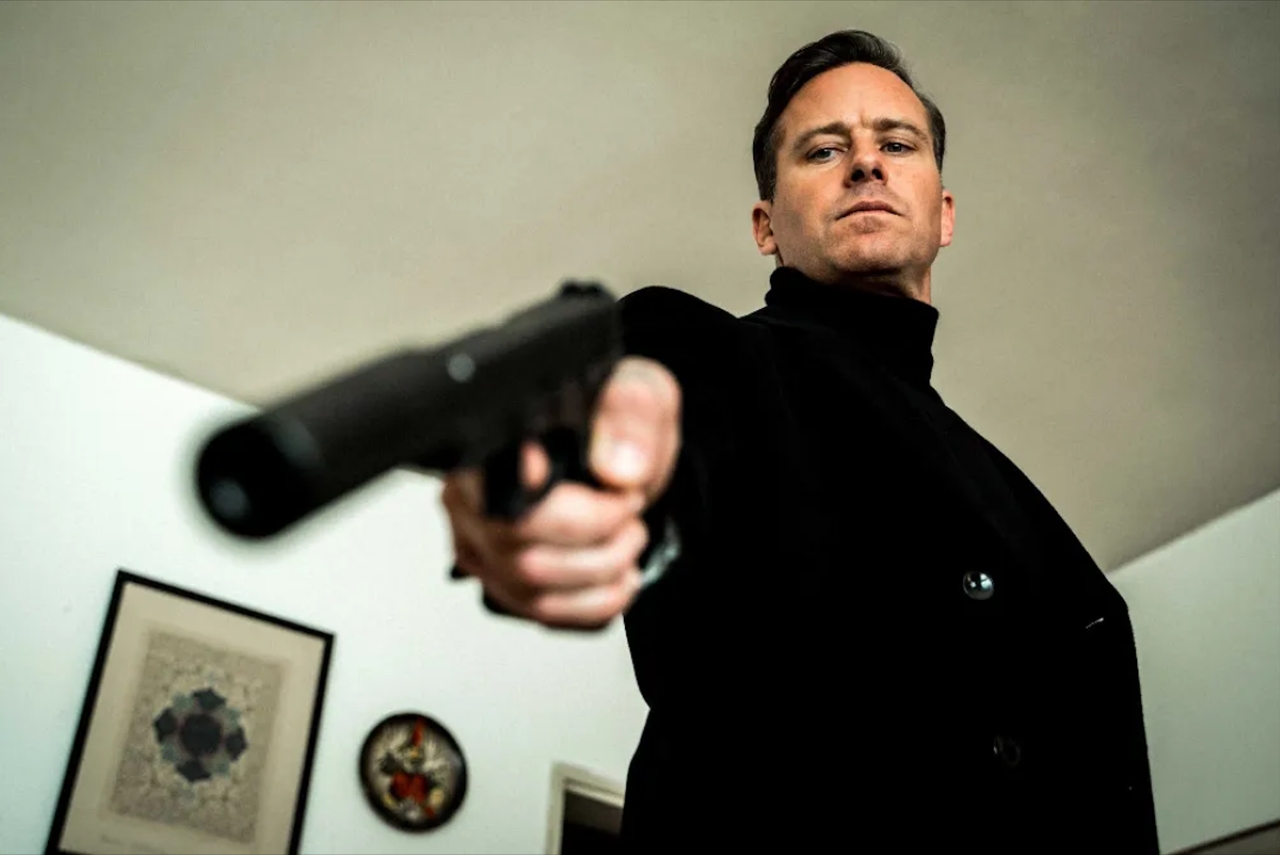
That said, Armie Hammer gives Citizen Vigilante great presence. Boll instinctively understands how Hammer looks on camera and makes sure he is handsome and perfectly groomed at all times. Hammer can project a great deal simply with his voice – and when it is focused in intent and lethal seriousness as here, it works rather well for the film. Certainly, Hammer is a whole lot better an actor than some of Boll’s other leading men – Michael Paré, Zack Ward, Dominic Purcell.
I am not someone on the bandwagon who calls Uwe Boll the world’s worst director – he’s made some bad films, he’s also made some good films. He is never less than interesting when he jumps on board issues as in films like the Rampage films, Darfur (2009), Auschwitz (2011) and Assault on Wall Street (2013). He is an angry man and his social media is filled with diatribes against issues of the moment. There is the recurrent theme in Boll’s films of people going on shooting rampages against the ills of modern life. This began with his third film Amoklauf/Rampage (1994) and continues in Heart of America: Home Room (2002), a depiction of school shootings in the post-Columbine era and the videogame adaptation Postal (2007), a work that revelled in bad taste. This was followed by Rampage (2009), which I would argue is his best work, a disturbing film that refuses any moral perspective as Brendan Fletcher goes on a shooting rampage. This led to two sequels Rampage: Capital Punishment (2014) and Rampage: President Down (2016). There was also Assault on Wall Street where Dominic Purcell takes up arms against the subprime mortgage crisis.
Boll returns to the idea of the armed vigilante on a shooting rampage in Citizen Vigilante. We get assorted scenes where Armie Hammer steps up to protect the vulnerable and downtrodden. In one scene in a bar, he notices two guys spiking two girls’ drinks with roofies and swaps these with the guys’ drinks. He has a scene where he confronts three youths who sneak onto a bus without paying fare and lectures them on social responsibility – later he comes across them bullying another youth and tasers them and stomps on the hands of the two guys (but not the girl). He personally promises a woman who lies in hospital after a beating and a teenage girl who was raped that he will track down and enact vengeance against those responsible. In the case of the woman in hospital, he goes to some length to talk about the ineffectuality of the legal system and the burden and wait times placed on victims and how his form of direct-action justice is superior. Later in the show, he impersonates a chauffeur and knocks out the judge (sardonically named Judge Reinhold) responsible for letting youths off a rape charge and takes him out in the middle of nowhere and kills him.
On the other hand, these scenes sit alongside others that make you scratch your head. There is a charged scene where Armie Hammer confronts the three fare-jumping youths on the bus, pays for their tickets and then sits down beside them and … lectures them on the need to pay their fares because it means that utilities are forced to raise their prices for everybody else. For someone who elsewhere in the film is deriding the forces of authority as useless and moribund, it seems an oddly traditionalist viewpoint to slip into. The single strangest scene is the WTF one where Hammer visits hooker Helen Al-Janabi and then stops in mid sex to note there is mould on the walls and to lecture her that she needs to inform her landlord, before revealing he is the owner of the building and then resumes having sex.
Where Citizen Vigilante crosses over a line is where Uwe Boll takes up the issue of immigrants and crime. The country that the film takes place in is specified as no more than ‘Europe’ (although location shooting took place in Croatia and the language on the buildings is in Croatian). This creates the sense that immigrant issues are a European-wide problem (which it was circa 2014 when Europe was dealing with a major influx of Middle Eastern refugees, which brought a reaction that eventually closed off most countries). Boll previously tackled European migrant issues in Run, which I haven’t seen, but appears to have a more balanced view, showing things from multiple viewpoints.
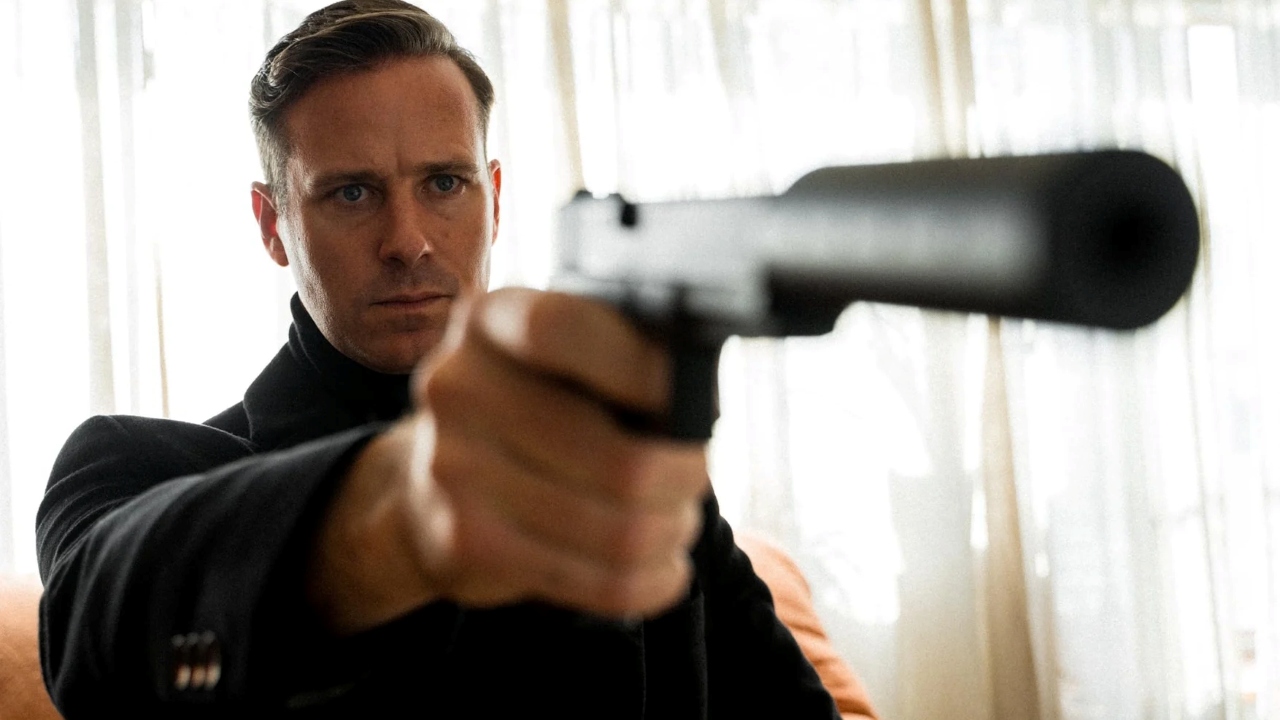
Several of the people encountered in the film – the man who attacks the woman leaving the supermarket in the prologue, one of the youths encountered on the bus and definitely the family at the end – are clearly immigrants. Although some of the attackers are also not – the two men who ply the girls with roofies, the Mafia gangsters. However, the attitudes throughout the film are very clearly not immigrant friendly. Armie Hammer lectures his business manager on immigrants who are not paying rent on his properties and urges the use of non-legal methods to evict them rather than wait months for the legal process. (I fail to see here why it is only immigrants who are targeted for non-payment of rent as surely this a problem spread across the population).
The most egregious scene is one where Armie Hammer breaks into the apartment of a Muslim immigrant family to find a youth who participated in the gang rape of a teenage girl but was let off by the justice system. While holding all of them at gunpoint, Hammer yells assorted contempt at excuses made about ‘traumatic integration’, their lack of regret and excuses on the grounds that “she asked for it” and then starts laying into Islamic values, before shooting the entire family, followed by the boys’ co-rapists who have been lured to the apartment. I don’t deny that clash between cultural values is a major issue when it comes to immigration, although the scene is shocking and appalling because it is no different from Trump’s labelling Mexicans as “thieves and murderers.”
I thought initially that Uwe Boll was making a commentary on such policies – maybe stepping back and satirising them as in Postal, or else dropping back to hold no moral position and letting the shock carry the effect as in Rampage. But the more I think about Citizen Vigilante, the more it feels like Boll, the same director who has angrily railed against ignored atrocities like Darfur or the crimes of the bankers of the subprime mortgage crisis, who has constantly thumbed his nose at Political Correctness and posited shooting rampages as ills of an uncaring society, has now swung in the other direction and drunken the Kool Aid of racial, anti-immigrant policies of people like Trump, Reform UK, Marine Le Pen, Viktor Orban and Germany’s AfD. The film’s end credit “This film is dedicated to the thousands of rape and murder victims in Europe who were betrayed by our legal system” makes the point that Boll is serious and this is no satire. Indeed, the idea of the same Boll of Postal, Rampage and Assault on Wall Street lecturing youth on paying their bus fares and getting angry about people unable to pay rents seems so far opposed to one another, you cannot help but wonder if this is the Boll who has gone from youthful defiance and slipped into an embittered middle-age.
Interestingly, the film went out with the title The Dark Knight, where Boll was forced to change this to Citizen Vigilante before release no doubt due to similarity to The Dark Knight (2008) and DC Comics. This seems intentional and there are similarities that go beyond the title. Batman is in effect a vigilante who enacts extra-judicial morality. It is not too hard to imagine Armie Hammer’s Sanders here as Bruce Wayne – he’s even outfitted with the inheritance of wealthy from absent/dead parents – but minus the capes and masks. It’s also a Bruce Wayne who has shifted over into being a social conservative, interested in defending the status quo and his own business interests rather than the disenfranchised.
Uwe Boll’s other genre films are:- the serial killer films Amoklauf/Rampage (1994) and Sanctimony (2000); the backwoods horror Blackwoods (2002); the high school shooting rampage film Heart of America: Home Room (2002); the zombie film House of the Dead (2003); the monster movie/videogame adaptation Alone in the Dark (2005); the vampire hunting videogame adaptation BloodRayne (2005) and its sequels Bloodrayne: Deliverance (2007) and Bloodrayne: The Third Reich (2011); the fantasy adventure In the Name of the King: A Dungeon Siege Tale (2007) and its sequels In the Name of the King: Two Worlds (2011) and In the Name of the King 3 (2014); the videogame adaptation Postal (2007), a surreal bad taste satire about a shooting rampage; Seed (2007) about an executed killer returned from the grave; the videogame adaptation Far Cry (2008); Rampage (2009) about a man on a shooting spree and its sequels Rampage: Capital Punishment (2014) and Rampage: President Down (2016); Stoic (2009) about sadism and brutality in a prison; The Final Storm (2010) about an apocalyptic storm and the arrival of a mysterious stranger; the gonzo bad taste comedy Blubberella (2011) about an overweight vampire heroine; and Assault on Wall Street/Bailout: The Age of Greed (2013) about a man on a shooting spree against bankers. Boll has also produced the ghost story They Wait (2007), Alone in the Dark II (2008), Zombie Massacre (2012), Legend of the Red Reaper (2013), Prisoners of the Sun (2013), Morning Star (2014), Viy (2014), Anger of the Dead (2015), Zombie Massacre 2: Reich of the Dead (2015) and Jack Goes Home (2016). Fuck You All: The Uwe Boll Story (2019) is a surprisingly insightful documentary about Boll and his career.
Trailer here