

Crew
Director/Story – Robert F. Slatzer, Screenplay – Robert F. Slatzer & James Gordon White, Producer – Anthony Cardoza, Photography – Wilson S. Hong, Music – Richard A. Podolor, Special Effects – Harry Woolman. Production Company – American Productions.
Cast
John Carradine (Jasper B. Hawkins), Joi Lansing (Joi Landis), John Mitchum (Elmer Briggs), Christopher Mitchum (Rick), Judy Jordan (Chris), James Craig (Sheriff Cyrus), Ken Maynard (Mr Bennett), Joy Wilkerson (Peggy), Lindsay Crosby (Wheels), Dorothy Keller (Nellie Bennett), Walt Zachrich (Deputy Hank), Doodles Weaver (Forest Ranger), Noble “Kid” Chessell (Hardrock), Nick Raymond (Slim), James Stellar (Bigfoot), Jerry Maren (Baby Creature), Nick Raymond (Evil Creature), Gloria Hill, Nancy Hunter & A’leisha Lee (Female Creatures)
Plot
Joi Landis is flying a small plane when it develops engine trouble and she is forced to bail out. She lands safely but is captured by a Bigfoot. A group of youths head into the forest on motorcycles only for Rick’s girlfriend Chris to be abducted by a Bigfoot. Rick returns to town and goes to Bennett’s general store to make a call to the sheriff Cyrus who does not take his story seriously. This is overheard by travelling salesman Jasper B. Hawkins who sees opportunity. Believing that he could make millions by capturing a Bigfoot, Jasper and his assistant Elmer Briggs set out to help Rick find Chris. Chris meanwhile is tied up alongside Joi where they realise the Bigfoots are holding them for breeding purposes.
The upshot of the Gimlin-Patterson film was a spate of films about Bigfoot throughout the 1970s. The big success among these was not about Bigfoot per se but was the surprise independent hit The Legend of Boggy Creek (1972), which took a mock documentary style way back before anybody called it a Mockumentary. Other films followed, all made independently and intended for drive-in audiences. These included The Curse of Bigfoot (1972), Shriek of the Mutilated (1974), The Legend of Bigfoot (1975), Manbeast! Myth or Monster? (1975), The Mysterious Monsters (1975), Creature from Black Lake (1976), In Search of Bigfoot (1976), Sasquatch: The Legend of Bigfoot (1976), Snowbeast (1977), The Capture of Bigfoot (1979) and Night of the Demon (1980). Many of these were mockumentaries, although a good number were also straight dramatic films. (For a more detailed listing see Bigfoot Films).
Into the 1980s and beyond, Bigfoot became family friendly after the modest mainstream hit of Harry and the Hendersons (1987). This identified Bigfoot as a shy creature who was usually an endangered species and a protector of the environment. Into the 2000s, the Bigfoot film has been claimed by the low- and medium-budgeted horror film and then various Found Footage offerings, alongside assorted comedy treatments and family films.
The distinction held by Bigfoot in the history books is merely that it was the first Bigfoot film. It is an auspicious landmark but one that the film itself does very little to distinguish. In almost all regards, the film is cheaply made, slackly plotted and with little dramatic engagement. The show gets dragged out with lots of cutaways to the mundane happenings back at the general store, or the kids on motorbikes on the woods. These come in between the main plot with travelling salesman John Carradine leading his own half-baked expedition to find the Bigfoot – they set out without any food or camping supplies, for instance.
Like most of the other Bigfoot films of this period, we never get to see much of the Bigfoots. For the most part, they are seen in shadow, blurred camerawork or hidden behind trees. There is a little more towards the end where the film introduces a Bigfoot family. On the other hand, while these are hulking and hairy as expected, the faces when seen consist of no more than blackout makeup.
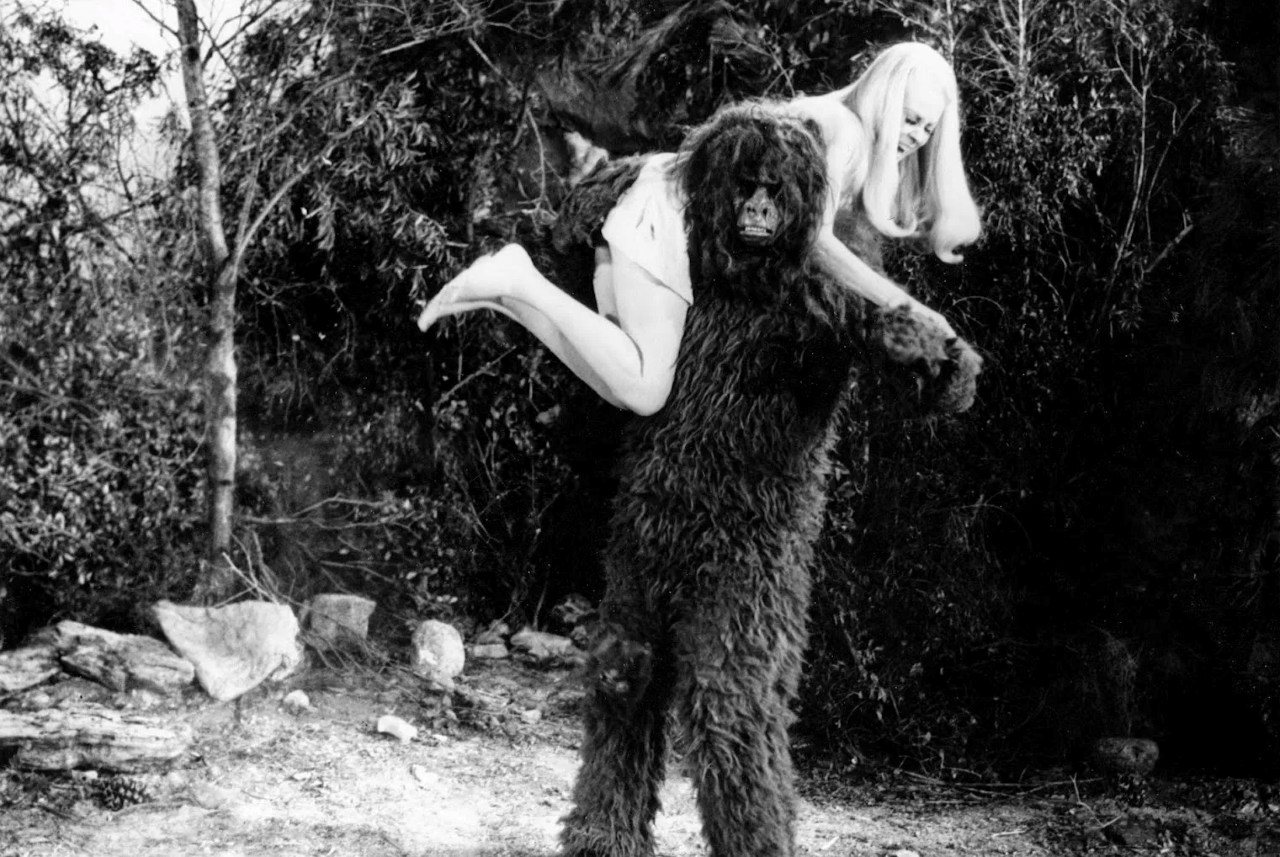
Unlike most of the Bigfoot films that followed and posed as mockumentaries tracking a real Bigfoot, Bigfoot is a drama. As such, it plants two feet in the exploitation genre – it keeps cutting back to big-breasted Joi Lansing and bikini-clad Judy Jordan imprisoned by the Bigfoot clan. It never gets them undressed any more than that – not from want of trying but apparently the producers wouldn’t pay enough money for Joi Lansing to take off her clothes. There is speculation by the imprisoned girls that the Bigfoots are keeping them there for the purposes of miscegenation – wanting to create Bigfoot-human hybrids – and towards the end Joi is dragged away screaming for that express purpose.
The film features an entertainingly garrulous performance from John Carradine. Carradine came to fame in the 1940s, playing Dracula in Universal’s House of Frankenstein (1944) and House of Dracula (1945) and went on to a long career in the horror genre. Although by 1970, Carradine was at the dregs of his career, appearing in junk like Hillbillys in a Haunted House (1967), Vampire Hookers (1978) and assorted Al Adamson films. He at least gets more screen time than usual here and opens up, even if you suspect that much of the performance was one that was filtered through a generous pickling of moonshine.
Among the rest of the cast, Joi Lansing was a pin-up model who branched out into films such as Orson Welles’ Touch of Evil (1958) and The Atomic Submarine (1959). Bigfoot would be her last film and she died two years later of breast cancer. Chris Mitchum was the son of Robert Mitchum and maintained a career with assorted roles mostly in B films, before becoming an unsuccessful Republican candidate for Congress in the 1990s. Ken Maynard, who plays the owner of the general store, was a former Western star from the 1920s through to the 1940s. This would be his second-to-last film.
Bigfoot was only one of two films made by Robert F. Slatzer (1927-2005), who elsewhere directed the biker film The Hellcats (1968).
Trailer here
Full film available here