


Crew
Director/Screenplay – Jean Rollin, Producer – Jean Lavie, Photography – Jean-Jacques Renon, Music – Yvon Gerault, Art Direction – Jio Berk. Production Company – Les Films ABC.
Cast
Olivier Martin (Pierre Radamante), Maurice Lemaitre (Georges Radamante), Christine Francois (Vampire), Ursula Pauly (Solange), Cathy Tricot & Pony Tricot [Catherine Castel and Marie Pierre Castel] (Servant Girls), Pascal Fardoulis (Robert), Bernard Musson (Voringe), Jean Aron (Fredor), Michael Delahaye (Grandmaster)
Plot
Pierre Radamante becomes curious about the secret ceremonies that his father Georges, a successful businessman, is conducting at his villa. He contrives to sneak in and discovers a ceremony conducted among hooded figures where followers are encouraged to commit suicide, before a woman comes and feasts on their blood. Pierre determines to find out what is going on. His father admits that he keeps the girl a prisoner and that she is a vampire. He is seeking to find others of her kind so that he can breed her and find a formula for immortality.
The Naked Vampire was the second film from French director Jean Rollin (1938-2010). A cult has grown up around Rollin, mostly centred around his early works. His first film was The Rape of the Vampire (1968), which began Rollin’s fascination with vampires in a modern setting, while having one foot in the surrealist tradition and the other in erotica (which would become outright porn in some of his later non-genre films). The Rape of the Vampire was a rather incoherent work but The Naked Vampire, his second film, improves on that – Rollin makes the move into colour, for one. Rollin would go on to make four of these erotic vampire films in a row with The Naked Vampire being followed by Le Frisson des Vampires (1971) and Requiem for a Vampire (1972), before broadening out into other works. (A full list of Jean Rollin’s other genre films is at the bottom of the page).
By this point of this, his second feature-length film, Rollin was starting to polish his act as a filmmaker and find the directorial elan that makes his vampire films such fascinating curios. This begins from the enigmatic but beautifully arty and surreal opening here. The film opens on a scene where women in cloth hoods are being undressed and examined in a laboratory. Olivier Martin then meets Christine Francois as she flees through the streets, pursued by figures wearing elaborate animal masks, including ones with full sets of antlers. There is no dialogue for the first nine minutes. And throughout there is a weird, atonal score.
This surreal erotic artiness continues. Olivier Martin sneaks into the ceremony held at his father’s chateau where people are lined up wearing cloth hoods. The photo of one of them is shown through a projector and the person selected and unmasked. They are then given a pistol to shoot themselves, whereupon Christine Francois appears and drinks the blood from the body. It is by this point that Jean Rollin has established himself as a surrealist par excellence, hang anything that The Naked Vampire ostensibly has to do with erotica, horror or vampires.
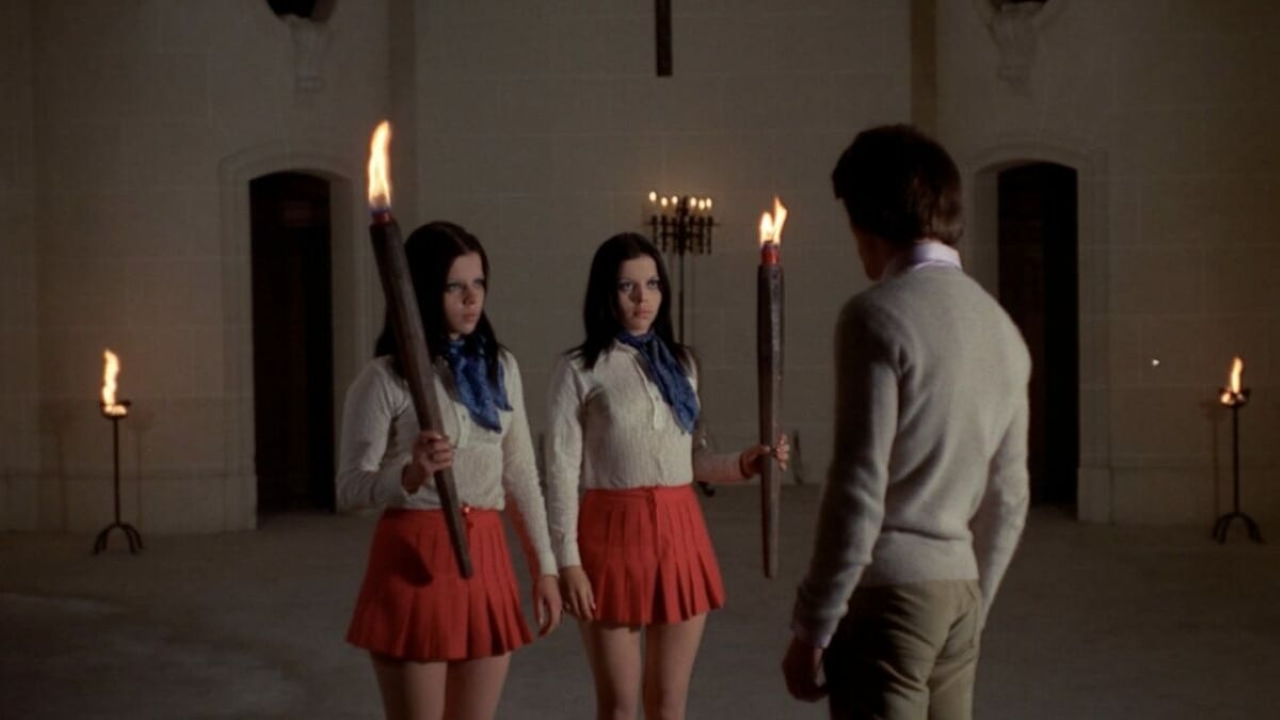
The costuming really pushes an avant garde envelope. We get a scene with a dancer with a scarlet wig and long spiked pasties over her nipples. Back home, Olivier is attended by two twins (Cathy Tricot and Pony Tricot) who wear clothing that is made of artful arrangements of plastic squares and wires. Elsewhere the twins are outfitted in leopard skins and spiked bikini bottoms, or skirts of leather straps that are peeled away.
Rollin’s vampire films are almost completely sketches in surrealism that are free of plot. By the point of The Naked Vampire, the idea of what a plot is has started to occur to him, although he still has no real idea about dramatic construction. The one he comes up with here about vampire medical experiments is not always clear about what is going on or why. Something to do with the need to find a suitable breeding partner for the vampire (who has to be kept away from meeting ordinary humans) so as to obtain immortality with somehow a weird suicide cult wound into the mix.
Jean Rollin’s other genre films include The Rape of the Vampire (1968), Le Frisson des Vampires (1971), Requiem for a Vampire (1972), The Iron Rose (1973), Demoniacs/Curse of the Living Dead (1974), Lips of Blood (1975), Pesticide/The Grapes of Death (1978), Fascination (1979), The Night of the Hunted (1980), Zombies’ Lake (1981), The Living Dead Girl (1982), Two Orphan Vampires (1997), The Fiancee of Dracula (2002), Night of the Clocks (2007) and The Mask of Medusa (2010)
Trailer here